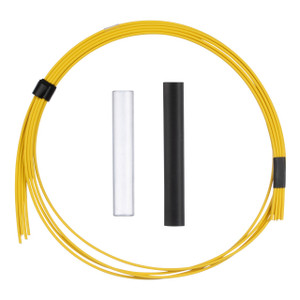
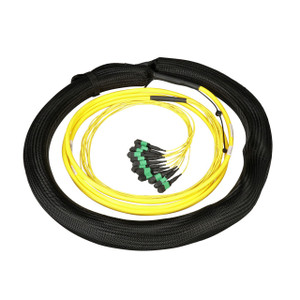
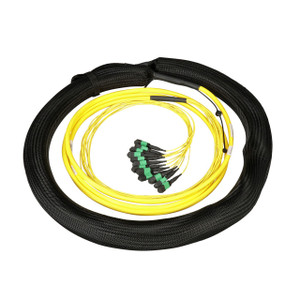
Panduit FOBKF576YM1 576-Fiber Singlemode Breakout Kit
High-density fiber installations demand breakout solutions that maintain signal integrity while simplifying the transition from trunk to individual connections. The Panduit FOBKF576YM1 handles up to 576 singlemode fibers in a flat configuration, bridging the gap between backbone trunk cables and patch panel terminations in enterprise datacenters, telecom central offices, and colocation facilities. The 1-meter breakout length provides enough working distance for rack-to-panel routing without excess slack that clutters pathways or creates points of failure. Yellow jacketing follows industry color standards for OS2 singlemode identification, reducing mis-patching risk during MAC operations or emergency troubleshooting when multiple fiber types share the same infrastructure. Pre-terminated factory construction eliminates field splicing labor and the fusion equipment overhead that can add 40-60 hours to a 576-fiber trunk deployment.
Key Features
- 576-fiber capacity supports spine-leaf architectures and 100G/400G uplink aggregation in hyperscale and enterprise datacenters
- Singlemode OS2 9/125µm fibers rated for 10km+ reach on 10GBase-LR, 40km on 100GBase-ER4, 80km+ on coherent 400G/800G optics
- 1-meter breakout length balances slack management with routing flexibility in standard 42U racks and overhead tray transitions
- Flat ribbon architecture maintains fiber position throughout the breakout, preventing crossovers and simplifying pair tracing during troubleshooting
- Yellow jacket color-coding aligns with TIA-598-C singlemode identification standards, reducing human error in multi-fiber-type environments
- Pre-terminated connectors with protective caps eliminate field splicing, fusion labor, and post-termination OTDR testing—reducing deployment time by 60-70%
- 30mm minimum bend radius compliance even at trunk-to-breakout transition points, critical for dense rack environments with power distribution and compute chassis
Datacenter and telecom backbone builds increasingly rely on ribbon fiber trunks to achieve port densities that match 400G and 800G switching infrastructure. A 576-fiber trunk consolidates what would otherwise require 288 duplex LC connections or 144 duplex jumpers into a single manageable pathway from MDF to IDF or from spine switch to leaf-tier aggregation points. Traditional breakout methods—field splicing individual legs or fusion-terminating 576 connectors on-site—introduce labor costs that can exceed hardware spend on large deployments. A skilled fiber technician averages 8-12 fusion terminations per hour when working with singlemode connectors; at that rate, a 576-fiber trunk requires 48-72 labor hours before a single link goes live. The FOBKF576YM1 arrives pre-configured with factory-terminated connectors protected during shipment, so installers transition directly from trunk unpacking to panel connection without specialized fusion equipment, consumable splice trays, or post-termination OTDR verification. This labor compression matters most in time-sensitive cutovers—migrating a live production fabric to new hardware during a maintenance window—where every hour saved translates to reduced business risk and faster ROI on infrastructure investment.
The flat ribbon format keeps all 576 fibers in their assigned positions throughout the breakout, preventing the fiber crossovers and tangles that occur when round trunk cables fan out to individual legs. In a round breakout design, fibers spiral around the trunk's central strength member; when that trunk fans into 288 duplex pairs, the spiral creates a three-dimensional tangle that obscures which physical fiber corresponds to which logical port. The flat ribbon architecture eliminates this problem—fiber position 1 at the trunk connector remains position 1 at the breakout leg, fiber 576 remains 576, with no rotation or crossing. This positional consistency matters most in troubleshooting scenarios: when a link goes down on fiber pair 384 between a spine switch and leaf switch, the flat architecture lets you trace that specific pair from panel to trunk without untangling a rat's nest of round breakout legs or consulting complex as-built documentation to decode the spiral offset. During MAC operations—moving 40G or 100G links between ports to rebalance traffic or accommodate new tenants—installers work faster because the physical fiber layout matches the logical port map without translation.
The 1-meter length targets the standard datacenter use case—trunk enters the top of a rack or overhead cable tray, breakout kit fans to patch panels mounted mid-rack or in adjacent frames. In a typical deployment, the 576-fiber trunk routes overhead in a 4-inch or 6-inch basket tray, drops vertically into the top of an equipment rack, and the FOBKF576YM1 fans those fibers across six FHD high-density enclosures (96 fibers each) mounted at rack mid-height. The 1-meter breakout provides enough length to route around dense power distribution units, avoid crossing hot-aisle airflow paths, and maintain the 30mm minimum bend radius even when transitioning from the trunk's 50mm outer diameter down to individual 3mm breakout legs. Shorter breakouts—500mm or 600mm—force tight bends that risk exceeding minimum bend radius on the trunk side, especially when the breakout must navigate around obstacles like rear-mounted PDUs or blade server chassis. Longer breakouts—2 meters or more—create service loops that block airflow in hot aisle containment systems, interfere with rear door heat exchangers, or violate ASHRAE thermal management guidelines by obstructing planned airflow paths. Installers working in retrofit scenarios—adding fiber capacity to racks already populated with compute and storage—gain the flexibility to route the 1-meter breakout around existing infrastructure without disturbing live equipment, violating manufacturer bend-radius specs, or triggering thermal warnings from BMC monitoring systems.
Singlemode OS2 fiber at 9/125µm core/cladding diameter supports significantly longer reach than multimode OM3, OM4, or OM5 alternatives. On 10GBase-LR optics, OS2 delivers 10km reach compared to 300 meters on OM3 or 550 meters on OM4. For 40GBase-ER4, singlemode extends to 40km while multimode tops out at 150 meters on OM4. When deploying 100G or 400G coherent optics—common in spine-leaf fabrics or DCI links between datacenter pods—singlemode becomes the only viable option, supporting 40km on 100GBase-ER4, 80km on 400GBase-ZR, and 120km+ on 800G coherent transceivers with appropriate amplification. This reach profile fits campus backbone links between buildings separated by parking lots or service roads, metro-area connections to colocation providers or disaster recovery sites 20-40km away, and intra-datacenter spine-leaf fabrics where future-proofing for 800G or 1.6T coherent optics justifies singlemode's lower loss budget over multimode alternatives. The yellow jacketing follows TIA-598-C Table 2 color codes (yellow for OS2 singlemode, aqua for OM3, erika violet or magenta for OM4), reducing human error when installers work in hybrid environments where multiple fiber types share the same cable tray or ladder rack. During MAC events—moving a 100G link from one spine switch to another, or migrating a tenant from a 10G to 100G service tier—color differentiation prevents the costly mistake of patching singlemode LR or ER optics into multimode fiber, or vice versa. That error typically results in no-link conditions that consume 20-30 minutes of troubleshooting time before the installer realizes the fiber-type mismatch, and in worst-case scenarios can damage expensive coherent optics if transmit power exceeds the multimode fiber's damage threshold.
This breakout kit integrates with Panduit's FHD, FHDM, and FAP fiber enclosure families, providing a factory-supported pathway from trunk entry to panel connection without mixing vendors or relying on field-improvised adapters. The 576-fiber capacity aligns with common trunk configurations: 6x 96-fiber MTP trunks in a spine-to-leaf deployment, 12x 48-fiber trunks in a distributed IDF architecture, or a single 576-strand backbone linking an enterprise MDF to a remote telecom facility. In hyperscale and colocation environments, the FOBKF576YM1 supports multi-tenant builds where each tenant receives a dedicated 48-fiber or 96-fiber allocation from a shared trunk—one 576-fiber trunk serves six tenants at 96 fibers each, with per-tenant breakouts handled at the FHD enclosure level. The flat ribbon construction also simplifies documentation and labeling: each 12-fiber ribbon within the 576-count trunk maps to a specific enclosure and port range, so as-built drawings show clear one-to-one relationships between trunk position, breakout leg, and panel port without complex lookup tables or color-coded sub-groups.
Installers specify this breakout kit when trunk-to-panel transitions must meet TIA-942 Rated-4 datacenter standards, support contractual SLAs requiring manufacturer-warrantied end-to-end pathways, or comply with government or defense requirements for traceable supply-chain components. The factory pre-termination provides a documented insertion loss and return loss spec for each connector, eliminating the variability introduced by field fusion work where technician skill, environmental conditions, and consumable quality all affect final link performance. For deployments requiring OTDR baseline documentation—common in financial services, healthcare HIPAA environments, or classified government facilities—the pre-terminated approach reduces testing time by 70% because installers verify end-to-end link loss rather than testing each individual fusion point. The 1-meter length and flat ribbon format also support structured cabling standards (TIA-568 and ISO/IEC 11801) that require permanent link pathways to maintain minimum bend radius, avoid undue stress on connectors, and provide clear separation between telecom infrastructure and electrical power distribution.