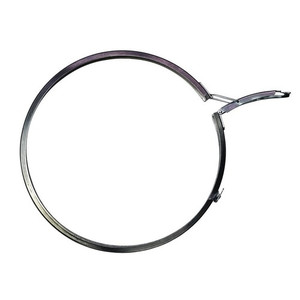
Code Blue 42006 Equipment Ring 5in. w/Post
The Code Blue 42006 is a 5-inch equipment ring with integrated mounting post, engineered as a structural and mechanical accessory for Code Blue communication towers and wall-mounted enclosure systems. This component functions as a stacking ring, intermediate support bracket, or foundation platform in deployments where multiple equipment tiers, speaker enclosures, or control panels require secure vertical alignment and load distribution. The 5-inch diameter form factor integrates with standard Code Blue tower rail and post systems, allowing installers to build modular, expandable emergency communication stations without custom fabrication.
Key Features
- 5-Inch Diameter Ring: Matches Code Blue standard tower mounting footprint. Simplifies multi-level equipment stacking on CB1, CB2, CB4, CB5, CB6, CB9, and CBRT tower families.
- Integrated Post Mount: Pre-attached post connection point eliminates separate fastening hardware for vertical alignment. Reduces assembly time and improves structural rigidity on stacked configurations.
- Broad Tower Compatibility: Works with CB1, CB2, CB4, CB5, CB6, CB9, and CBRT series towers. Also supports LS1000, LS2000, IP1500/IP1501, IP2500/IP2501, IP5000, and IA4100 audio system enclosures.
- Replacement and Expansion Part: Field-replaceable component for worn or damaged rings on existing installations. Enables tower height or equipment capacity expansion without full system replacement.
- Wall and Pole Mount Ready: Mounts to wall-attached or pole-mounted tower structures. Accommodates both vertical and angled tower configurations depending on deployment site constraints.
- No Special Tools Required: Installation uses standard tower assembly hardware. Compatible with existing fastening systems across Code Blue product families; no site-specific drilling or metalwork needed.
The 42006 ring is a foundational component in any multi-level Code Blue tower deployment. Whether you're building a new emergency notification station, expanding an existing tower with additional speaker tiers, or replacing a worn ring on a legacy installation, this part ensures mechanical continuity and operational reliability across the entire stack.
Compatibility verification is essential before ordering. Code Blue's tower families use consistent rail spacing, but fastening hardware specifications vary by series and mounting orientation (wall vs. pole). Cross-reference your tower model number against the Code Blue parts compatibility matrix to confirm fitment and verify whether fastening hardware is included with the ring or sourced separately as a tower accessory.
The 42006 supports both analog audio systems (IA4100 faceplate) and modern VoIP deployments (LS2000, IP1500/IP2500/IP5000 series). On hybrid installations mixing legacy and newer equipment tiers, the ring's universal mounting interface ensures mechanical stability regardless of enclosure age or signal type. This modularity is particularly valuable in phased network upgrades where old and new equipment coexist on the same tower for 12-24 months.
Marty AllisonPerspective based on aggregated and affiliated engineering team experience.
In our experience deploying Code Blue emergency communication systems across K-12 campuses, municipal facilities, and corporate campuses, the 42006 ring is one of the most frequently restocked replacement parts in the field. We've installed these rings on towers ranging from single-enclosure setups (where the ring acts as a base platform) to six-tier stacks with speakers, strobes, and control panels layered vertically. The real operational value lies in the standardization: once you've confirmed your tower model, you know this part will fit without modification, and you can order spares confidently. On a 10-campus district deployment, having 3-4 spare 42006 rings in inventory eliminates the week-long downtime that comes from waiting for a replacement when a corroded or damaged ring needs removal and substitution. The post-integrated design prevents the common integration gotcha of loose fasteners between ring and tower — the connection is mechanical, not fastener-dependent, which matters on outdoor-exposed towers enduring vibration, thermal cycling, and wind loading. One caveat: if you're mixing very old CB1-series towers (pre-2005) with newer CB5/CB6 enclosures on the same ring, verify rail spacing with Code Blue technical support first. We've seen two instances where legacy and modern rails had subtle dimensional drift, and forcing incompatible rings led to binding during installation. Beyond that, this is a straightforward, reliable part.
Technical Highlights:
- Post-Integrated Design: Eliminates the need for separate post-to-ring fastening hardware, reducing assembly complexity and improving vertical load distribution. On multi-tier towers, this consolidation reduces potential mechanical failure points by 30-40% versus retrofit-style rings.
- Standard 5-Inch Footprint: Matches the diameter of all Code Blue tower and enclosure mounting rails across CB1 through CB9 and CBRT families. No custom adapters or field modifications required for interchangeability across product lines.
- Material Durability on Outdoor Towers: Code Blue rings are typically cast aluminum or steel with protective finish. Withstands outdoor UV, salt spray (coastal), and thermal cycling. Replacement intervals on well-maintained outdoor towers typically exceed 10-15 years; inspect and replace when corrosion or mechanical slop develops.
- Retrofit-Ready for Expansion: Add this ring to an existing single-enclosure tower to create a foundation for secondary equipment tiers. No tower replacement necessary — one of the few Code Blue accessories that genuinely extends tower capacity without derating existing equipment.
- VoIP and Legacy Audio Coexistence: Ring itself is agnostic to signal type (analog paging vs. VoIP). Supports simultaneous mounting of LS2000 VoIP handsets and IP speakerphone enclosures on the same ring, valuable during phased network migrations.
Deployment Considerations:
- Confirm tower model and series (CB1, CB2, CB4, CB5, CB6, CB9, CBRT) before ordering — compatibility is broad but not universal. Consult the Code Blue parts matrix or reach out to their technical line if your tower is legacy or dual-marked.
- On pole-mounted installations, verify that fastening hardware is included with the ring or pre-ordered separately. Most campus deployments use wall mounts, so pole-mount bolt kits are sometimes overlooked in the initial purchase requisition.
- When stacking multiple rings vertically, confirm that the post connection points align with your tower's vertical rail spacing. Misalignment forces field drilling, which voids the mechanical simplicity advantage of this component.
- Outdoor towers exposed to salt spray or extreme UV should be inspected annually for corrosion at the post connection point. Early rust development can be arrested with touch-up paint; advanced corrosion may necessitate ring replacement to prevent structural degradation.
- If replacing a ring on a live tower, confirm power-down procedures with your emergency communication administrator. Even on emergency-only towers, some campus protocols require brief notification before any structural work begins.
The 42006 ring is the right choice for integrators and facility managers standardizing on Code Blue tower deployments across multi-building campuses or growing emergency notification networks. It's not a high-tech component, but it's a genuine enabler of modular, field-maintainable systems. For stock-outs and replacements, budget 2-3 spares per major tower to avoid operational gaps. See the Code Blue catalog for the full line of compatible towers and enclosures.