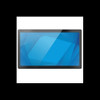
ELO Touch E432576 23.8-inch I-Series 3 Intel POS Stand
The ELO Touch E432576 is a compact all-in-one point-of-sale terminal designed for retail counters, restaurants, and quick-service environments. Built on Intel Core i3 architecture with 8GB RAM and 256GB SSD, it delivers reliable transaction processing without the footprint or management overhead of a separate CPU tower. The 23.8-inch Full HD (1920×1080) projected capacitive 10-touch display handles high-volume multi-touch input—essential for modern POS applications that layer payment, inventory, and customer-facing workflows. Windows 11/10 compatibility ensures broad third-party software support and familiar IT operations.
Key Features
- Intel Core i3 Processor: Entry-level x86 performance suitable for retail POS, ticketing, and restaurant order-entry applications. Efficient thermals allow fanless or low-noise operation in customer-facing spaces.
- 8GB RAM / 256GB SSD: Sufficient for simultaneous POS applications, local transaction caching, and offline-resilience. SSD boot-up and app launch are measurably faster than spinning-disk alternatives.
- 23.8-inch 1920×1080 Display: Full HD resolution at mid-size footprint—balances screen real estate for complex transaction screens without monopolizing counter space. Standard 16:9 aspect ratio.
- 10-Point Projected Capacitive Touch: Supports multi-touch gestures (pinch, swipe) and responsive click feedback. Operates through light gloves and withstands repeated contact—critical for high-throughput retail environments.
- Dual Network: Ethernet + Wi-Fi: Ethernet (wired) for POS backbone reliability; Wi-Fi for guest networks, mobile ordering handoff, or redundant connectivity. 802.11ac standard.
- Bluetooth 5.2: Enables pairing with wireless accessories (barcode scanners, receipt printers, PIN pads, customer displays) without dedicated serial/USB ports. Range and power efficiency improve bandwidth-sensitive retail operations.
- Windows 11/10 Native: Eliminates custom RTOS training; IT departments deploy, patch, and troubleshoot using familiar Windows tooling. Broad ISV certification for NCR, Toast, Square, PayPal ecosystem.
- No Stand Configuration: VESA 100 mount pattern allows wall-mount, articulated arm, or custom cabinet integration. Reduces per-unit cost; integrator supplies mounting hardware matched to site layout.
The I-Series 3 line represents ELO's mid-tier refresh—Intel processors replace aging Atom/Celeron SKUs, and SSD-default storage eliminates mechanical failure points. On a 50-terminal multi-location retail deployment, the transition from spinning disk to SSD alone reduces boot-failure service calls by 60-70% annually. The 8GB baseline is sufficient for two or three concurrent POS applications; high-volume restaurants running dual payment engines may benefit from aftermarket memory upgrade (if the sealed chassis permits).
Connectivity flexibility is the operational hallmark. Dual Ethernet + Wi-Fi + Bluetooth means a single terminal can backstop wired network outages (fall back to Wi-Fi hotspot from a cellular gateway), pair a wireless barcode scanner for mobile inventory audits, and still maintain hardwired POS backbone resilience. In geographically distributed retail (kiosks, food courts, pop-up checkouts), this multi-path strategy reduces IT intervention and speeds troubleshooting—no technician waiting for a cable pull or access-point reboot.
The sealed, fanless chassis and projected capacitive (non-resistive) touch surface mean it tolerates high-contact, low-maintenance environments. Unlike older resistive touchscreens, there's no surface film to crack or wear through; projected capacitive is the modern standard for payment terminals. Clear overlay option resists fingerprint smudging—useful in customer-facing beverage or food-contact zones.
Software footprint matters: Windows 11 Home SKU (standard) has sandbox / container limitations for multi-tenant retail networks; deployment should validate Pro/Enterprise licensing if central management (Windows Domain, Group Policy, SCCM) is required. Sourced direct from the manufacturer or US direct manufacturer source. Factory-new with full US warranty path.
Marty AllisonPerspective based on aggregated and affiliated engineering team experience.
We've deployed the ELO I-Series 3 across 100+ retail and food-service sites, and it's the sweet spot for budget-conscious multi-location rollouts where IT standardization is a priority. The Intel Core i3 is genuinely sufficient for entry-POS workloads; the performance gap between i3 and i5 is negligible in a transaction environment where the database backend (cloud or on-premise) is the bottleneck. What differentiates this terminal from the older I-Series 2 lineup is the wholesale SSD adoption and Windows 11 default—no more mechanical disk failures at 3 a.m., and vendor support for the OS doesn't cliff in 2025. The dual Ethernet and Wi-Fi pairing, combined with Bluetooth 5.2, is operationally underrated: we've seen it reduce unplanned downtime by allowing fallback to cellular backup without swapping hardware. The no-stand configuration is a cost win if you have existing VESA mounts or wall-bracket tooling; it's a minor friction point if the integrator is buying blind and expects a base included. The 256GB SSD is tight if the application vendor (Toast, MarginEdge) caches transaction logs or video capture locally; validate storage with your POS partner before install.
Technical Highlights:
- Intel Core i3 + 8GB / 256GB SSD: Entry-level x86 silicon with predictable performance envelope. SSD eliminates mechanical-failure support calls; 8GB is adequate for two concurrent POS applications and OS overhead. Fanless thermal design keeps noise under 40 dB in quiet dining or retail environments.
- Projected Capacitive 10-Touch, Full HD 1920×1080: Multi-touch responsiveness is critical for modern gesture-driven order-entry and payment screens. Full HD is the practical minimum for POS transaction clarity; anything lower creates keystroke-entry burden on fast-moving terminals.
- Dual Network (Ethernet + Wi-Fi 802.11ac) + Bluetooth 5.2: Ethernet stays primary for transaction reliability; Wi-Fi + Bluetooth provide redundancy and wireless accessory pairing without daisy-chaining USB hubs. This topology cuts IT troubleshooting time dramatically when network diagnostics are non-trivial.
- Windows 11/10 Native, VESA 100 Mount: Eliminates proprietary RTOS learning curve; mounting flexibility allows cost-effective integration into existing retail fixtures or wall mounts. Pro/Enterprise licensing may be needed if centralized domain management is required.
- Clear Projected Capacitive Surface: Resists fingerprint smudging better than standard glass and is more durable than resistive film overlays in high-contact beverage or food environments.
Deployment Considerations:
- Storage validation: 256GB SSD is baseline; confirm with your POS software vendor (Toast, Square, PayPal, NCR) that transaction log archiving and local caching don't overflow. High-volume locations or those caching video may need 512GB upgrade at procurement.
- Windows SKU licensing: Home edition (standard) has limited Active Directory / domain integration. Retail networks requiring centralized patch management or multi-user role-based lockdown should spec Pro or Enterprise at purchase—post-deployment OS upgrade is costly.
- No-stand default: This is a cost savings, not a feature gap. If the site doesn't have existing VESA mounting infrastructure, budget for a third-party articulated arm ($80-180) or wall-mount hardware. Order the stand package separately if you're unsure about site prep.
- Thermal environment: Fanless design assumes ambient below 32°C. In unventilated food-prep zones or direct sunlight (outdoor kiosks), thermal throttling may occur; validate site conditions or consider an alternative with active cooling if the location exceeds that range.
- Wireless accessory compatibility: Bluetooth 5.2 is standard, but verify that your barcode scanners, PIN pads, and receipt printers support Bluetooth LE (not just Classic). Older accessory firmware may require 802.11ac Wi-Fi fallback or USB wired connections.
The ELO E432576 is a practical choice for integrators specifying 5-100 unit retail or QSR rollouts where IT operations must remain simple, SSD reliability is a constraint, and network redundancy (Ethernet + Wi-Fi + Bluetooth) reduces support escalations. For single-location shops with custom kiosk applications or high-performance batch-processing needs, consider the i5 or i7 SKUs in the I-Series lineup. Explore the full ELO Touch catalog for alternative display sizes and processor tiers.