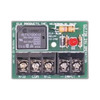
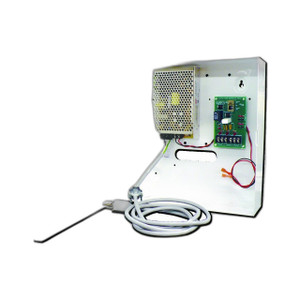
ELK Products ELK-912B6 SPDT Relay Module 12VDC
The ELK-912B6 is a single-pole double-throw (SPDT) relay module rated at 12 VDC, designed to handle switching and control functions in security integration, access control, and alarm automation circuits. This component provides reliable conditional switching between two independent circuit paths — meaning you can route signals to different destinations based on system logic or external triggers. Unlike hardwired connections, a relay module isolates control circuits from high-current loads, protecting your control panel from damage and keeping signal integrity intact.
Key Features
- SPDT Configuration: Single-pole double-throw design lets you switch between two separate circuits with one control signal. Practical for door strike selection, alarm output routing, or conditional automation — you pick which path the signal takes based on system state.
- 12 VDC Rated: Operates from standard 12-volt DC power, common in security control cabinets and distributed panel nodes. Check your control panel's auxiliary relay voltage before installation — this module expects 12 VDC, not 24 VDC.
- Compact Module Form: Designed for control cabinet mounting, panel enclosure installation, or distributed switching nodes. Fits standard DIN rail or cabinet layouts without consuming excessive space.
- Low Power Draw: Minimal current consumption keeps loading on your power supply predictable. Stacking multiple relay modules remains feasible without overloading auxiliary power circuits.
- Direct ELK Integration: Built to work with ELK Products control system platforms where remote relay control is required. Also compatible with third-party security panels and automation systems that support 12 VDC auxiliary relay modules via standard control lines.
- Isolation & Protection: Relay isolation prevents high-current switching loads from back-feeding control logic. Protects sensitive panel inputs and extends panel lifespan in high-switching environments.
Integration & Compatibility
Install the ELK-912B6 in control cabinets, alarm panel enclosures, or distributed switching nodes wherever remote or logic-driven circuit control is required. Common deployment scenarios include door strike control (switching between locked/unlocked states), alarm output routing (directing sirens or notifications based on zone triggers), and system automation tasks. The module integrates into ELK Products control systems and third-party security platforms that provide 12 VDC auxiliary relay control. Verify your panel's relay control voltage and confirm the target circuit voltage tolerance before wiring — mismatched voltage will cause relay failure or inability to close contacts.
Wire the common contact (C) to your control signal source, and terminate the normally-open (NO) and normally-closed (NC) contacts to your two target circuits. When the control signal energizes, the relay switches from NC to NO, redirecting current. Verify contact ratings against the actual load current — exceeding rated amperage causes contact wear or welding.
Frequently Asked Questions
Q: What voltage should I apply to the ELK-912B6 coil?
A: This module is rated for 12 VDC. Applying 24 VDC or AC voltage will damage the coil and relay. Confirm your control panel's auxiliary relay output voltage matches 12 VDC before installation.
Q: Can I use the ELK-912B6 to switch high-current loads directly?
A: The relay provides isolation, but you must stay within the contact rating. Check the datasheet for maximum switching amperage and voltage for each contact. For loads exceeding the relay rating, use an external contactor or power relay downstream.
Q: Is the ELK-912B6 suitable for door strike control?
A: Yes. The SPDT design allows you to route power to a strike solenoid or buzzer based on access logic. Confirm the strike's voltage and current draw match the relay contact rating, and include a protective diode or snubber across inductive loads to prevent coil damage.
Q: Does the ELK-912B6 work with Milestone, Genetec, or other third-party VMS platforms?
A: The relay itself is a passive component — it switches circuits. Integration depends on your control panel's ability to drive 12 VDC relay outputs and communicate with your VMS. ELK panels with ONVIF support can integrate with major VMS platforms. Verify your specific panel model's compatibility with your VMS.
Q: What is the life expectancy of the relay contacts?
A: Contact life depends on switching frequency and load current. Inductive loads (solenoids, door strikes, buzzers) wear contacts faster than resistive loads. Typical mechanical relays are rated for 100,000–1,000,000 cycles. Monitor for contact degradation if the relay triggers frequently throughout the day.
Q: Can I parallel multiple ELK-912B6 modules for redundancy?
A: Relay modules can be configured in redundant architectures, but this requires careful circuit design to prevent conflicts. Consult your control panel documentation or a systems integrator for safe dual-relay wiring before installation.
Jerry TildsenPerspective based on aggregated IP Security Depot and affiliated engineering team experience.
The ELK-912B6 is a workhorse relay module, but it's not a smart device — it's a dumb switch with a 12 VDC coil. That simplicity is its strength. You mount it in a cabinet, wire your control signal to the coil, and the contacts flip between normally-closed and normally-open paths. No firmware updates, no network misconfiguration, no cybersecurity headaches. That said, integration quality depends entirely on how well your control panel (or third-party security system) can drive the 12 VDC coil and expose that relay through your VMS or automation logic.
Technical Highlights:
- SPDT Configuration: One control signal, two independent circuit paths. You're not locked into a single output — you choose which load gets power based on system state or external triggers. That flexibility is critical when you need conditional switching (door strike vs. buzzer, siren routing, etc.).
- Isolation Design: The relay isolates control logic from high-current switching loads. A door strike solenoid or loud buzzer won't back-feed your panel's delicate input circuits. In noisy environments (warehouses, industrial sites), this isolation prevents false triggers and crosstalk.
- 12 VDC Standard: Aligns with ELK Products ecosystem and most legacy alarm panels. Check your panel's auxiliary relay voltage before ordering — if your cabinet runs 24 VDC, this module won't work without a voltage converter.
Deployment Considerations:
- Contact Rating Mismatch is the Most Common Failure: The relay spec sheet lists maximum switching current and voltage for the contacts. A door strike pulling 2 amps through a relay rated for 1 amp will fuse the contacts closed after a few cycles. Verify load current, not just voltage.
- Inductive Load Snubbing: Door strikes, solenoids, and buzzers generate back-EMF when the coil de-energizes. Without a protective diode or RC snubber across the load, that voltage spike can arc the relay contacts or damage downstream electronics. Always include protection on inductive circuits.
- Cycle Life Degrades Fast Under Heavy Switching: If your automation triggers the relay hundreds of times per day, expect contact wear. Review the cycle count against your operational profile before committing to this relay for high-frequency applications.
The ELK-912B6 is the right choice for low-to-medium frequency switching (door strikes on access events, siren routing on alarm conditions, gate lock/unlock cycles). For high-frequency automation or loads that exceed the relay rating, step up to a solid-state relay or external power contactor. In access control and alarm environments where you need conditional logic without network complexity, this relay delivers reliable isolation and straightforward troubleshooting.