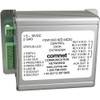
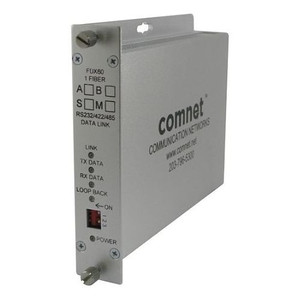
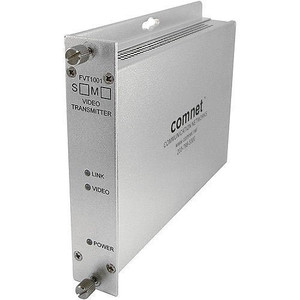
Comnet FVT2MI Dual HDMI Multi-Mode Fiber Optic Transmitter
Overview
The Comnet FVT2MI is a dual HDMI fiber optic transmitter designed to move uncompressed high-resolution video and audio over multi-mode fiber spans where electrical isolation, distance, or noise immunity demands fiber instead of copper. This is the transmitter half of a point-to-point link; pair it with a matching receiver (FVR2MI or equivalent) to complete the transmission path. It handles up to 1080p60 at full HDMI 1.3a spec with 16-bit color depth, supports up to 8 channels of uncompressed audio plus IEC 61937-compliant compressed streams, and maintains HDCP encoding integrity throughout the link — critical if your source is copy-protected content.
Key Features
- 1080p60 uncompressed video: Delivers frame-for-frame, pixel-for-pixel video with zero compression artifacts — essential for evidence-grade footage or applications where even minor latency or image degradation matters. No frame dropping, no temporal resampling.
- HDMI 1.3a compliance with 16-bit color: Full backward compatibility with legacy HDMI devices while supporting the color depth and bandwidth headroom of HDMI 1.3a. If your matrix or source is HDMI 1.4 or later, it will downgrade gracefully to 1.3a spec without loss of video or audio sync.
- Up to 8 channels uncompressed audio: Handles multi-channel audio (7.1 surround, multi-track recording, or split feeds) in lossless form over the same fiber pair as video. IEC 61937-compliant compressed streams (AC-3, DTS, etc.) also pass through intact, preserving the original bitstream.
- Bi-directional communication: Maintains HDCP, EDID (Extended Display Identification Data), and CEC (Consumer Electronics Control) handshake traffic in both directions over fiber. This means your source can auto-detect the receiver's capabilities and your receiver can signal back to the source without a separate control channel.
- HDCP encoding integrity: The transmitter does not decrypt, re-encode, or strip HDCP — it passes the protected bitstream through fiber unchanged. If your content is HDCP 2.2 or 1.4, the link preserves that protection end-to-end, critical for broadcast, cinema DCP, or licensed content workflows.
- Bi-color LED indicators (Red/Green): Provides real-time link status at a glance — green for healthy fiber connection, red for fault or fiber break. Simplifies troubleshooting in remote or noisy environments where you can't rely on software monitoring alone.
- DIN-rail mounting: Installs into standard 35mm DIN rails used in electrical racks, network closets, and industrial control cabinets. Compact footprint (2 lbs) means it fits tight spaces without requiring dedicated shelf space or custom brackets.
Integration and Compatibility
The FVT2MI works with any HDMI 1.0+ source or switcher — cameras with HDMI output, video processors, matrix switchers, or recording appliances. Its dual HDMI ports allow you to split or bridge two independent HDMI streams over a single fiber pair, or run redundant feeds on separate fiber strands for failover. Because it maintains HDCP and CEC, it integrates transparently into chains that include copyright-protected sources (live broadcast feeds, cinema projection systems, secured playback devices) without requiring decryption or re-encoding. Pair with a multi-mode fiber-ready receiver (typically SC or ST connector variants) rated for the same distance range — standard multimode goes up to 2 km at HDMI 1.3a speeds depending on fiber grade.
Video Transmission and Bandwidth
Uncompressed HDMI 1.3a video over fiber demands high bandwidth. At 1080p60, the FVT2MI uses the full TMDS (Transition Minimized Differential Signaling) clock headroom of HDMI 1.3a to encode the bitstream. Multi-mode fiber (MMF) carries the signal via pairs of wavelengths — typically 1310 nm and 1550 nm or 1310 nm alone depending on the receiver. Because there is no intermediate decode-encode step, latency is < 1 µs (microsecond range), making it suitable for live video monitoring, emergency response displays, or synchronized multi-camera feeds where even frame delay would be unacceptable.
Audio and Control Path
Audio travels embedded in the HDMI stream (LPCM PCM, uncompressed multi-channel, or compressed AC-3/DTS bitstream pass-through). The EDID and CEC signals are also preserved in the fiber link, meaning your source device can query what audio formats the receiver accepts and your receiver can send play/pause commands back to a source media player without a second control cable. This simplifies system wiring in long-distance installations.
Installation Considerations
The FVT2MI accepts standard HDMI cables on both input ports — use quality certified HDMI cables (not knockoffs) on the source side. Fiber side uses industry-standard multimode connectors (SC, ST, LC, or MPO depending on your receiver variant). Because the unit is compact and DIN-rail mountable, install it in a climate-controlled cabinet near your source or at a patching point in your fiber infrastructure. Bi-color LEDs indicate TX (transmit) status on each port; use these for quick health checks before diving into deep VMS logs.
Specifications at a Glance
- Video: up to 1080p60, HDMI 1.3a, 16-bit color
- Audio: 8 channels uncompressed, IEC 61937 compressed streams supported
- Fiber: multi-mode, dual-wavelength (wavelength set depends on receiver)
- Power: per your receiver documentation (typically low-power USB or 12V aux, supplied separately)
- Status: bi-color LED indicators (Red/Green) per port
- Mount: DIN-rail (35 mm)
- Weight: 2 lbs
What's in the Box
Package contents are not fully detailed in the source evidence. Contact the manufacturer or your distributor to confirm included cables, fiber pigtails, power adapter, and mounting hardware for this specific FVT2MI unit.
Frequently Asked Questions
Q: Does the FVT2MI come with fiber cables and a matching receiver?
A: No. The FVT2MI is the transmitter only. You will need a compatible fiber receiver (such as an FVR2MI) and multimode fiber patch cables with the appropriate connectors (SC, ST, or LC). These are typically ordered separately or as a complete kit.
Q: What is the maximum fiber distance the FVT2MI can transmit over?
A: Maximum distance depends on your fiber grade and receiver model. Standard multimode fiber (MMF) at HDMI 1.3a rates typically supports up to 2 km. Consult your receiver datasheet for the specific distance specification for your configuration.
Q: Will the FVT2MI work with 4K video sources?
A: No. The FVT2MI is rated for HDMI 1.3a, which tops out at 1080p60. 4K and higher resolutions require HDMI 2.0 or later, which demands different fiber encoding and a different transmitter model. If your source is 4K, you will need to downscale it to 1080p60 or use a 4K-capable fiber optic solution.
Q: Does the FVT2MI preserve HDCP copy protection?
A: Yes. The FVT2MI passes HDCP-encoded content through the fiber link without decryption or re-encoding, maintaining full copy protection integrity. This is essential for broadcast, cinema, and licensed content workflows.
Q: Can I mount the FVT2MI on a standard electrical DIN rail?
A: Yes. The FVT2MI has DIN-rail mounting capability and is compact at 2 lbs, making it suitable for installation in electrical racks, network closets, and industrial control cabinets alongside other equipment.
Q: What do the LED indicators on the FVT2MI mean?
A: The FVT2MI features bi-color (Red/Green) LED indicators that show link status in real time. Green indicates healthy fiber transmission; red indicates a fiber fault or break. These visual cues help with quick troubleshooting without requiring access to software monitoring.
The Comnet FVT2MI is built for installations where you need uncompressed video fidelity over distance without electrical noise coupling into your signal path. I reach for the FVT2MI when the source (a video matrix, surveillance DVR HDMI output, or broadcast monitor feed) must travel more than 100 meters and copper cable immunity is a liability — fiber break and re-lock are your only worries, not ground loops or EMI. The dual HDMI ports give you flexibility: run stereo feeds to separate remote monitors, bridge two independent sources, or keep a backup feed on standby.
Technical Highlights:
- 1080p60 uncompressed pixel-for-pixel delivery: Zero compression loss, zero frame drop — every pixel from your source arrives at the receiver intact. This matters in control rooms, evidence logging, and live OB (outside broadcast) where latency or image artifacts will get caught on camera or trigger a false alert in your VMS.
- HDMI 1.3a with 16-bit color depth: Covers bandwidth requirements up to 1.65 Gbps per channel (TMDS clock 165 MHz). If your source is HDMI 2.0 or 2.1, it will step down to 1.3a performance automatically — no manual mode switching needed, but you cannot exceed 1080p60 without resolution loss.
- 8-channel audio + IEC 61937 pass-through: Supports surround sound (7.1 LPCM), multi-track recording feeds, and compressed bitstreams (AC-3, DTS) without re-encoding. If you're feeding an audio matrix or recording appliance that expects DTS bit-for-bit integrity, the FVT2MI preserves it.
- HDCP + EDID + CEC bidirectional: Your source auto-detects the receiver's capabilities; your receiver can signal back to the source. Eliminates the need for manual EDID emulators or separate control cables in broadcast and cinema workflows where copy-protected feeds must stay protected.
Deployment Considerations:
- The FVT2MI is half a link — you absolutely must have a compatible fiber receiver on the far end (FVR2MI or equivalent). Confirm the receiver connector type (SC, ST, LC, MPO) matches your installed fiber and cable plant before ordering.
- Fiber distance is not infinite. Standard multimode at HDMI 1.3a speeds maxes out around 2 km; check your receiver specs for the exact distance your configuration supports. Single-mode fiber can go further but requires a single-mode receiver, not a multimode unit.
- The bi-color LEDs (Red/Green) are your first line of defense. If you see red on power-up and it doesn't flip to green within a few seconds, you have a fiber break, connector mismatch, or receiver offline. Don't assume it's a software problem until you've walked the LED status.
Deploy the FVT2MI in broadcast truck back hauls, remote camera-to-matrix runs, stadium control room links, or anywhere your HDMI source and display are separated by distance and copper ground loops are a concern. It is not suitable for 4K, but for 1080p60 evidence or live monitoring in fiber-rich facilities, it is the cleaner choice than copper balun chains.