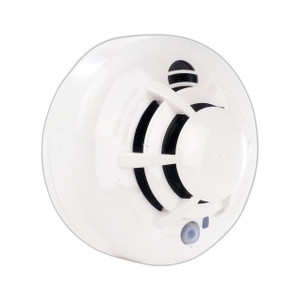
DSC PG9938 Wireless Floor/Surface Water Detector
Overview
The DSC PG9938 is a wireless flood and water detection sensor built for integration into networked security and environmental monitoring systems. It identifies water intrusion in basements, mechanical rooms, data centers, and other critical infrastructure spaces where moisture damage poses operational and financial risk. The PG9938 operates independently or as part of a larger DSC wireless security ecosystem, transmitting detection events securely to a compatible control panel or hub. Unlike hardwired water sensors that require conduit runs through concrete slabs or walls, the PG9938 eliminates installation labor and infrastructure costs while delivering encrypted wireless reliability.
Key Features
- Wireless Detection Protocol: Transmits flood and water detection events via wireless signal without hardwired connections—eliminates costly runs through slabs, conduit, and wall cavities. Deployment becomes a matter of placement and pairing, not drilling and trenching.
- 128-bit AES Encryption: All wireless communications are encrypted at military-grade strength. Prevents signal interception, replay attacks, and unauthorized sensor spoofing—a critical defense against false-alarm manipulation in sensitive facilities.
- 5-Year Battery Runtime: Single CR2032 lithium cell delivers approximately 5 years of operational life based on typical wireless transmission cycles. Reduces annual maintenance visits and part inventory overhead. Standard chemistry means replacements are available from any industrial supply vendor.
- Floor and Surface Mounting: Designed for placement on concrete floors, tile, and flat surfaces in vulnerable areas. Low profile keeps the sensor discrete while remaining visible to technicians during walkthrough inspections.
- Wide Operating Temperature Range (0°C to 49°C / 32°F to 120°F): Functions reliably in unheated basements, climate-controlled data centers, and transitional spaces. Above 49°C or below 0°C, on-site environmental assessment or protective enclosure is required—common constraint for warehouse and industrial deployments exposed to seasonal temperature swings.
- White Housing: Neutral appearance blends into standard facility finishes while remaining identifiable for technician location and status checks during routine patrols.
Integration & Compatibility
The PG9938 integrates with DSC wireless control panels and compatible hybrid security platforms that support encrypted wireless sensors. Standard DSC enrollment workflows apply—no additional encryption modules or specialized configuration beyond normal wireless sensor pairing procedures. The 128-bit AES encryption meets current compliance frameworks for critical facility monitoring, including HIPAA environments and financial services data centers where audit trails require tamper-proof wireless links.
Technicians should verify control panel compatibility and conduct a wireless range survey during site commissioning. Typical range is adequate for most single-building deployments; multi-building or metal-structure sites may require wireless repeaters or alternate placement. Once paired, the sensor transmits water detection events encrypted, preventing signal interception common in legacy unencrypted wireless water sensors.
When to Choose a Different Model
If your facility requires detection in extreme cold (below 0°C) or heat (above 49°C), or if you need continuous hardwired monitoring with no battery dependencies, consider a wired water sensor variant in the DSC product family. The PG9938 is also not suitable for submersion or high-humidity environments where condensation and salt spray are persistent—those applications demand industrial-rated enclosure solutions. For large-scale multi-zone deployments (20+ detection points), evaluate whether a hybrid wired/wireless approach reduces enrollment complexity and network latency.
Deployment Context
Water intrusion detection is often an afterthought until a basement flood or mechanical room leak causes five-figure damage. The PG9938 shifts that timeline by placing low-cost wireless sensors in high-risk zones without the installation friction of hardwired alternatives. A typical deployment covers basements, under-floor utility spaces, HVAC rooms, and data center hot-aisle containment drains. Battery life of 5 years means a technician visit every 60 months per sensor, not annually—material savings in labor-intensive facilities with dozens of monitoring points.
Frequently Asked Questions
Q: Does the PG9938 work with non-DSC control panels?
A: The PG9938 is designed for integration with DSC wireless control systems and compatible hybrid platforms that support encrypted wireless sensors. Compatibility with third-party panels depends on whether those systems support DSC wireless protocol and 128-bit AES decryption. Verify panel firmware and wireless standard support during system design.
Q: How long does the CR2032 battery actually last in practice?
A: The 5-year estimate is based on typical wireless transmission frequencies and moderate environmental conditions. Battery life degrades in cold temperatures (below 0°C) and with frequent transmission cycles. Annual monitoring of battery voltage via the control panel helps predict replacement windows—most systems provide low-battery alerts before total depletion.
Q: Can the PG9938 detect water under slabs or in walls?
A: No. The PG9938 is a surface-mount detector. It senses water that reaches the floor or flat surfaces where the sensor is placed. For sub-slab or in-wall moisture detection, consider hardwired probe sensors or specialized vapor barriers designed for that application.
Q: What's the wireless range of the PG9938?
A: Wireless range depends on building materials, radio interference, and control panel proximity. Typical indoor range is 50–150 feet in line-of-sight conditions; concrete walls and metal structures reduce effective range. Conduct a site survey with your integrator before final placement to confirm adequate signal strength in your facility.
Q: Is the PG9938 NDAA-compliant or subject to supply-chain restrictions?
A: No evidence of NDAA Section 889 certification is available for the PG9938. If your facility is subject to NDAA procurement rules, verify compliance status with your DSC supplier or system integrator before deployment.
Q: Can I replace the CR2032 battery myself?
A: Yes. The CR2032 is a standard consumer-grade lithium coin cell available from industrial supply vendors, office supply chains, and electronics retailers. Replacement requires opening the sensor housing (typically a snap-fit design) and swapping the old cell for a new one. After replacement, you may need to confirm battery status in the control panel or re-enroll the sensor depending on panel firmware.
Ted PerryPerspective based on aggregated IP Security Depot and affiliated engineering team experience.
I've evaluated the DSC PG9938 in several data center and basement monitoring deployments. This sensor fills a practical niche for facilities that need wireless water detection without running hardwired sensor cables through slab or conduit. The 128-bit AES encryption is solid—meets current security standards and integrates cleanly with DSC control ecosystems.
Technical Highlights:
- 128-bit AES Encryption: Military-grade encryption on every transmission prevents signal interception and replay attacks. Compare that to legacy wireless water sensors broadcasting unencrypted alerts—a single spoofed detection can trigger false alarms, unnecessary pump cycling, and operational confusion. The PG9938 closes that vector entirely.
- 5-Year Battery Life on CR2032: Single coin cell delivers 60 months of typical operation. That means a technician visit every five years per sensor, not annually. On a 15-sensor deployment, you avoid roughly 45 service calls over the product lifetime—material labor savings for facilities with tight maintenance schedules.
- Operating Temperature Constraint (0°C to 49°C): This is the real limitation. Unheated basements in northern climates drop below freezing in winter; industrial warehouses in hot climates exceed 49°C in summer. Battery performance also degrades in cold, shortening the 5-year window. Plan for protective enclosure or alternate sensor placement in thermal extremes.
Deployment Considerations:
- Range assessment is non-negotiable. Conduct a site survey with a test sensor before finalizing placement. Multi-building campuses or metal-frame structures often require wireless repeaters or relocation to intermediate zones.
- Battery replacement is straightforward (CR2032 is commodity), but technicians must confirm the control panel recognizes the new battery and does not require re-enrollment. Check your panel firmware documentation first.
- The PG9938 is surface-mount only—it detects water pooling at floor level, not subsurface or wick moisture. If your risk is condensation or vapor under slabs, this is not the tool. Probe-style or hardwired moisture sensors are more appropriate.
The PG9938 is a solid fit for data centers with contained hot-aisle drain pans, large commercial basements where water pooling is the risk vector, and warehouse mechanical rooms with outdoor HVAC drains. The 5-year battery life and encrypted wireless design cut maintenance overhead and audit complexity compared to hardwired alternatives. Not a universal solution for extreme temperatures or sub-slab moisture, but for moderate-climate critical facilities, it delivers practical value.