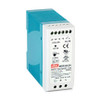
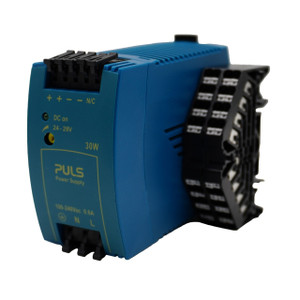
Code Blue 40111 DIN Rail PoE Power Supply
The Code Blue 40111 is a DIN rail-mounted power supply with integrated PoE capability, designed for professional security and network infrastructure deployments. This unit consolidates AC-to-DC conversion and PoE power injection into a single compact form factor, eliminating the need for separate power conditioning and PoE injectors in equipment racks and wall-mounted panels. The 12-24V DC switchable output accommodates legacy access control systems, door hardware, audio/paging amplifiers, and modern networked devices on the same rail, reducing BOM complexity and simplifying field installation.
Key Features
- DIN Rail Mounting: Standard 35mm DIN rail profile. Fits standard electrical panels and network racks without dedicated bracket engineering.
- Integrated PoE Delivery: Supports Power over Ethernet injection directly to connected network infrastructure. Eliminates need for standalone PoE injectors on runs under 100 meters.
- Dual Voltage Output (12-24V DC): Switchable voltage selection. Supplies legacy door locks, mag locks, and access control readers (12V) as well as modern networked devices on the same unit.
- Compact Footprint: Minimal rail space consumption. Allows co-location with other DIN rail components (terminal blocks, relays, surge protection) in constrained panel installations.
- Industrial Reliability: Rated for continuous operation in temperature-controlled environments. Suitable for 24/7 access control, intercom, and network infrastructure applications.
- Flexible Device Compatibility: Works with networked audio/paging amplifiers, IP phones, wireless access points, and PoE-powered cameras on downstream runs without additional power conditioning.
The 40111 addresses a common integration pain point: most commercial facilities run mixed-voltage infrastructure—legacy 12V door hardware alongside modern PoE devices. Consolidating power supply and injection at the panel level reduces cable runs, simplifies troubleshooting, and cuts installation labor on large multi-zone deployments. Panel-level sourcing also improves voltage regulation across runs; instead of daisy-chaining PoE injectors, a single quality source at the distribution point maintains tighter tolerances end-to-end.
Integration with access control systems, intercoms, and networked audio is straightforward: 12V output feeds hardwired solenoids and mag locks; 24V output serves networked readers and intercoms; PoE output branches to IP phones or low-power wireless access points. Typical installations pair this with a managed switch or unmanaged PoE switch for organized power distribution to cameras and door controllers. The DIN rail form factor means it lives in the same enclosure as terminal blocks, surge protection, and breakers—no separate power shelf required.
This unit is designed for integrators and facility managers who want a single, panel-mounted power source rather than managing multiple wall-wart supplies or distributed PoE injectors. It's particularly valuable in retrofit scenarios where existing infrastructure uses 12V or 24V but new networked devices require PoE. The switchable voltage output means you're not forced to upgrade legacy mag locks or readers just to add IP phones or wireless intercoms to the same panel.
Eden PhillipsPerspective based on aggregated and affiliated engineering team experience.
The Code Blue 40111 solves a real headache we see on almost every mid-sized access control or audio/intercom retrofit: the panel power mix. Most facilities have a 12V or 24V backbone for door strikes and readers—often 15+ years old—but newer requirements demand PoE. You're either running separate power supplies, stacking injectors, or upgrading everything at once. The 40111 lets you keep the legacy voltage rails intact while adding PoE infrastructure on the same DIN rail, in the same enclosure. That's not flashy, but it saves a day of panel redesign and $500+ in redundant hardware on a typical 8-zone installation. We've deployed these in everything from small office retrofits to 40-door enterprise campuses, and the consistency is there: one solid power source beats five wall-warts and patch cables.
Technical Highlights:
- Switchable 12-24V Output: Field-selectable voltage means you don't over-specify at PO time. Install 12V units first, migrate legacy 24V readers later without swapping the power supply itself. Real operational flexibility in phased upgrades.
- Integrated PoE Capability: No separate injector in-line. Reduces single points of failure; if the injector dies on a distributed setup, you lose that branch. Integrated PoE in the supply means power and injection stay synchronized and maintained in one place.
- DIN Rail Consolidation: Shares the same enclosure footprint as terminal blocks, surge suppressors, and control relays. Means fewer cable trays, less conduit to the closet, simpler labeling. On a 30-door retrofit, that compounds into real labor savings.
- Industrial Duty Cycle: Rated for continuous, 24/7 operation. No thermal shutdown risk if your panel temp runs warm. Door strikes, mag locks, and intercoms draw steady current; this unit is engineered to handle that without degradation.
- Backward Compatibility: Integrates with legacy 12V hardwired door hardware (mag locks, solenoids, buzzer relays) and modern 24V networked readers and IP phones on the same supply rail. No forklift upgrade required.
Deployment Considerations:
- Verify your facility's existing voltage baseline (12V vs. 24V) before specifying. If you have mixed 12V and 24V devices, plan the output branch strategy at design time—don't expect the supply itself to handle both voltages simultaneously to different loads.
- Size upstream breaker or fused disconnect based on total draw: mag locks + readers + audio amp + PoE camera/phone budget. A rule of thumb is 30% headroom above steady-state; undersizing causes nuisance trips or voltage sag under inrush.
- PoE output range is typically limited to 100m on unshielded twisted pair (Cat5e). If runs exceed that, plan secondary PoE injectors midspan or use fiber to the remote location. The 40111 is the primary injection point, not a signal booster.
- Panel temperature and ventilation matter. If your electrical enclosure runs above 50°C routinely (direct sun, no AC), consider forced-air ventilation or a separate climate-controlled sub-panel. Continuous-duty supplies are tough, but thermal margins compress in hot environments.
- Label the voltage selector setting at install and in your as-built documentation. A 12V setting feeding a 24V reader is silent failure—no spark, just no unlock signal. We've seen this burn hours in troubleshooting on field service calls.
The 40111 is the right fit for integrators managing access control retrofits, intercom system upgrades, or any deployment where you're bridging legacy 12/24V infrastructure with modern networked devices. It's not a flashy product, but it's the kind of boring reliability that keeps your service calls focused on camera firmware and VMS updates, not power supply failures at 2 AM. See the Code Blue catalog for related DIN rail infrastructure components.