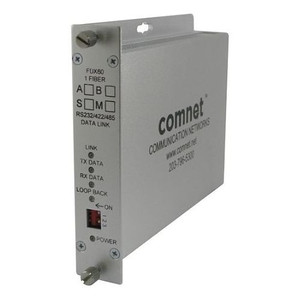
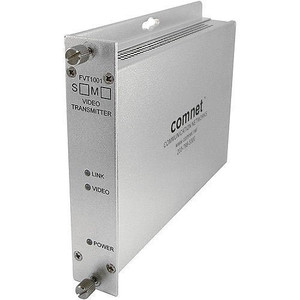
Comnet FVT1014M1 Digitally Encoded Video Transmitter with 4 Bi-directional Data Channels
Overview
The Comnet FVT1014M1 is a digitally encoded video transmitter designed to extend surveillance video and control data over a single multimode fiber strand, eliminating the need for multiple cable runs in retrofit installations or where fiber-optic backbone infrastructure already exists. This unit carries one video channel and four bi-directional data lines, all encoded into a 10-bit digital signal optimized for long-distance fiber transmission.
The FVT1014M1 addresses a specific problem in modern security deployments: when you've already invested in fiber infrastructure (for IT networking, intercom, or other systems), adding a dedicated copper run for each camera becomes wasteful. This transmitter collapses video plus four independent control channels into a single fiber pair, reducing installation labor and simplifying future expansions where fiber is already trenched or run through existing conduit.
Key Features
- Single-Fiber Multimode Transmission: Uses standard multimode fiber (the same type in most commercial buildings) at 1310/1550nm wavelengths, meaning it integrates into existing fiber plants without requiring specialty single-mode infrastructure. One fiber carries video and four data channels simultaneously.
- 10-Bit Digital Encoding: Each video frame is encoded to 10-bit resolution before transmission, preserving shadow and highlight detail across the entire signal chain. This is critical for forensic-grade evidence recovery in mixed-lighting environments where analog compression would lose recoverable detail.
- Four Bi-directional Data Channels: RS232, RS422, and RS485 support means you can run PTZ camera controls, alarm inputs/outputs, sensor telemetry, or access-control signals over the same fiber. Bi-directional capability allows the far end to send feedback (camera position confirmations, alarm status) back to the control room without additional wiring.
- EIA RS-250C Short-Haul Video Standard: Guarantees compatibility with standard CCTV analog video outputs and inputs, allowing the FVT1014M1 to integrate with legacy analog systems, hybrid analog/digital workflows, or analog-to-IP gateways without additional converters in the video path.
- Transient Voltage Protection: Built-in surge protection on both video and data lines shields downstream equipment from fiber-run voltage transients caused by lightning strikes or grounding differentials across long cable runs—a real problem in sites spanning multiple buildings or outdoor perimeters.
- NEMA TS-1/TS-2 Operating Range: Rated for -40°C to +60°C (-40°F to 140°F), covering outdoor cabinet deployments, unheated shelters, and equipment rooms without climate control. Dual-temperature rating reflects confidence in performance under freeze-thaw and thermal cycling stress.
Integration & Compatibility
The FVT1014M1 is a transmitter half of a fiber pair. It requires a matching receiver (FVR1014M1 or equivalent) at the remote end to recover video and data channels back to analog/digital form. The unit terminates video on standard BNC connectors and data on DB9 or RJ45 connectors (per configuration), so it seats into existing analog CCTV rack layouts or hybrid systems without mid-stack rework.
Because the FVT1014M1 operates at the analog/fiber boundary, it does not require IT network configuration, DHCP, or VMS driver installation. It is camera-agnostic: any analog camera with standard composite output (NTSC or PAL) feeds into the video input; any camera with RS485 PTZ control outputs into the data channels. This makes it especially valuable in retrofit scenarios where fiber exists but camera replacement is not economically justified.
Data channel flexibility means you can pair camera control with environmental sensors, access-control relay outputs, or intercom return audio on the same fiber backbone, reducing the number of fiber pairs required when expanding surveillance across large properties.
Frequently Asked Questions
Q: Does the FVT1014M1 require a matching receiver?
A: Yes. The FVT1014M1 is a transmitter only. You must install a compatible receiver (such as an FVR1014M1) at the remote end to extract video and data signals from the fiber.
Q: Can I use this with single-mode fiber instead of multimode?
A: No. The FVT1014M1 is optimized for multimode fiber at 1310/1550nm wavelengths. Single-mode fiber requires different optical components and is not supported by this model.
Q: What video standards does the FVT1014M1 accept?
A: The unit adheres to EIA RS-250C short-haul video standard, supporting NTSC and PAL composite video outputs from analog cameras.
Q: Can I run multiple cameras on one FVT1014M1?
A: No. The FVT1014M1 accepts one video channel. Each camera requires a dedicated transmitter and fiber pair.
Q: What happens if lightning strikes the fiber run?
A: The built-in transient voltage protection shields the unit and connected equipment from induced surges, but fiber itself is non-conductive, so direct lightning damage risk is minimal. Grounding and surge protection on power supplies and data lines remain necessary for complete site safety.
Q: Does the FVT1014M1 work in outdoor equipment cabinets?
A: Yes. The NEMA TS-1/TS-2 operating range (-40°C to +60°C) covers unheated outdoor cabinets, though you should verify your cabinet's internal temperature during peak summer or winter conditions.
The FVT1014M1 fills a deployment niche that often gets overlooked: sites where you've already paid for fiber infrastructure but want to avoid installing separate coax runs for each camera. I've seen this save integrators weeks of conduit labor on campus-wide projects, where IT fiber was already in place and adding a single multimode transmitter-receiver pair meant one less cable pull. The 10-bit encoding ensures that detail from the analog camera survives the digital encoding step—worth paying attention to if evidence integrity matters in your jurisdiction.
Technical Highlights:
- 10-Bit Digital Encoding: Preserves shadow and highlight detail from the source analog video; critical when forensic recovery or court-admissible evidence is a requirement. Analog cable runs don't degrade the image further once encoded.
- Four Bi-directional Data Channels (RS232/422/485): One fiber pair now carries PTZ control, alarm signals, and sensor telemetry simultaneously. Bi-directionality means the camera can send back position confirmations and status without running separate return copper.
- Transient Voltage Protection: Long fiber runs can build up induced voltage from lightning and grounding differentials across multi-building sites. Built-in surge shielding protects the downstream equipment from line transients—not a guarantee against direct strikes, but a real reduction in nuisance equipment damage.
Deployment Considerations:
- The FVT1014M1 is transmit-only; you cannot buy one unit and use it standalone. Budget for a matching receiver at the remote end, and factor multimode fiber cost and termination into your material estimates.
- Analog video output is your only option—no IP or digital video out. If your control room is migrating to network video recorders or IP-based VMS, this becomes a legacy bridge only, not a primary camera interface.
Best fit: retrofit campus or warehouse surveillance where existing fiber backbones exist, analog cameras remain serviceable, and you need to avoid trenching new coax or adding more fiber pairs. Also solid for hybrid analog/digital workflows where PTZ and alarm feedback run on the same infrastructure as video.