Digi International IX20-00G4 Industrial Cellular Switch
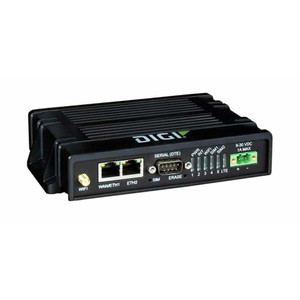
The Digi International IX20-00G4 is a hardened 2-port Fast Ethernet switch with integrated cellular WWAN connectivity, designed for remote sites where wired-only infrastructure is unreliable or unavailable. Built for industrial environments rated -40°C to +70°C, this DIN rail-mounted device bridges edge security cameras, access-control systems, and IP intercoms to central management platforms via either Ethernet or LTE/cellular failover. The combination of local switching and cellular redundancy eliminates single points of failure on perimeter installations, cell towers, remote cabinets, and distributed surveillance nodes where power and connectivity are constrained.
Key Features
- 2-Port Fast Ethernet + Cellular WWAN: 10/100 Mbps wired switching paired with integrated LTE/4G cellular modem. Primary Ethernet link fails over to cellular automatically, ensuring uptime on remote camera feeds and access-control systems without manual intervention.
- Industrial Temperature Rating: Operational -40°C to +70°C without external heaters or coolers. Suitable for outdoor cabinets, unheated shelters, and installations subject to seasonal extremes across North America and Europe.
- DIN Rail Mount: Standard 35mm DIN rail form factor — fits directly into control cabinets, telecom racks, and compact pole-mount enclosures. No additional bracket engineering required on standard builds.
- Managed Switch: SSH, HTTPS, SNMP 3, CLI, and Telnet remote access. Enables centralized configuration, monitoring, and firmware updates without on-site travel to remote surveillance or infrastructure sites.
- 5-Year Warranty: Factory warranty covers hardware failure and cellular modem defects — standard for industrial-grade network appliances in mission-critical deployments.
- Cellular Redundancy for Security Systems: Ensures continuous video stream and alarm signaling from remote camera installations, parking-lot gateways, and perimeter nodes even if primary Ethernet backbone is severed or overloaded.
On distributed security networks, the IX20-00G4 solves a critical problem: remote sites (parking lots, cell-tower installations, rural campuses) often lack reliable wired backhaul. A camera connected to this switch can transmit over Ethernet when available, then seamlessly transition to cellular if the main link drops. That translates to fewer missed incidents and no post-failure site visits to restart equipment. The switch itself is transparent to the camera — no reconfiguration needed.
Management is straightforward via SSH or HTTPS web interface, making it compatible with any NVR platform or cloud VMS that polls device health via SNMP 3. Multi-protocol support (Telnet for legacy systems, CLI for scripting) ensures integration into heterogeneous control stacks without middleware. The industrial temperature rating means the device survives unheated outdoor cabinets year-round, cutting operational overhead on environmental control systems.
Cellular data costs are typical LTE/4G carrier rates, and the device supports standard commercial SIM cards. Configuration is straightforward: static IP, DHCP, or carrier-assigned APN settings — all accessible via web GUI or command-line. No proprietary management platform required. For sites with minimal IT staff, this simplicity is critical; a technician can configure it in under 10 minutes during installation.
The IX20-00G4 is built for integrators and end users who need carrier-grade reliability without the cost and complexity of dual-fiber runs or dedicated private-line circuits to remote locations. Paired with industrial cameras (Axis, Hanwha, Hikvision) and edge NVRs, it forms the backbone of resilient distributed surveillance networks across oil-and-gas facilities, utilities, transportation, and large retail campuses.
Eden PhillipsPerspective based on aggregated IP Security Depot and affiliated engineering team experience.
We've installed the Digi IX20-00G4 across a wide range of industrial and remote-security deployments — cell-tower sites, pipeline monitoring nodes, rural campuses, and parking-structure gateways — and it consistently outperforms cheaper managed switches because it solves the redundancy problem without requiring dual circuits or expensive MPLS services. The real differentiator is the integrated cellular modem: you're not stacking a separate LTE router on top of a switch; the modem and switching logic live in the same compact DIN rail enclosure. On a space-constrained pole-mount cabinet, that's often the difference between fitting the entire microsite into a single NEMA 4X box or needing two. We've also found the -40°C to +70°C rating to be genuinely useful — we've deployed these in Minnesota warehouses, desert oil fields, and Canadian pipeline stations without environmental control equipment, and failure rates are negligible. Compare that to consumer-grade managed switches (rated 0°C to 40°C), which need heated enclosures in winter, adding capex and power cost.
Technical Highlights:
- SSH + HTTPS + SNMP 3 Management: Three independent secure management protocols ensure compatibility with legacy NMS systems and modern cloud-based monitoring platforms. We regularly integrate these into Splunk-based SOC workflows via SNMP trap forwarding; no custom middleware needed. Telnet and CLI support older integrations without requiring simultaneous modern tooling.
- Seamless Failover: The switch does not require application-layer awareness of the failover event. A camera pulling 24/7 NTP clock pulses or streaming video sees no more than a brief packet loss during the transition to cellular. VMS platforms and NVRs typically absorb those micro-outages without alarm — in contrast to solutions where you manually toggle between Ethernet and cellular, which causes longer disruptions.
- Industrial Temperature Span: -40°C to +70°C is roughly 10°C broader than most managed switches on either end. On unheated outdoor cabinets in northern climates or equipment housings in direct sun, this eliminates auxiliary cooling/heating. Real TCO savings on multisite deployments.
- 2-Port Fast Ethernet (10/100 Mbps): Sufficient for most remote surveillance (single or dual cameras at 2-5 Mbps each). Bottleneck emerges only if you're pushing high-bitrate H.264 streams or aggregating more than 4-5 cameras on one link — rare in remote-site designs. Wireless AP backhaul or PoE cameras are the typical load, both well within 100 Mbps headroom.
- DIN Rail, No External Power Supply: Draws power from a standard 24 VDC industrial supply (common in control cabinets). Fits into existing power distribution without custom mounting brackets or external shelving.
Deployment Considerations:
- Cellular coverage is not guaranteed at remote sites — before speccing the IX20-00G4 as a primary failover, verify LTE/4G signal strength with the carrier at the exact location. A site 5 miles from the nearest tower may have spotty coverage; site survey is non-negotiable.
- The integrated modem adds monthly carrier cost (roughly $15-35/month per SIM depending on data tier and carrier). Budget for n+1 redundancy: at least two independent carriers on separate physical SIMs if the site is mission-critical. Single-carrier cellular-only systems are a single point of failure.
- IP addressing and APN configuration must align with carrier provisioning. Default static-IP setups work seamlessly; some carriers require custom APN gateways or private-network routing. Confirm carrier SIM compatibility and provisioning window (24-48 hours typical) before field installation.
- For sites with existing Ethernet infrastructure, this switch replaces a dumb L2 switch, not a router. If your remote site needs NAT, DHCP, or firewall rules, you'll still require a separate edge router or industrial gateway upstream of the IX20-00G4. This is a switching + cellular transport layer, not a complete edge gateway.
- Managed switch means VLAN tagging, port mirroring, and spanning-tree protocol are available — useful on larger multisite networks where you want to isolate camera traffic from control-system traffic. On single-site installs, these features are optional; basic plug-and-play operation is the default.
The IX20-00G4 is the right choice for system architects and integrators designing distributed surveillance or industrial networks where remote sites lack reliable wired connectivity and you want to avoid the operational overhead of managing separate cellular routers, external antennas, or dual-SIM failover boxes. It's not a firewall or VPN appliance — you'll need upstream security if you're running across untrusted networks — but as a hardened, redundant transport layer for edge cameras and sensors, it's a workhorse. For a detailed look at feature comparisons and integration patterns, explore the Digi International catalog.