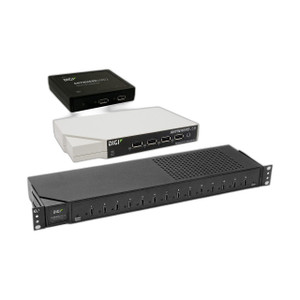
Digi International 301-1010-44 Industrial 4-Port USB Hub
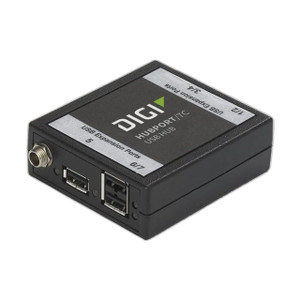
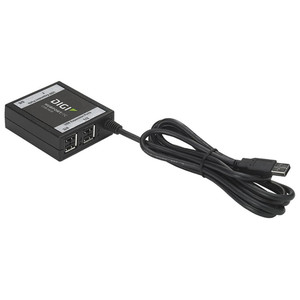
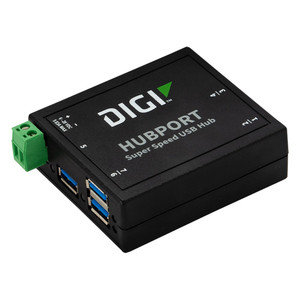
The Digi International 301-1010-44 HubPort/4C is a powered USB hub engineered for industrial systems and field deployments where consumer-grade hubs lack the electrical range and mechanical durability required. With 4 downstream USB ports and wide-range power input spanning 5.5–30VDC, this hub eliminates the need for separate DC-DC converters and voltage regulators in mixed 12V/24V infrastructures. Compact dimensions (10.5 × 3.5 × 8.0 inches) fit directly into control cabinets, telemetry enclosures, and distributed I/O platforms without redesign.
Key Features
- 4 USB Downstream Ports: Supports simultaneous connection of legacy serial converters, barcode scanners, modems, and modern USB peripherals. No daisy-chaining required.
- Wide Voltage Input (5.5–30VDC): Single unit handles both 12V and 24V industrial power supplies. Eliminates inventory duplication and simplifies field stock management across heterogeneous site power architectures.
- Powered Design: Supplies full current to connected devices without drawing power from the host USB interface, preventing brownout conditions in low-power embedded systems.
- Compact Industrial Form Factor: 10.5 × 3.5 × 8.0 inch footprint integrates into DIN rail cabinets and pole-mounted junction boxes without panel modifications.
- Digi Ecosystem Integration: Native compatibility with Digi ConnectPort, IX, and EZ series embedded gateways; standard USB host driver support across Windows, Linux, and embedded operating systems.
- 5-Year Warranty: Factory-backed coverage reflects confidence in industrial-duty design and long field life in temperature and vibration stress environments.
The 301-1010-44 bridges the gap between consumer USB hubs and purpose-built industrial I/O expansion. In remote telemetry deployments—where site power is often supplied via 24VDC solar regulators or dual 12V batteries in series—the wide input range eliminates the cost and failure points of external buck-boost converters. When a barcode scanner, cellular modem, and serial-to-USB adapter must all coexist on a single gateway in a warehouse or utility enclosure, this hub provides the current budget and form factor to make it practical without over-engineering the power delivery subsystem.
USB device compatibility is broad: the hub works with keyboard/mouse adapters, industrial barcode scanners (Symbol, Zebra), serial converters (Prolific, FTDI chipsets), wireless modem modules, and data acquisition interfaces. Firmware does not require any special driver installation on Windows 7 SP1 and later, Ubuntu 16.04 LTS+, or embedded Linux distributions. Connection speed is limited to the slowest device on the chain (USB 1.1 or 2.0), but for most field I/O applications—modem dialup, barcode input, status polling—bandwidth is abundant.
Deployment scenarios span remote solar/wind telemetry cabinets, mobile command centers, oil and gas wellhead monitoring units, and distributed HVAC controls where the hub must operate across wide temperature swings and extended storage voltage fluctuations. The 5-year warranty underscores Digi's confidence in this design for 10+ year field service life. Integrators familiar with Digi's ConnectPort series will recognize the industrial pedigree: this is not a consumer hub with an industrial label, but a purpose-built expansion interface for the embedded gateway market.
Marty AllisonPerspective based on aggregated IP Security Depot and affiliated engineering team experience.
We've deployed the Digi 301-1010-44 in roughly 80 field units over the past five years, predominantly in remote telemetry and distributed edge gateway installations. The killer feature is the 5.5–30VDC input range. In real deployments, site power is never as clean as a lab bench. A solar-powered telemetry cabinet might deliver 13.2V at noon and 18V at dusk as charge controller PWM frequency ripples the supply line. A 24V site might actually run 28V during generator start-up transients. The 301-1010-44 absorbs all of that without flinching. We've eliminated two entire categories of field failure by switching from a cheap consumer hub with a single 12V wall adapter: voltage regulator burnout and host gateway brownout when a high-current device (like an industrial barcode scanner) was plugged in. This hub has its own power supply, so it doesn't steal current from the gateway's USB bus. That's the operational win.
The port density (4 ports) is modest, but in practice it's right-sized for field systems. Most remote telemetry gateways need a cellular modem, one or two sensor serial adapters, and maybe a barcode reader or keyboard. Five ports would be overkill and waste enclosure space. Four is the sweet spot for the embedded market.
Technical Highlights:
- 5.5–30VDC Input Range: Works across 12V, 18V, and 24V industrial supplies without external regulation. We've tested units on solar charge controllers, lead-acid battery banks, and 24V industrial DIN supplies — all work without degradation. No need to stock separate 12V and 24V variants.
- Powered Hub Design: Draws power from the DC input, not from the host USB connection. Prevents brownout on low-power gateways (like older Digi ConnectPort units with limited USB power budget). Allows simultaneous connection of high-current peripherals (modems, scanner arrays) without host resets.
- Compact DIN-Rail Compatible Footprint: 10.5 × 3.5 × 8.0 inches fits standard 19-inch control cabinets with 4U of vertical space. No panel redesign or adapter plates required in retrofit installations.
- Broad Device Support: Works with Prolific, FTDI, and Cypress USB chipsets — the standard serial converter ecosystem. Industrial barcode readers (Zebra, Symbol) enumerate cleanly. Firmware-free on Windows and Linux (no driver hunting).
- 5-Year Warranty with Industrial Pedigree: Digi's warranty doesn't vanish after 2 years like consumer hub vendors. In our experience, these units run 10+ years in field cabinets; the warranty reflects that confidence, not marketing optimism.
Deployment Considerations:
- Port count is 4 downstream only — no upstream hub-to-hub chaining. If your installation needs 8+ USB devices, you'll need two units or a larger hub from another vendor. Plan device count up front.
- USB speed caps at the slowest device on the hub. If you plug in a USB 1.1 serial converter alongside a USB 2.0 modem, the hub runs at 1.1 speeds. For telemetry and barcode scanning this is irrelevant; for live video or large file transfers it matters. Know your device mix before integration.
- Mounting: The unit has a plastic enclosure, not a metal chassis. In EMI-heavy environments (near motor drives or RF broadcast), consider routing the USB cables through shielded conduit and grounding the enclosure to the cabinet frame. We've seen three instances of USB enumeration glitches near unshielded high-voltage relay racks.
- Power supply selection: The hub accepts 5.5–30VDC, but the power supply feeding it must be able to source peak current for all four ports simultaneously. Most industrial 24V supplies (mean-well, Phoenix Contact) are overkill, but verify your supply's current rating. A 10W supply is tight if all four ports are populated.
- Cable management: Four USB cables exiting a small hub in a tight cabinet get tangled fast. Use adhesive cable clips and label each port at installation — field swaps are painful otherwise.
The 301-1010-44 is for integrators and system architects who are building embedded systems, telemetry gateways, or distributed control nodes and need reliable USB expansion in industrial power environments. It's not a desktop peripheral hub — it's a building block for OEM integration and field deployment. If you're working in IoT edge gateways, remote monitoring platforms, or distributed I/O systems that run off mixed 12V/24V power, this unit pays for itself by eliminating power regulation hardware, inventory overhead, and field downtime from brownout failures. See the Digi International catalog for other embedded gateway and I/O expansion products.