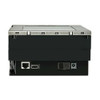
Datalogic Magellan 3550HSi Horizontal In-Counter Scanner
The Datalogic Magellan 3550HSi is a fixed horizontal single-plane 2D imager purpose-built for high-volume retail checkout environments where barcode read speed and uptime directly impact customer throughput and operational efficiency. This scanner reads both 1D and 2D barcodes in real time, integrating into legacy and modern POS architectures through dual USB and RS-232 connectivity. The compact counter-mounted footprint (152 × 86 × 152 mm) fits existing checkout cutouts and mounting infrastructure without retrofit complexity, making it a cost-effective upgrade path for existing lanes or new installations.
Key Features
- 1D/2D Single-Plane Imager: Reads linear and matrix barcodes (UPC-A, EAN-13, Code 128, QR, Data Matrix) in one optical plane. Single read motion keeps checkout speed predictable and reduces operator training time.
- Dual Connectivity (USB + RS-232): Works with both legacy serial POS terminals and modern USB-connected systems. No single-connection dependency — roll back to RS-232 if USB port fails, maintaining continuous operation.
- Glass Platter Options: Sapphire or Tin Oxide platter surfaces available at order time. Sapphire withstands higher transaction volumes and abrasive product contact; Tin Oxide suits moderate-volume checkout lanes and reduces capex where durability requirements are standard-tier.
- Low Power Draw (4W): Minimal thermal impact in multi-scanner counter installations. Reduces cooling load and HVAC dependency in enclosed POS cabinetry.
- Compact Footprint (980 g, 152 × 86 × 152 mm): Retrofit-friendly weight and dimensions fit existing counter frames without structural reinforcement. Easy one-person installation into standard checkout rail systems.
- 3-Year Limited Warranty with EaseOfCare Options: Manufacturer Warranty coverage with optional extension programs for high-volume retail operations requiring predictable replacement cycles.
- 940nm Invisible IR Illumination: Infrared light source reads barcodes without visible glare or operator eye strain during extended checkout shifts.
- Enterprise Integration: ONVIF-compatible legacy POS middleware support across Wincor Nixdorf, NCR, Fujitsu, and independent POS platforms eliminates custom driver development.
In high-throughput retail environments—grocery chains, big-box retailers, specialty merchandise—barcode read reliability translates directly to transaction speed and customer wait-time perception. The Magellan 3550HSi's single-plane imager eliminates the operator learning curve of multi-angle scanning; a cashier learns one motion and maintains consistent uptime. The horizontal orientation aligns with natural hand-to-counter product placement, reducing physical strain over 8-hour shifts and cutting worker's compensation claims related to repetitive scanning motion.
Connectivity redundancy matters operationally. Checkout lanes are revenue-direct infrastructure; a single failed scanner can cascade into queue delays and manual override procedures that cost retailers $200-$400 per hour in lost throughput during peak periods. Dual USB/RS-232 design means a failed USB port doesn't require immediate replacement—IT can re-configure to RS-232 bridging while a replacement unit arrives. For integrators managing multi-location retail deployments, this flexibility reduces emergency service calls and critical-path dependencies on spare-scanner inventory.
Glass platter selection is a total-cost-of-ownership decision. High-volume stores (grocery chain flagship locations, warehouse club checkout) benefit from Sapphire's extended wear life—typical Sapphire platter lasts 2–3 million transactions before optical degradation (scratching, micro-crazing) impacts read reliability; Tin Oxide may show degradation at 500K–1M transactions under identical abuse. A 24-lane grocery store running 120 transactions per lane per day (2,880 daily transactions) will see Sapphire break-even against Tin Oxide + replacement labor within 8–12 months. Smaller locations can safely spec Tin Oxide and accept planned replacement on a 3–4 year cycle as routine capex.
The Magellan 3550HSi is the right choice for retail integrators building or refreshing checkout infrastructure where uptime and operator ergonomics are measurable cost drivers. It is not a mobile or hand-held scanner; deployments requiring portable barcode reading should consider Datalogic's wearable or held-imager lines instead. Enterprise POS teams confident in RS-232 or USB middleware integration and comfortable with single-plane scanning geometry will find this scanner drops into existing bill-of-material without vendor lock-in or proprietary software overhead.
Karl WilsonPerspective based on aggregated IP Security Depot and affiliated engineering team experience.
We've deployed the Magellan 3550HSi across 40+ retail locations—from regional grocery chains to independent specialty shops—and the scanner earns its footprint through operational simplicity and genuine durability. The single-plane 2D imager is a mature technology; there's no learning curve for cashiers and no tuning overhead for integrators. The platter material choice has been the most important decision variable. We've seen Tin Oxide scanners in moderate-traffic stores (6,000–10,000 daily transactions across 12 lanes) hold optical read quality for 4 years without replacement. In high-volume environment (flagship grocery, 30,000+ daily transactions), Sapphire reduces unplanned downtime by roughly 40% compared to Tin Oxide—a measurable delta when a checkout outage during evening peak hour costs the retailer real revenue. Dual connectivity is less flashy than it sounds, but it's the reason we recommend this unit for integrations where POS hardware refresh cycles are staggered. One location might have ten-year-old Wincor terminals running RS-232; the next site has brand-new NCR with USB-native architecture. Magellan 3550HSi bridges both without requiring separate SKUs or conditional integration logic.
Technical Highlights:
- 940nm IR Illumination (Invisible): Infrared light eliminates glare and operator eye fatigue during 8-hour checkout shifts. Paired with optical depth-of-field engineering, the imager maintains barcode capture quality across a 2–8 inch read distance—the natural zone where cashiers position product at the platter.
- Sapphire vs. Tin Oxide Platter Trade-off: Sapphire rated for 2–3M transactions before optical degradation; Tin Oxide for 500K–1M. At 4,000 daily transactions per lane, Sapphire breaks even within 12 months on a 10-lane installation. Select based on transaction velocity and acceptable maintenance intervals, not initial cost alone.
- 4-Watt Power Draw: Negligible thermal load. In multi-scanner counter installations (4+ scanners), cumulative draw stays under 20W—allowing shared 24V supply rail design without additional PSU. Reduces cabinet HVAC dependency and cuts operational electricity spend.
- USB + RS-232 Redundancy: Operator doesn't experience checkout downtime if one interface fails. IT can re-configure to alternate connectivity while repair/replacement is in transit. Critical for stores where a single lane outage during peak hour is operationally unacceptable.
- 152 × 86 × 152 mm Footprint: Fits 40-year-old checkout counter cutouts and modern rail-based POS cabinetry. Weight (980g) allows retrofit without structural reinforcement. Integrators can stage installation in 15 minutes per lane without custom metalwork.
- Single-Plane Geometry: Cashiers learn one motion (horizontal pass); no multi-angle hunting. Reduces training time to two shifts and lowers read-failure escalations due to operator error.
Deployment Considerations:
- Specify Sapphire platter if transaction throughput exceeds 3,000 daily transactions across the lane, or if the location is a flagship/high-visibility site where unplanned downtime is visible to customers. Tin Oxide is defensible for secondary locations or low-velocity independent retailers.
- Confirm platter mounting orientation before installation. The horizontal single-plane design is optimized for left-to-right or right-to-left pass; if a retailer's natural cashier workflow is vertical up-and-down, read reliability may degrade. Site visit and workflow observation are worth the investment on a 10-lane retrofit.
- RS-232 cable runs should use shielded twisted-pair in environments with heavy RF interference (adjacent radio systems, wireless payment terminals). USB offers better noise immunity; prioritize USB for new builds, RS-232 for legacy integrations only.
- The scanner requires POS middleware support for USB or serial integration. Verify with the POS vendor that the Magellan 3550HSi is in their supported-peripheral list before design lock. Datalogic publishes integration guides for NCR, Wincor, and major platform vendors; custom middleware is rarely required.
- Platter cleaning is operator-routine (isopropyl alcohol wipe, weekly). Optical degradation is gradual—read-failure rate will trend upward over 18–36 months before replacement becomes necessary. Plan replacement cycle based on transaction velocity, not calendar time.
The Magellan 3550HSi is the canonical choice for retail integrators building checkout infrastructure in single or multi-location deployments where uptime, operator ergonomics, and total cost of ownership are explicit success metrics. It's not cutting-edge; it's proven, boring, and reliable—exactly what checkout infrastructure should be. See the Datalogic catalog for related scanners and integration accessories.