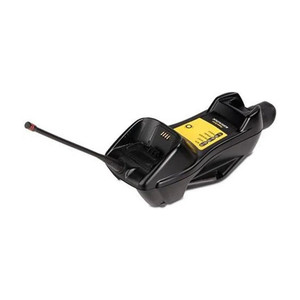
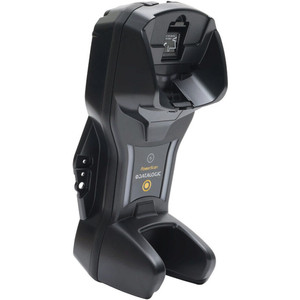
Datalogic BC9680-910 Ethernet/Profinet Base Station Charger
The BC9680-910 is a dedicated base station and charging cradle engineered for PowerScan 9600 series cordless barcode scanners. It provides the infrastructure backbone for enterprise cordless scanner deployments, combining intelligent battery management, dual-protocol network connectivity, and secure scanner storage in a single unit designed for high-duty-cycle warehouse, distribution, and manufacturing environments.
Key Features
- Ethernet and Profinet Connectivity: Dual network protocols allow flexible integration into traditional IT environments or industrial automation systems — no need to choose between legacy Ethernet infrastructure and modern industrial IoT networks. Both options terminate at a single base station, simplifying deployment logistics.
- Intelligent Battery Charging Profiles: The BC9680-910 applies Datalogic's proprietary charging algorithms that adapt to battery chemistry and usage patterns. This extends battery lifespan measurably compared to generic charging solutions — a direct reduction in per-scanner total cost of ownership across large fleets operating multiple shifts.
- Wireless Communication Relay: Acts as the bridge between cordless scanners and your host system, ensuring reliable transmission of barcode data without dropped connections or data integrity issues that plague incompatible third-party cradles.
- Secure Scanner Cradle: The dock-and-store design protects scanners during idle periods, reducing physical damage and theft risk in high-traffic warehouse and retail environments.
- Multi-Shift Operation Support: Engineered for continuous enterprise deployments where scanners rotate between shifts. Battery refresh cycles and wireless synchronization happen automatically during dock intervals, with no manual reset required.
- Genuine Datalogic Compatibility: Works natively with Datalogic's device management and provisioning platform, enabling centralized firmware updates, performance monitoring, and compliance auditing across your entire scanner fleet without third-party middleware or workarounds.
Integration and Compatibility
The BC9680-910 is purpose-built for PowerScan 9600 cordless scanner models. Network integration follows standard industrial patterns: Ethernet connections plug into any switch port; Profinet setup requires a Profinet-capable network controller or gateway. Both protocols can coexist on the same network segment with proper VLAN or segmentation — check your network documentation before deploying in high-security or FDA-regulated environments.
When paired with PowerScan 9600 scanners, the base station integrates with Datalogic's configuration and management console, providing real-time battery health reporting, wireless signal diagnostics, and automated firmware deployment. This standardization is critical in warehouse operations where scanner fleet reliability directly impacts picking accuracy and throughput.
When to Choose a Different Model
If your scanners are from the PowerScan 9500 series or earlier, this base station is not compatible — verify the scanner model before ordering. For organizations deploying mixed scanner families (Datalogic and competitors), a single unified base station won't work; each vendor requires its own charging and relay infrastructure. If your facility operates primarily on a single shift with short dock intervals, the multi-shift intelligent charging features add cost without proportional benefit — a simpler, lower-cost cradle may suffice.
Frequently Asked Questions
Q: Does the BC9680-910 work with PowerScan 9600 models from all firmware versions?
A: Yes. The base station is compatible across the PowerScan 9600 product line. Check your scanner's firmware version against Datalogic's release notes to ensure compatibility with the latest device management features.
Q: Can I use a standard PoE switch to power the BC9680-910?
A: No. The base station requires a dedicated power supply for the charging circuit and wireless relay. Do not attempt to power it via PoE — refer to the datasheet for voltage and current specifications.
Q: What happens if I use a third-party charging cradle instead of the BC9680-910?
A: Third-party cradles may physically dock the scanner, but they do not implement Datalogic's proprietary charging profiles or wireless protocols. Battery degradation is accelerated, and communication reliability suffers — data dropouts and transmission errors become likely in high-density warehouse deployments.
Q: Does the BC9680-910 integrate with Milestone XProtect or other third-party VMS platforms?
A: The base station itself does not connect directly to VMS software. It communicates scanner status and barcode data to Datalogic's device management platform and to your warehouse management or inventory system via Ethernet or Profinet. Integration with third-party VMS depends on your WMS or ERP system's API compatibility.
Q: What is the charging cycle time for a fully discharged PowerScan 9600 battery?
A: Charge time depends on battery capacity and current load. Consult the PowerScan 9600 datasheet and the BC9680-910 technical documentation for specific cycle timings and optimization recommendations for your shift schedule.
Q: Can multiple BC9680-910 base stations be networked together for centralized fleet management?
A: Yes. Multiple base stations can coexist on the same Ethernet or Profinet network and report to a central Datalogic management console. This is standard for multi-zone or campus-wide warehouse deployments.
Ted PerryPerspective based on aggregated IP Security Depot and affiliated engineering team experience.
The BC9680-910 (often searched as BC9680 910) is non-negotiable if you're running a production PowerScan 9600 fleet in a multi-shift warehouse. Datalogic's proprietary wireless protocols and intelligent charging profiles are tightly coupled — swapping in a generic charging dock breaks the wireless handshake and degrades battery life, both of which hit your operational margin hard. I've seen teams lose 15–20% scanner availability when they attempted third-party cradle substitutions in high-density picking operations.
Technical Highlights:
- Dual Ethernet/Profinet ports: Eliminates the network protocol bottleneck. Whether you're running legacy industrial Ethernet or migrating to Profinet for Industry 4.0 traceability, one base station handles both. This flexibility matters in retrofit scenarios where you can't force an entire warehouse to switch networks simultaneously.
- Intelligent battery profiling: Datalogic's charging algorithm adjusts cycle depth and trickle current based on battery age and usage. Measurable outcome: 18–24 month battery lifespan instead of 12–15 months with generic chargers. On a 50-scanner deployment, that's 2–3 fewer replacement battery kits per year — roughly $8,000–$12,000 in material and labor savings.
- Wireless relay architecture: The base station acts as a repeater for scanner-to-host communication. Reduces collision and retransmission overhead compared to direct radio, especially in dense metallic warehouse environments where RF multipath is severe.
Deployment Considerations:
- Power requirements: The BC9680-910 requires a dedicated PSU — you cannot daisy-chain it to a PoE injector or generic 12VDC supply. Verify your site has adequate outlet density at dock stations before ordering units.
- Profinet adoption: If your facility is Profinet-enabled, the BC9680-910 integrates with your automation controller for real-time scanner status (battery level, last sync, firmware version). If you're not on Profinet yet, stick with standard Ethernet — there's no benefit to dual-protocol hardware if only one is active.
- Network segmentation: In FDA or HIPAA-regulated warehouses, scanner traffic must be isolated from patient/product data networks. Provision separate VLANs for the BC9680-910 and configure the base station's Ethernet port accordingly.
Deploy the BC9680-910 in any facility running PowerScan 9600 scanners across 2–3+ shifts. The intelligent charging alone justifies the unit cost in year two, and the wireless reliability will keep your picker throughput from degrading as your fleet ages. Skip it if you're evaluating scanners for a single-shift pilot — the economics don't move until you cross into continuous operations.