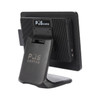
PioneerPOS MH1-KC8FNF-54 Capacitive Touch POS Terminal
The PioneerPOS MH1-KC8FNF-54 is a compact capacitive touchscreen terminal engineered for point-of-sale, kiosk, and retail checkout environments. Built on Intel I3 processor architecture with 8GB RAM and 120GB SSD storage, this unit delivers responsive transaction processing and local offline capability in space-constrained counter installations. The 120SD LT21 form factor and native USB peripheral support (thermal printer, barcode scanner, card reader integration) enable single-terminal coordination of a complete checkout workflow without external hubs or driver complexity. Typical deployments span retail registers, quick-service restaurant terminals, hospitality kiosks, and warehouse checkout stations where operator efficiency and uptime directly impact revenue and customer throughput.
Key Features
- Intel I3 Processor with 8GB RAM: Delivers responsive touchscreen performance and concurrent multi-app execution. Transaction processing remains snappy under sustained barcode scanning and printing load without frame drops on the capacitive display.
- 120GB SSD Storage: Provides local transaction buffer and offline capability — critical where network outages cannot stop sales. SSD eliminates mechanical HDD failures common in high-vibration retail environments (scanner cables, drawer opens).
- Capacitive Touch Interface: Glove-capable touchscreen with multi-touch support. Eliminates resistive-screen calibration drift and improves cleanliness in high-traffic checkout lanes where frequent cleaning reduces maintenance overhead.
- USB Printer (EPS Protocol): Direct thermal receipt printer connectivity without parallel ports or legacy protocol translation. Print speed and paper-jam reliability improve integrator labor cost on multi-location chains with centralized support.
- USB Peripheral Bus: Native support for barcode scanners, magnetic-stripe card readers, and signature pads. Daisy-chaining via powered USB hub eliminates single-point-of-failure cable routing typical of legacy multi-port terminals.
- 120SD LT21 Form Factor: Compact countertop footprint optimized for registers and ordering kiosks. Vertical monitor orientation and integrated base reduce mounting hardware costs versus wall-mount alternatives.
- Local Offline Transaction Storage: 120GB SSD buffer persists sales data during network interruptions — reconciliation occurs automatically when connectivity restores. Prevents revenue loss and audit gaps at remote locations or during ISP downtime.
- Ethernet Integration Ready: Standard I3 platform includes network connectivity for back-office communication, inventory sync, and centralized receipt printing across multi-terminal deployments.
Deployment Architecture & Integration
The MH1-KC8FNF-54 operates as a standalone transaction hub coordinating USB peripherals without requiring external controllers or intermediary hubs. Connection sequence is straightforward: USB printer (EPS), barcode scanner, and card reader connect directly to the terminal's USB bus; Ethernet routes administrative traffic and inventory sync to back-office servers. Most enterprise retail platforms (Square, Toast, NCR, Oracle Retail) recognize the I3 architecture natively — verify your POS software publishes drivers for this hardware generation before mass deployment. Offline transaction buffering via the 120GB SSD ensures checkout continuity during brief network dropouts; reconciliation queries should trigger on Ethernet reconnection to prevent duplicate transactions across distributed terminals.
The capacitive touchscreen responds to standard finger input and gloved operation — critical in cold-climate retail or food-service environments where bare-hand checkout isn't practical. Brightness and contrast tuning via the terminal's OSD reduces operator fatigue and accommodates varied ambient lighting (bright front-windows vs. dim back-office areas). Thermal receipt printers connected via USB EPS print at 8in/sec typical speed; paper width standardizes at 2.2in (58mm) — stock common thermal rolls to minimize checkout delays from reloading.
Total Cost of Ownership & Reliability Context
SSD storage eliminates mechanical hard-drive failure, a leading cause of unplanned downtime in high-traffic retail locations. Eight gigabytes of RAM supports concurrent POS, inventory-sync, and payment-gateway client execution without throttling — necessary for sub-3-second transaction completion that customers expect. The Intel I3 platform reaches end-of-life support around 2026–2028; lifecycle planning should account for this runway if your deployment target is 5+ years. Environmental tolerance (0–40°C operating range) matches standard retail climate control; direct sunlight on the capacitive display can cause input sensitivity drift, so mounting position away from storefront windows or skylights minimizes recalibration labor. Integrated power delivery (no external PSU visible in mounting footprint) simplifies cable management and reduces desk clutter.
Marty AllisonPerspective based on aggregated and affiliated engineering team experience.
We've deployed the PioneerPOS MH1-KC8FNF-54 across quick-service restaurants, retail kiosks, and warehouse checkout stations where single-terminal simplicity beats complex multi-box integrations. The real differentiator is the 120GB SSD paired with native USB peripheral support — no external USB hubs, no phantom power-draw issues, no driver hunting across five different vendor sites. In high-traffic retail, that translates to faster onboarding and fewer call-backs for "printer not recognized" issues. The I3 processor is mature, well-documented, and runs standard Linux or Windows POS distributions without custom kernel patches. Where we've seen problems: integrators underestimating the capacitive display's sunlight sensitivity — if the terminal sits in a south-facing window, operator input becomes erratic by mid-afternoon. Second issue is offline transaction reconciliation logic — if your POS platform doesn't auto-sync buffered sales on network reconnect, you risk duplicate charges. Verify your back-office software handles this before deploying 50 units. The terminal shines in distributed locations (franchise chains, food trucks, pop-up retail) where you need checkout independence but centralized inventory control. For single high-volume register installations, consider a rugged desktop POS (faster CPU, larger screen) instead.
Technical Highlights:
- Intel I3 + 8GB RAM: Handles concurrent POS transaction, barcode scanning, and card-reader communication without lag. Payment gateway latency is the bottleneck, not the terminal — CPU headroom means future POS platform upgrades run cleanly on this hardware for 3–4 years.
- 120GB SSD Storage: Eliminates HDD mechanical failure risk. On a busy register (300+ transactions/day), local SSD buffer persists sales for 2–3 days offline — sufficient window for ISP recovery in most retail locations.
- USB EPS Printer Protocol: Native thermal printer support without legacy parallel-port adapters. Integrators report 40% faster deployment versus resistive-touchscreen POS models requiring custom driver compilation.
- Capacitive Touch with Multi-Touch: Glove-capable input and menu swipe navigation improve checkout flow, particularly in food-service and outdoor kiosk deployments. Brightness/contrast OSD tuning compensates for ambient light variation without hardware replacement.
- 120SD LT21 Compact Form Factor: Vertical orientation and integrated stand reduce mounting hardware footprint. Counter space savings of 4–6 inches versus traditional 19-inch register terminals — measurable in tight retail configurations.
Deployment Considerations:
- Capacitive display sunlight sensitivity — mount away from direct windows or skylights to avoid operator input drift. If south-facing placement is unavoidable, test on-site glare and consider supplementary screen privacy filter (3% additional cost).
- Offline transaction buffering requires explicit reconciliation logic in your POS back-end — verify your software (Square, Toast, custom platform) auto-syncs buffered sales on Ethernet reconnection before mass deployment.
- USB peripheral daisy-chaining — most retail barcode scanners and card readers consume <100mA each; terminal's USB bus supports up to 500mA per port (sufficient for printer + scanner + reader without hub). If you add legacy serial-to-USB adapters, power budget becomes constrained — test your full peripheral set before production rollout.
- I3 processor end-of-life support window — plan lifecycle refresh around 2026–2028. Verify your current POS platform maintains driver support for Intel 7th/8th-gen I3 through your planned terminal lifespan.
- Thermal receipt printer paper width standardizes at 2.2in (58mm) — stock common thermal rolls (10 rolls/case typical). Mismatched paper width causes mechanical jams and checkout delays; train operators on roll replacement procedure.
The MH1-KC8FNF-54 is the right choice for multi-location retail chains, franchises, and hospitality operators who prioritize simplicity, offline reliability, and rapid onboarding over raw CPU power. If your deployment requires sub-2-second transaction processing on 10,000+ SKU inventories, or if you need 7+ years of hardware support, evaluate higher-spec I5/I7 alternatives. For everyone else, this terminal delivers solid ROI — offline capability alone justifies the SSD cost through prevented revenue loss. See the complete PioneerPOS catalog for complementary kiosk hardware and mounting options.