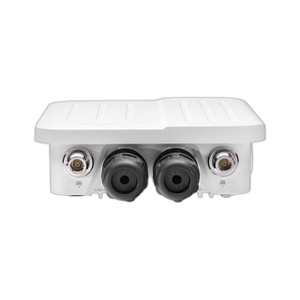
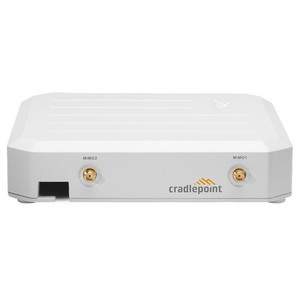
Cradlepoint TAA-BE01-1850-5GC-GN 5G Wideband Adapter
Overview
The Cradlepoint TAA-BE01-1850-5GC-GN is a managed 5G wideband adapter designed to integrate cellular backhaul with existing wired network infrastructure. This unit provides secure remote connectivity and failover WAN redundancy for branch offices, temporary sites, and distributed endpoints. TAA compliance means you can procure this device for government and federal integrations without procurement complications—a real advantage if your customer base includes public sector or NDAA-sensitive environments.
The TAA-BE01-1850-5GC-GN operates as a standalone gateway, supporting LTE, 4G, and 5G transmission with 3.4 GBps modem throughput. That throughput capacity is useful when you need to absorb cellular bandwidth without becoming the bottleneck in your failover chain. The 2.5G Ethernet data link protocol support means you're not constrained by legacy 1G Ethernet speeds—important if your primary WAN is already 2.5G or faster and you want failover to match, not degrade, throughput symmetry.
Key Features
- 5G/LTE/4G Multi-Band Support: The adapter supports LTE, 4G, and 5G transmission, letting you leverage the fastest available cellular network in any given location. In areas with mature 5G infrastructure, you'll see lower latency and higher throughput than LTE alone. In remote or rural branches still on LTE, failover still works—you're not locked into 5G-only coverage.
- 3.4 GBps Modem Throughput: This is the theoretical maximum data rate the modem can process. For branch failover, it means the adapter won't be the limiting factor if your circuit is under 3 Gbps, which covers most mid-market WAN scenarios. Useful when you're sizing redundancy for offices with multiple gigabit connections.
- 2.5G Ethernet Interface: Standard 1G Ethernet would cap your failover speed at 1 Gbps, even if the modem can handle more. The 2.5G interface removes that cap, letting you preserve throughput parity between primary and backup links. Matters most if your primary connection is already 2.5G or higher.
- Managed Gateway Operation: The device integrates into your network management frameworks, enabling remote monitoring and policy control across distributed endpoints. You can configure failover rules, monitor cellular link quality, and adjust settings without visiting the site—standard practice for branch deployments but worth confirming your NMS supports SNMP or API polling.
- Desktop and Wall-Mounted Deployment Options: Flexible installation accommodates both small office layouts (desktop) and rack/wall-mounted infrastructure. Desktop deployment is easier for proof-of-concept or temporary failover installations; wall-mounting saves floor space in permanent branch setups.
- TAA Compliance: Trade Agreements Act compliance removes procurement friction for government, federal, and NDAA-sensitive customers. If your integrations cross into the public sector, this certification is essential—it's not a performance feature, but it's a deal enabler for a significant buyer class.
Integration & Compatibility
The TAA-BE01-1850-5GC-GN integrates as a standard gateway endpoint and works with common network management platforms. Managed operation supports both standalone deployments and multi-site management across distributed branches. Confirm your network management stack (Cradlepoint NetCloud, third-party NMS, or cloud-based SD-WAN platforms) supports this model's management API or SNMP MIBs before final procurement.
Because this is a cellular adapter, provisioning includes SIM card activation and carrier configuration—a step many IT teams overlook in their deployment timeline. Coordinate with your cellular carrier to confirm 5G, 4G, and LTE band support in the regions where your branches operate. Coverage maps from carriers are notoriously optimistic; real-world testing before permanent installation is common practice.
When to Choose a Different Model
If your failover requirement is for small offices with 1G Ethernet infrastructure and sub-1 Gbps circuit speeds, a lower-cost 1G Ethernet variant may suffice and reduce capex. If your use case is primary WAN (not failover), consider whether a higher-throughput Cradlepoint model with redundant cellular modems fits your availability requirements better. Consult with your Cradlepoint integrator on the full product family before final selection.
Frequently Asked Questions
Q: Is the TAA-BE01-1850-5GC-GN compliant with TAA and NDAA Section 889?
A: Yes, TAA compliance is explicit in the model designation. NDAA Section 889 applicability depends on your specific customer's regulatory obligations; confirm with your compliance team whether this classification is sufficient for your government contracts.
Q: What's the warranty on the TAA-BE01-1850-5GC-GN?
A: Warranty information is not provided in the product evidence. Contact your Cradlepoint distributor or the manufacturer for warranty details and support terms.
Q: Can I use the TAA-BE01-1850-5GC-GN for primary WAN, or is it failover-only?
A: The unit is designed for both primary WAN and failover deployments. Its 2.5G Ethernet and 3.4 GBps modem throughput support primary circuit speeds for mid-market and enterprise branches. Configuration and SLA expectations depend on your carrier and site design.
Q: What SIM card types does the TAA-BE01-1850-5GC-GN support?
A: SIM support details are not specified in the available product documentation. Consult your Cradlepoint sales engineer or the manufacturer to confirm SIM form factors and carrier compatibility for your region.
Q: Do I need a separate power supply, or does it support PoE?
A: Power and PoE information is not included in the product evidence. Confirm with Cradlepoint whether the TAA-BE01-1850-5GC-GN requires external power or supports 802.3at/802.3bt PoE.
Ted PerryPerspective based on aggregated and affiliated engineering team experience.
The TAA-BE01-1850-5GC-GN is a straightforward play for branch-office failover in government-eligible and NDAA-sensitive deployments. The 3.4 GBps modem throughput and 2.5G Ethernet interface tell you that Cradlepoint intended this as a proper throughput peer to modern WAN links, not a lowest-common-denominator failover adapter. That matters if your branches are already running 2.5G or faster circuits—you won't degrade to 1G on failover.
Technical Highlights:
- 2.5G Ethernet Interface: Eliminates throughput asymmetry between primary and failover links. If your primary is 2.5G, your backup won't bottleneck at 1G. Real cost in redundancy design—most branch routers still ship with 1G, so this forces you to upgrade the primary WAN port too.
- 3.4 GBps Modem Throughput: Theoretical maximum, but useful for sizing. Most 5G branches won't saturate this in practice, but it means the modem itself isn't the constraint. LTE and 4G fallback still works in coverage gaps, so you're not betting on 5G-only availability.
- TAA Compliance Built-in: No procurement delays for government customers. The model number itself flags compliance—saves your sales team and the customer's procurement team a round of certification chasing.
Deployment Considerations:
- SIM provisioning and carrier configuration are not simplified by the device—you're coordinating with your cellular carrier independently. Plan 2–3 weeks for SIM activation and band confirmation across your deployment footprint.
- Power and PoE support are not documented in the available specs. Before final design, confirm whether this adapter requires dedicated AC/DC power or can run on PoE from your branch router. That decision cascades into your branch network design.
- Management integration depends on your existing NMS or SD-WAN platform. Confirm API support and SNMP MIB availability with your Cradlepoint integrator before procurement—standalone gateway mode is default, but managed failover policies require your management stack to support it.
Position the TAA-BE01-1850-5GC-GN for federal and public-sector branch offices that need 2.5G failover symmetry and can't procure non-TAA adapters. For commercial branches with 1G Ethernet, consider the cost-benefit of the 2.5G interface—if primary is 1G and likely to stay that way, the overhead of 2.5G infrastructure might not justify the capex. Testing 5G/4G coverage at candidate branch locations before design finalization is non-negotiable.