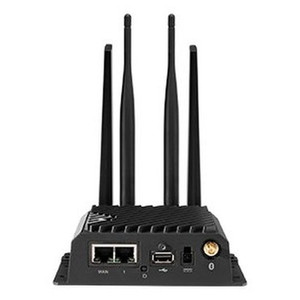
Cradlepoint TAA-MAA5-0920-C7A-NA R920 Wireless Router
Overview
The Cradlepoint TAA-MAA5-0920-C7A-NA R920 is a desktop WWAN wireless router purpose-built for remote sites, field deployments, and network locations where cellular failover or primary mobile connectivity is the design requirement. It bridges 3G and 4G cellular networks with Wi-Fi 6 (802.11ax) and Gigabit Ethernet, making it suitable for security integrators deploying camera systems at unstaffed locations, IT teams managing branch-office redundancy, and warehouse automation engineers wiring IoT endpoints across distributed sites. The TAA-compliant variant meets federal procurement standards (NDAA Section 889), eliminating compliance risk for government contracts and regulated-sector integrations.
Key Features
- WWAN Modem with 300 Mbps Throughput: The embedded cellular modem delivers up to 300 Mbps transmission across 3G and 4G networks, sufficient for real-time video streaming from remote cameras or continuous sensor telemetry without requiring terrestrial broadband — critical when fiber or cable is unavailable or prohibitively expensive to deploy.
- Wi-Fi 6 (802.11ax) Radio: Native Wi-Fi 6 support improves spectral efficiency and throughput density compared to older Wi-Fi 5 routers, reducing latency for connected devices and supporting higher client counts without crowding the available bandwidth — valuable in warehouse or multi-building campuses where dozens of mobile devices and IoT sensors are active simultaneously.
- Gigabit Ethernet Connectivity: Wired LAN ports support standard Gigabit speeds, allowing direct connection to IP cameras, NVRs, access control panels, and other fixed infrastructure without bottlenecking at Fast Ethernet (100 Mbps) limits — ensures your hardwired surveillance or automation backbone runs at line rate.
- 8GB Flash Storage: Onboard flash memory provides space for device firmware, configuration backups, and cached logs without relying on external storage or cloud sync, reducing operational complexity in air-gapped or high-latency environments where continuous cloud connectivity is not guaranteed.
- Embedded Bluetooth: Integrated Bluetooth enables wireless pairing and management of compatible mobile devices for on-site configuration and diagnostics, reducing the need for physical access or direct IP connectivity during initial deployment and troubleshooting cycles.
- Desktop Form Factor: Compact, fixed-location design suits rack, shelf, or wall-mounted placement in equipment rooms or network closets; no outdoor enclosure required, so installation cost stays low compared to industrial-grade outdoor cellular gateways.
Deployment & Integration
The R920 is designed for integrators and IT architects managing multi-site networks where terrestrial connectivity is unreliable, cost-prohibitive, or absent. Pair it with network video recorders or IP cameras at remote branch locations to achieve cellular-backed surveillance with automatic failover. In warehouse automation, use the R920 as the primary gateway for IoT scanners, conveyors, and access-control readers that require redundant connectivity. The TAA-compliant SKU (TAA-MAA5-0920-C7A-NA, often searched as TAA MAA5 0920 C7A NA) is mandatory for federal GSA Schedule bids, Department of Defense projects, and any procurement requiring NDAA Section 889 certification — verify your integrator or reseller carries the TAA variant to avoid contract rejection at award time.
When to Choose a Different Model
If your site has stable, high-speed terrestrial broadband, a traditional wireless router without embedded WWAN will be more cost-effective and simpler to manage. If you need industrial-grade outdoor placement with extended temperature or humidity ratings, consider a ruggedized cellular gateway or industrial IoT edge appliance in the broader network infrastructure family. The R920 is a desktop device; outdoor weather protection requires a separate weatherproof enclosure, adding cost and complexity.
Frequently Asked Questions
Q: Is the TAA-MAA5-0920-C7A-NA eligible for federal GSA contracts?
A: Yes. The TAA-compliant variant meets NDAA Section 889 procurement requirements and is eligible for federal schedules. Confirm your purchase order specifies the TAA model to ensure compliance.
Q: Can the R920 connect to both cellular and Ethernet simultaneously?
A: Yes. The R920 supports simultaneous WWAN and Gigabit Ethernet connections. You can configure it for primary/failover or load-balancing depending on your network policy.
Q: What is the maximum number of Wi-Fi clients the R920 supports?
A: The product documentation does not specify a hard client limit. For precise capacity planning, contact the manufacturer or your systems integrator to test under your specific device types and traffic profile.
Q: Does the R920 require a separate SIM card for cellular connectivity?
A: Yes. The embedded modem requires a compatible SIM card (3G/4G) from your cellular carrier. Confirm carrier and plan compatibility before deployment.
Q: What power input does the R920 require?
A: The product documentation does not specify power consumption or input voltage. Consult the datasheet or your integrator to confirm power requirements for your installation environment.
Ted PerryPerspective based on aggregated and affiliated engineering team experience.
The TAA-MAA5-0920-C7A-NA R920 fills a specific niche that desktop-only, non-cellular routers cannot: sites where terrestrial broadband is absent or fails regularly, and federal procurement rules demand a NDAA Section 889–compliant device. The 300 Mbps WWAN throughput is adequate for single-camera remote sites or low-bandwidth branch offices, but expect real-world cellular variability to reduce peak throughput 20–40% depending on signal strength and network congestion. Deploy this carefully if your design calls for multi-stream 4K camera failover; the bottleneck will be the SIM card's plan and tower load, not the router.
Technical Highlights:
- Wi-Fi 6 (802.11ax) Radio: Improves spectral efficiency and client density over Wi-Fi 5, reducing latency in warehouse environments with dozens of mobile scanners or IoT sensors. Backward compatible with older Wi-Fi 4 and Wi-Fi 5 devices, so legacy hardware won't fail.
- Gigabit Ethernet Ports: Wired LAN runs at full 1000 Mbps, eliminating the throughput ceiling imposed by Fast Ethernet. If your NVR or access-control panel supports Gigabit, the R920 will not bottleneck hardwired infrastructure.
- 8GB Flash Storage: Adequate for firmware and configuration snapshots in air-gapped or intermittently connected sites. No reliance on cloud sync or continuous uplink for basic operation.
- TAA Compliance: The -C7A-NA suffix ensures NDAA Section 889 eligibility, eliminating legal risk on federal contracts. Non-TAA models may not be procurement-eligible; order the TAA variant explicitly.
Deployment Considerations:
- The R920 is desktop-form-factor only; outdoor environments require a separate weatherproof enclosure, which adds cost and increases installation complexity. If the site demands true outdoor placement, a ruggedized industrial cellular gateway may be a better long-term choice.
- Cellular throughput will vary dramatically with tower proximity, weather, and network load. A 300 Mbps spec is theoretical peak; real deployments typically see 50–150 Mbps depending on signal and plan type. If your design margins are tight, include a terrestrial backup or test on-site before final commissioning.
- The TAA-MAA5-0920-C7A-NA requires a compatible SIM card from your cellular provider. Confirm 3G/4G support and data plan allocation before purchase; legacy 2G networks are being decommissioned, which will break older SIM cards.
Position the R920 for remote branch surveillance (single or dual-camera sites), warehouse IoT failover, and federal contracts where TAA compliance is non-negotiable. It is not a high-throughput edge appliance; use it where simplicity and regulatory clearance matter more than peak bandwidth.