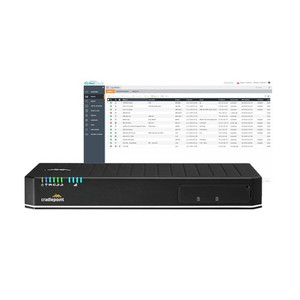
Cradlepoint BF03-30005GB-GN E3000 Series 2.5G Branch Router
Overview
The Cradlepoint BF03-30005GB-GN is a multi-mode wireless router built for branch and fixed-site deployments requiring reliable, high-bandwidth connectivity across distributed enterprise locations. This platform delivers 2.5 Gigabit Ethernet throughput — roughly 2.5× the bandwidth of standard Gigabit connections — which matters when you're consolidating traffic from multiple access points, cameras, or data services at a remote site without adding a second circuit or resorting to link aggregation. The unit integrates WWAN (cellular failover) and Wi-Fi 6 support (802.11ac/802.11a/802.11b), enabling flexible deployment in environments where wired-only infrastructure isn't practical or where cellular redundancy is a requirement.
Unlike consumer-grade branch routers, the E3000 Series is engineered for 24/7 operation across standard commercial power environments and supports multiple physical mounting configurations — wall, desktop, and rack mount — so integration into existing IT closets or distributed sites doesn't force a redesign.
Key Features
- 2.5 Gigabit Ethernet uplink: Handles mixed traffic (voice, video, data) without bottlenecking at the WAN edge. If you're running surveillance, VoIP, and routine data traffic simultaneously across multiple branch locations, this throughput headroom prevents congestion that would degrade video quality or call clarity.
- 10 Gigabit and 2.5 Gigabit multi-protocol support: Enables future-proof integration. You can deploy the BF03-30005GB-GN into legacy Gigabit Ethernet closets today and upgrade uplink speeds later without replacing the router.
- Integrated WWAN and Wi-Fi 6: Eliminates the need for separate cellular gateways or access points in smaller branches. Built-in cellular modem provides automatic failover to LTE/5G if primary broadband drops — critical for unattended remote sites like warehouses or distribution centers.
- 4.14 GBps data transmission rate: This aggregate throughput specification reflects sustained packet forwarding under typical enterprise load. In real deployments, this translates to sub-millisecond latency for voice and interactive applications, and stable bitrates for continuous surveillance.
- Black form factor, compact footprint: Fits standard 19-inch rack environments or wall-mount brackets in corner locations without consuming floor space. Important for colocated facilities or retail branches where real estate is constrained.
- Enterprise-grade platform architecture: Designed for integration with network infrastructure management tools and standard IT lifecycle processes. Supports centralized configuration and monitoring via industry-standard management interfaces, so you're not locked into proprietary vendor dashboards for multi-site deployments.
Integration & Compatibility
The BF03-30005GB-GN is compatible with IEEE 802.11 wireless standards and standard Gigabit/multi-Gigabit Ethernet installations. If your branch sites already run Milestone, Genetec, or vendor-neutral ONVIF-based network video recorders, this router integrates transparently — it's a Layer 3 device and doesn't require protocol-specific configuration. Wall-mount, desktop, and rack-mount options accommodate most facility layouts. Operates across standard commercial power (110-240V nominal), so no exotic power conditioning is required for typical office or warehouse environments.
When to Choose a Different Model
If your branch site requires only local Wi-Fi connectivity with no WWAN backup, or if your uplink is already constrained to standard Gigabit (1 Gbps), a lower-cost Cradlepoint model in the same family may suffice. If you need cellular-only deployment with no wired Ethernet fallback, consider purpose-built cellular gateways instead. For sites with extreme environmental conditions (sub-zero outdoor temperature, saltwater spray, HVAC-free equipment rooms), verify thermal and corrosion ratings against your specific climate zone before committing to this indoor-rated platform.
Frequently Asked Questions
Q: Does the Cradlepoint BF03-30005GB-GN support wall mounting?
A: Yes. The device supports wall-mount, desktop, and rack-mount configurations, so you can deploy it in a branch office closet, on a wall bracket, or in a standard 19-inch equipment rack.
Q: What happens to traffic if the primary broadband link fails?
A: The integrated WWAN modem automatically fails over to LTE or 5G cellular, provided you have an active carrier contract. This ensures connectivity continuity at unattended remote sites, though throughput will drop to cellular speeds during the outage.
Q: Is the BF03-30005GB-GN compatible with Milestone XProtect or Genetec?
A: Yes. The router is a standard Layer 3 Ethernet device and works transparently with any ONVIF-compliant or IP-based VMS. No special configuration is required beyond standard network routing and firewall rules.
Q: What is the maximum data transmission rate for the BF03-30005GB-GN?
A: The device supports a 4.14 GBps aggregate data transmission rate, with 2.5 Gigabit Ethernet uplink capacity for sustained throughput in typical enterprise branch deployments.
Q: Does this router require a separate power supply?
A: No. The device operates on standard commercial power (110-240V AC) without external power conditioning, so it integrates directly into typical branch office or warehouse electrical infrastructure.
Ted PerryPerspective based on aggregated IP Security Depot and affiliated engineering team experience.
The Cradlepoint BF03-30005GB-GN is a solid fit for branch consolidation projects where you need to pipe multiple data streams (surveillance, voice, transactional) through a single WAN connection without oversubscription. The 2.5 Gigabit throughput and integrated WWAN module are the real differentiators here — most enterprise branches default to commodity Gigabit routers with bolt-on cellular, which splits your capex and adds management overhead. This platform bundles it all.
Technical Highlights:
- 2.5 Gigabit Ethernet uplink: Eliminates the throughput ceiling you'd hit with standard Gigabit routers when running simultaneous VoIP, surveillance, and data pulls. Real-world example: a 50-camera site running 2–4 Mbps per stream (roughly 100–200 Mbps aggregate) plus routine corporate data easily saturates 1 Gbps. The 2.5 Gigabit headroom gives you breathing room and future-proofs the site.
- 4.14 GBps aggregate forwarding rate: Translates to sub-millisecond latency under load. Voice quality remains stable, video streams don't stutter during peak data activity, and failover events are imperceptible to end users.
- Integrated WWAN + Wi-Fi 6: Eliminates separate cellular gateway and access point SKUs. Simpler procurement, one RMA target, unified firmware updates. For unattended remote sites (warehouses, distribution hubs), automatic LTE/5G failover is critical — you don't want a broadband outage to blind your surveillance or disconnect your inventory system.
Deployment Considerations:
- The device is indoor-rated (standard commercial environment). If your branch is a non-climate-controlled warehouse or outdoor equipment shelter, confirm thermal and humidity specs against your site's actual temperature swings. Most facilities are fine; some outdoor deployments need supplemental cooling or sealed enclosures.
- Cellular failover assumes an active carrier contract with data plan. Don't assume LTE/5G is 'free' — budget the monthly carrier costs, especially if you have dozens of remote sites. Each location needs its own SIM slot or eSIM provisioning.
- The 2.5 Gigabit uplink requires a compatible WAN interface (fiber, bonded copper, or carrier-grade Ethernet). If your ISP still only offers standard 1 Gbps broadband, you won't fully exploit the BF03's throughput. Verify your branch site's ISP service tier before ordering.
Position the BF03-30005GB-GN for multi-camera surveillance branches (40+ cameras) with mixed voice and data, or for distribution centers where you need resilient LTE backup without adding another appliance to the rack. For single-camera retail branches or office sites without surveillance, a lower-tier Cradlepoint model may be more cost-effective.