
Speco Technologies N128NR8TB vs Speco Technologies N128NR32TB: Specification Comparison
Both the N128NR8TB and N128NR32TB are Speco Technologies 128-channel 4K H.265 network video recorders targeting mid-to-large IP camera deployments. They share the same channel capacity, codec, resolution ceiling, and integrated analytics engine, making them direct cross-shop candidates. The primary differentiator is internal storage: 8TB versus 32TB. Secondary differences in PoE standard, resolution ceiling, and physical specs are also present and evaluated below.
In This Guide
- How do storage capacity and recording channel depth compare between the two NVRs?
- What are the PoE standard, physical footprint, and power requirements for each unit?
- How do the two NVRs compare on analytics capability, camera compatibility, and resolution support?
- Which should you choose: the N128NR8TB or the N128NR32TB?
- Side-by-Side Specs
- FAQ
How do storage capacity and recording channel depth compare between the two NVRs?
The N128NR8TB ships with 8TB of internal storage, while the N128NR32TB ships with 32TB — four times the onboard capacity. Both units support 128 IP camera channels simultaneously at 4K UHD resolution. For a 128-channel deployment recording at 4K with H.265 compression, storage depth directly determines retention period before overwrite; the 32TB model provides substantially longer local retention without adding external expansion. Neither spec sheet discloses maximum expandable storage or the number of HDD bays, so total expansion ceiling is not spec-confirmed for either model.
H.265 (HEVC) compression is confirmed on both units, and both also support H.264 as a fallback. The N128NR32TB spec sheet identifies the storage interface as Serial ATA, which is the only bay-level detail provided. Neither datasheet specifies RAID support or hot-swap capability.
What are the PoE standard, physical footprint, and power requirements for each unit?
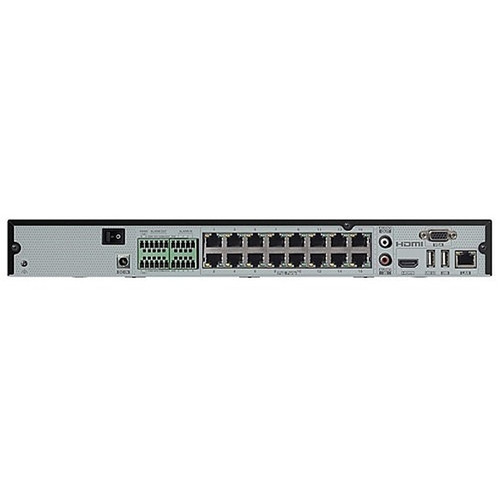
The N128NR8TB is specified with PoE+ (802.3at), which delivers up to 30W per port, accommodating higher-draw cameras such as PTZ units or multi-sensor heads. The N128NR32TB is specified with PoE (802.3af), which caps at 15.4W per port — sufficient for standard fixed cameras but potentially limiting for power-hungry devices. Neither datasheet specifies the total PoE power budget or the number of PoE ports, so per-switch aggregate wattage cannot be confirmed from provided specs.
Physical dimensions and weight are provided only for the N128NR32TB: 15" (W) × 2.83" (H) × 13.4" (D), 12 lbs gross. Both units include Rack as a listed mount type; the N128NR8TB additionally lists Wall, Ceiling, Pole, Pendant, and Corner mounts, suggesting a more flexible deployment envelope. The N128NR32TB specifies a 12VDC, 5A power supply; the N128NR8TB does not disclose power supply voltage or current draw in the provided specs.
How do the two NVRs compare on analytics capability, camera compatibility, and resolution support?
Both units include an onboard integrated analytics engine for on-device video processing. The N128NR8TB describes this as an 'onboard integrated engine'; the N128NR32TB describes it as an 'integrated video analytics engine' for 'event detection and response.' Neither spec sheet enumerates specific analytic functions (e.g., line crossing, intrusion, face detection), so depth of analytics capability cannot be compared from provided data.
Both units confirm ONVIF compliance, enabling third-party IP camera integration. The N128NR32TB additionally notes optimized discovery and installation for Speco IP cameras specifically. On resolution, the N128NR8TB lists a spec-level resolution of 5MP, while the N128NR32TB lists 16MP — a meaningful difference if the NVR's own resolution ceiling governs the maximum per-camera stream quality beyond the shared 4K UHD label. The N128NR8TB also specifies two-way audio with a built-in mic and WDR; the N128NR32TB confirms two-way audio but does not list a built-in mic or WDR in the provided specs. Frame rate is specified only for the N128NR32TB at 30fps; the N128NR8TB does not disclose a frame rate figure in the provided specs.
Which should you choose: the N128NR8TB or the N128NR32TB?
Our take: The N128NR32TB is the stronger choice when local storage retention and high-resolution camera support are the primary requirements. Its 32TB internal storage is four times that of the N128NR8TB's 8TB, directly extending on-device footage retention across 128 channels without immediate need for external expansion. Its listed resolution ceiling of 16MP also exceeds the N128NR8TB's stated 5MP spec, a meaningful advantage in deployments using high-megapixel cameras. Conversely, the N128NR8TB specifies PoE+ (802.3at) rather than the N128NR32TB's PoE (802.3af), making it the better fit where cameras or edge devices require up to 30W per port. The N128NR8TB also supports more flexible mounting options beyond rack. Buyers standardizing on Speco cameras who need maximum local retention should favor the N128NR32TB; installations with high-power-draw cameras on a tighter storage budget should evaluate the N128NR8TB.
Side-by-Side Comparison
Spec-for-spec, from manufacturer data.
| Specification | Speco Technologies N128NR8TB | Speco Technologies N128NR32TB |
|---|---|---|
| Channel Capacity | 128 channels | 128 channels |
| Video Resolution | 4K UHD | 4K UHD |
| Spec-Level Resolution | 5MP | 16MP |
| Video Codec | H.265; H.264 | H.265 (HEVC); H.264 |
| Internal Storage | 8TB | 32TB |
| Storage Interface | — | Serial ATA |
| Analytics | Onboard integrated engine | Integrated video analytics engine |
| ONVIF | Yes | Yes |
| PoE Standard | PoE+ (802.3at) | PoE (802.3af) |
| Frame Rate | — | 30fps |
| Audio | Two-way; Built-in mic | Two-way |
| WDR | Yes | — |
| Mount Types | Wall; Ceiling; Pole; Pendant; Corner; Rack | Rack |
| Power Supply | — | 12VDC, 5A |
| Dimensions (W x H x D) | — | 15" x 2.83" x 13.4" |
| Warranty | 3-year | 3-year |
Frequently Asked Questions
Which should you choose: the N128NR8TB or the N128NR32TB?
The N128NR32TB is the stronger choice when local storage retention and high-resolution camera support are the primary requirements. Its 32TB internal storage is four times that of the N128NR8TB's 8TB, directly extending on-device footage retention across 128 channels without immediate need for external expansion. Its listed resolution ceiling of 16MP also exceeds the N128NR8TB's stated 5MP spec, a meaningful advantage in deployments using high-megapixel cameras. Conversely, the N128NR8TB specifies PoE+ (802.3at) rather than the N128NR32TB's PoE (802.3af), making it the better fit where cameras or edge devices require up to 30W per port. The N128NR8TB also supports more flexible mounting options beyond rack. Buyers standardizing on Speco cameras who need maximum local retention should favor the N128NR32TB; installations with high-power-draw cameras on a tighter storage budget should evaluate the N128NR8TB.
Is the N128NR8TB or N128NR32TB better for longer video retention on a 128-camera site?
The N128NR32TB is better for longer retention. It ships with 32TB of internal storage versus 8TB on the N128NR8TB — four times the onboard capacity. At equivalent recording settings across 128 channels at 4K with H.265, the N128NR32TB will store approximately four times as many hours of footage before overwrite. Neither spec sheet confirms maximum expandable storage, so the advantage for sites that cannot add external NAS or SAN is clearly with the N128NR32TB.
Can I connect PTZ cameras or high-power edge devices to either NVR's built-in PoE ports?
The N128NR8TB specifies PoE+ (802.3at), which supports up to 30W per port and is compatible with most PTZ cameras and higher-draw devices. The N128NR32TB specifies PoE (802.3af), which caps at 15.4W per port and may not supply enough power for PTZ cameras or multi-sensor units that require more than 15.4W. Neither datasheet discloses total PoE budget or number of PoE ports, so verify aggregate wattage with Speco before finalizing a design.
Do both NVRs support third-party IP cameras, or are they limited to Speco cameras?
Both units confirm ONVIF compliance, which enables integration with ONVIF-compliant third-party IP cameras. The N128NR32TB additionally notes optimized discovery and installation for Speco IP cameras. Neither datasheet lists specific third-party camera compatibility matrices or ONVIF profile levels (S, G, T), so confirm profile support with Speco for cameras outside their own lineup.
More NVR Comparisons
- Speco Technologies N128NR vs Speco Technologies N128NR32TB
- Speco Technologies N128NR vs Speco Technologies N128NR128TB
- Speco Technologies N128NR32TB vs Speco Technologies N128NR128TB
- Speco Technologies N128NR160TB vs Speco Technologies N128NR
- Speco Technologies N128NR160TB vs Speco Technologies N128NR32TB
- Speco Technologies N128NR30TB vs Speco Technologies N128NR
Get a Second Opinion on Your Camera Choice
Share your site layout, coverage goals, and budget. Our team will validate the camera selection, flag anything we would change, and recommend products that match the use case.