
Speco Technologies N128NR80TB vs Speco Technologies N128NR: Specification Comparison
Both the Speco Technologies N128NR80TB and N128NR are 128-channel 4K H.265 NVRs designed for large-scale IP camera deployments in commercial and enterprise physical-security installations. They share the same channel capacity, codec support, ONVIF compliance, and rack-mount form factor, making them direct cross-shop candidates. The key differentiators are storage architecture—pre-populated 80TB versus user-configured SATA bays—maximum resolution ceiling, analytics specificity, and warranty coverage, all of which carry real weight for integrators sizing a deployment.
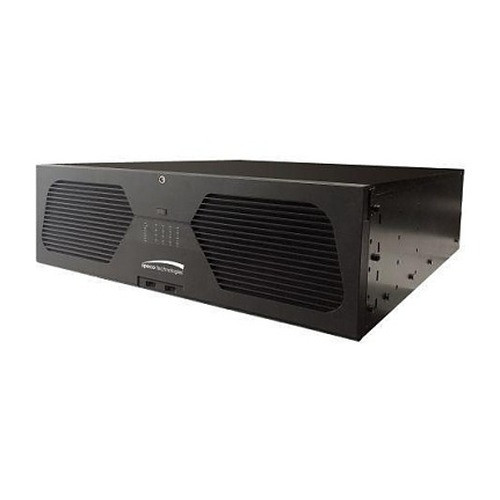
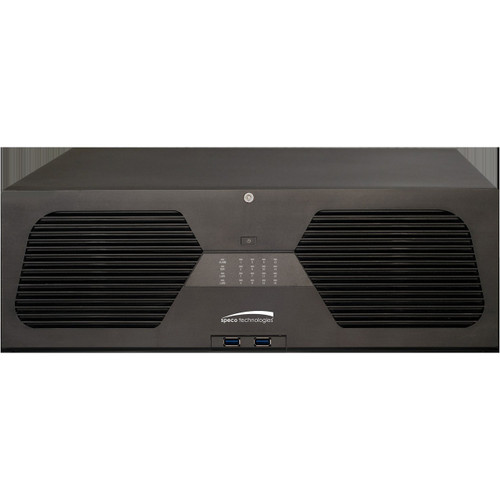
In This Guide
- How do the storage architecture and recording capacity differ between the N128NR80TB and N128NR?
- Which NVR supports higher camera resolution and more specific embedded analytics?
- How do warranty coverage, environmental ratings, and camera compatibility compare?
- Which should you choose: the N128NR80TB or the N128NR?
- Side-by-Side Specs
- FAQ
How do the storage architecture and recording capacity differ between the N128NR80TB and N128NR?
The N128NR80TB ships with 80TB of built-in storage, meaning the integrator receives a deployment-ready appliance with no additional drive procurement required. The spec does not disclose the number of drive bays or whether the 80TB is expandable beyond the factory configuration.
The N128NR provides 16 SATA HDD bays populated by the installer. This architecture gives the buyer direct control over drive brand, capacity tier, and total storage ceiling—up to whatever density 16 bays will accept with current HDD technology—but requires separate drive procurement, pricing, and installation labor.
For deployments where budget certainty and fast commissioning are priorities, the N128NR80TB's pre-configured 80TB reduces variables. For sites that need to right-size storage to a specific retention policy or expect future capacity growth beyond 80TB, the N128NR's 16-bay open architecture is the more flexible platform. Neither spec discloses RAID level, hot-swap capability, or expansion port availability.
Which NVR supports higher camera resolution and more specific embedded analytics?
The N128NR is specified at a maximum resolution of 20MP (2592×1944), while the N128NR80TB lists 4K/16MP as its resolution ceiling. Both units support H.265 (HEVC) and H.264 compression at up to 30fps across all 128 channels.
On analytics, the N128NR enumerates three discrete engine types in its spec: line crossing detection, license plate recognition (LPR), and vehicle detection. The N128NR80TB describes its analytics as 'integrated video analytics with event detection' without naming specific algorithm types. Neither spec discloses whether analytics run on-device or are camera-side, nor whether additional analytics modules are licensable.
For deployments requiring confirmed LPR or vehicle-classification workflows—parking enforcement, perimeter access, fleet monitoring—the N128NR's named analytics provide spec-level assurance the N128NR80TB does not currently offer. For general motion-event recording at 4K, both units are rated equivalent on codec and frame rate.
How do warranty coverage, environmental ratings, and camera compatibility compare?
The N128NR80TB carries a 3-year warranty; the N128NR carries a 2-year warranty. This one-year difference is material for total-cost-of-ownership calculations in enterprise procurement and may affect service-contract structuring.
The N128NR specifies an operating temperature range of 14°F to 122°F (−10°C to 50°C). The N128NR80TB does not list an operating temperature in the provided spec data, which is a gap integrators should resolve with Speco before deploying in unconditioned spaces.
Both units are specified as ONVIF compliant and share the same PoE (802.3af) power input notation, audio input, IR/Day-Night notation, and EZ-Record/EZ-Copy/EZ-Search workflow features. Two-way audio is explicitly confirmed only for the N128NR; the N128NR80TB lists audio input but does not specify two-way capability. Both accept the same bundle IDs (21279, 21287, 7004, 21286), suggesting shared accessory compatibility.
Which should you choose: the N128NR80TB or the N128NR?
Our take: The N128NR80TB is the stronger choice when the deployment prioritizes storage certainty and longer warranty coverage, while the N128NR is the stronger choice when maximum resolution headroom, named analytics (LPR, vehicle detection), and storage flexibility matter most. Concrete spec deltas: the N128NR supports 20MP versus the N128NR80TB's 16MP ceiling; the N128NR80TB includes 80TB ready-to-record storage versus the N128NR's drive-less 16-bay chassis; and the N128NR80TB holds a 3-year warranty versus the N128NR's 2-year term. Platform qualifier: integrators standardizing on license plate recognition or vehicle-detection workflows should select the N128NR based on its named analytics spec; integrators who need a commissioning-ready appliance with predictable storage cost should favor the N128NR80TB, provided the unlisted operating-temperature spec is confirmed with Speco before deployment.
Side-by-Side Comparison
Spec-for-spec, from manufacturer data.
| Specification | Speco Technologies N128NR80TB | Speco Technologies N128NR |
|---|---|---|
| Channel Capacity | 128 channels | 128 channels |
| Max Resolution | 16MP (4K) | 20MP (2592×1944, 4K) |
| Video Codec | H.265, H.264 | H.265, H.264 |
| Frame Rate | 30fps | 30fps |
| Storage Architecture | 80TB built-in | 16 SATA HDD bays (drives not included) |
| Storage Capacity | 80TB | User-configured via 16 bays |
| Embedded Analytics | Event detection (type unspecified) | Line crossing, LPR, vehicle detection |
| Two-Way Audio | — | Yes |
| Audio Input | Yes | Yes |
| ONVIF Compliance | Yes (Profile S and T) | Yes |
| PoE Input | PoE (802.3af) | PoE (802.3af) |
| Mount Type | Rack | Rack |
| Operating Temperature | — | 14°F to 122°F (−10°C to 50°C) |
| Warranty | 3-year | 2-year |
| Housing Color | White | White |
| IR / Day-Night | IR | IR / Day-Night |
Frequently Asked Questions
Which should you choose: the N128NR80TB or the N128NR?
The N128NR80TB is the stronger choice when the deployment prioritizes storage certainty and longer warranty coverage, while the N128NR is the stronger choice when maximum resolution headroom, named analytics (LPR, vehicle detection), and storage flexibility matter most. Concrete spec deltas: the N128NR supports 20MP versus the N128NR80TB's 16MP ceiling; the N128NR80TB includes 80TB ready-to-record storage versus the N128NR's drive-less 16-bay chassis; and the N128NR80TB holds a 3-year warranty versus the N128NR's 2-year term. Platform qualifier: integrators standardizing on license plate recognition or vehicle-detection workflows should select the N128NR based on its named analytics spec; integrators who need a commissioning-ready appliance with predictable storage cost should favor the N128NR80TB, provided the unlisted operating-temperature spec is confirmed with Speco before deployment.
Is the N128NR80TB or N128NR better for larger deployments that may need to expand storage over time?
The N128NR is better suited for storage expansion planning because its 16 SATA HDD bays allow the installer to add or swap drives as retention requirements grow. The N128NR80TB ships with a fixed 80TB configuration, and its spec does not confirm whether additional bays or expansion ports are available beyond the factory build.
Does either NVR support license plate recognition out of the box?
Based on the provided specifications, only the N128NR explicitly lists license plate recognition (LPR) as a named embedded analytic alongside line crossing and vehicle detection. The N128NR80TB describes its analytics as 'integrated video analytics with event detection' but does not name LPR as a supported function in the available spec data.
Which unit has the longer warranty, and does it matter for service contract planning?
The N128NR80TB carries a 3-year warranty versus the N128NR's 2-year warranty. For enterprise procurement and service-level agreement structuring, the additional year of manufacturer coverage on the N128NR80TB can reduce the cost or duration of supplemental service contracts, making it a relevant differentiator in total-cost-of-ownership comparisons.
More NVR Comparisons
- Speco Technologies N128NR vs Speco Technologies N128NR32TB
- Speco Technologies N128NR vs Speco Technologies N128NR128TB
- Speco Technologies N128NR32TB vs Speco Technologies N128NR128TB
- Speco Technologies N128NR160TB vs Speco Technologies N128NR
- Speco Technologies N128NR160TB vs Speco Technologies N128NR32TB
- Speco Technologies N128NR30TB vs Speco Technologies N128NR
Get a Second Opinion on Your Camera Choice
Share your site layout, coverage goals, and budget. Our team will validate the camera selection, flag anything we would change, and recommend products that match the use case.