
i-PRO S85702-F3L vs i-PRO S85702-F3L1: Specification Comparison
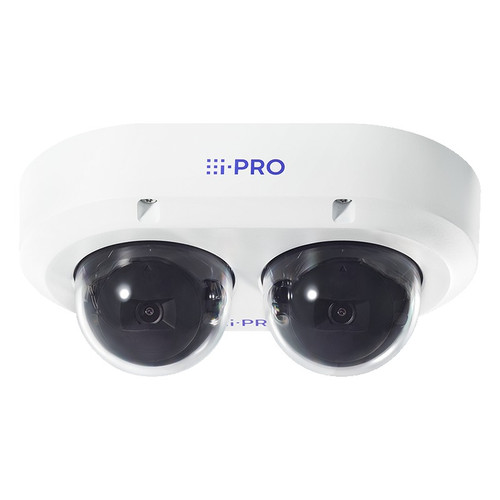
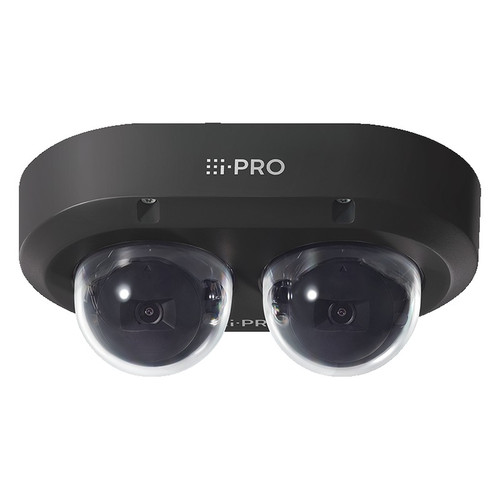
Both the i-PRO WV-S85702-F3L and WV-S85702-F3L1 are outdoor dual-sensor fixed-lens dome cameras sharing the same 2×8MP (16MP combined) resolution class, the same Ambarella CV2 SoC, and the same general physical form factor. A buyer evaluating either unit for perimeter coverage or infrastructure surveillance would legitimately cross-shop these two models. The comparison below examines where the specifications converge and where they diverge across imaging, installation, and integration dimensions, drawing exclusively from the provided spec data.
In This Guide
How do the imaging specs compare?
Both cameras share an identical imaging core: dual 1/2.8-inch CMOS sensors with a 5.56 mm(H) × 3.13 mm(V) scanning area, a fixed 3.1 mm lens yielding 104° horizontal and 56° vertical field of view, a maximum aperture of f/1.4, and a minimum focus distance of 3 m. Both deliver 3840×2160 resolution at 30 fps via H.265/H.264/MJPEG, achieve 120 dB dynamic range (Super Dynamic level 31), and reach a minimum illumination of 0.05 lux in B&W with IR. The Ambarella CV2 SoC drives identical DORI distances: Detect 60 m, Observe 24 m, Recognize 12 m, Identify 6 m. IR range is 40 m at 30 IRE / 30 m at 50 IRE on both units. The F3L1 spec sheet explicitly notes 4-step adjustable IR output; the F3L spec does not call out step-count for IR adjustment.
Noise reduction, gain control (AGC 0–11), digital zoom (up to 6× at 640×360), image rotation (0°/90°/180°/270°), privacy masking (8 zones), VIQS (8 zones), BLC/HLC (0–31), fog compensation (0–8 levels), and adaptive black stretch (0–255) are specified identically for both models. The F3L1 lists additional resolution sub-modes explicitly: 2560×1440, 1920×1080, and 1280×720 alongside the 3840×2160 maximum; the F3L spec only lists 3840×2160 in the H.265/H.264/MJPEG row, though sub-modes are not stated to be absent. In practice the optical and sensor performance is identical by spec.
What about installation and environment?
Environmental ratings are identical: IP67/IP66 (IEC 60529), Type 4X (UL50E), NEMA 4X compliant, IK10 impact resistance (IEC 62262), wind resistance up to 40 m/s (~89 mph), NEMA TS 2 (2.2.7–2.2.9), and an anti-condensation Temish element. Both share the same operating humidity (10–100%, no condensation) and the same powered operating temperature floor of −20°C, with the storage/unpowered floor at −40°C. Power is PoE+ (IEEE 802.3at) at 18.9 W on both; the F3L spec additionally lists DC 54 V as an alternative power source, while the F3L1 spec lists PoE+ only. Both carry identical safety certifications: UL/c-UL (UL62368-1 / CSA C22.2 No.62368-1), CE, IEC62368-1, and identical EMC marks (FCC Part 15 Class A, ICES-003 Class A, EN55032 Class A, EN55035).
Dimensions and mass are identical: 250 mm(D) × 150 mm(W) × 105 mm(H), approximately 1.8 kg. The pan/tilt/yaw adjustment envelope differs slightly in how it is expressed: the F3L states Horizontal ±230°, Vertical +10° to +105°, Yaw ±90°; the F3L1 states Horizontal −50° to +230°, Vertical +10° to +105°, Yaw ±90°. The numerical range is the same (460° total horizontal travel); the F3L1 simply states it as an absolute range rather than a ±value. The finish differs: the F3L is aluminum die cast with stainless steel and PC resin; the F3L1 is aluminum die cast black with stainless steel screws. The F3L1 housing is black; both are listed as Housing Color: White in the attribute fields — the finish description for the F3L1 says 'aluminum die cast black,' which conflicts with the White housing-color attribute. Installers should verify final color with the distributor.
Which fits your VMS and analytics better?
Both cameras support ONVIF Profiles G, M, S, and T; 24 simultaneous users; FIPS 140-2 Level 3; HTTPS; 802.1X; and brute-force protection. Supported protocols are identical (IPv6, TCP/IP, UDP/IP, HTTP, HTTPS, SSL/TLS, SMTP, DNS, NTP, SNMPv1/v2/v3, DHCPv6, RTP, MLD, ICMP, ARP, IEEE 802.1X, DiffServ, LLDP, MQTT). AI analytics are identical in both specs: AI motion, face, people, vehicle, and occupancy detection, plus sound classification for gunshot, yell, vehicle horn, and glass break. Alarm sources (3 terminals, VMD, SCD, command, audio detection) and alarm actions (email, HTTP, TCP notification, SD recording) match on both models. Edge storage is compatible with microSD/SDHC/SDXC up to 512 GB on both, though the F3L1 specifies a minimum card size of microSD 2 GB and microSDHC 4–32 GB more explicitly.
Audio transmission mode is where a functional difference appears: the F3L specifies 'Interactive (Full duplex)' only, while the F3L1 lists 'Off / Mic / Audio Out / Half Duplex / Full Duplex,' providing explicit half-duplex and output-only modes that give integrators more flexibility. The F3L1 also specifies audio output level (−20 dBV) while the F3L does not. The F3L lists 3× 3.5 mm stereo mini jack audio inputs; the F3L1 also lists 3× 3.5 mm stereo mini jack inputs. GUI languages: the F3L explicitly names 9 languages (English, Italian, French, German, Spanish, Portuguese, Russian, Chinese, Japanese); the F3L1 states '9 languages' without listing them. Browser support (Edge, Firefox, Chrome) and mobile compatibility (iOS 8.0+, Android) are identical.
Which should you choose: the S85702-F3L or the S85702-F3L1?
Our take: The WV-S85702-F3L1 is the stronger choice when audio mode flexibility matters or when the integrator requires an explicitly black housing finish, while the WV-S85702-F3L is preferable when a DC 54 V backup power feed is needed alongside PoE+. Three concrete spec deltas: (1) Power — the F3L supports both PoE+ (IEEE 802.3at) and DC 54 V; the F3L1 spec lists PoE+ only, offering no stated DC alternative. (2) Audio transmission — the F3L1 provides five selectable modes (Off / Mic / Audio Out / Half Duplex / Full Duplex) versus the F3L's single Interactive Full Duplex mode, giving the F3L1 greater intercom/PA flexibility. (3) IR output control — the F3L1 explicitly specifies 4-step adjustable IR output; the F3L does not state a step count. All other imaging, environmental, analytics, codec, and VMS-integration specs are identical by the provided data. Select based on your site's power infrastructure and audio architecture requirements.
Side-by-Side Comparison
Spec-for-spec, from manufacturer data.
| Specification | i-PRO S85702-F3L | i-PRO S85702-F3L1 |
|---|---|---|
| Resolution (per sensor) | 8MP (3840×2160) | 8MP (3840×2160) |
| Total / Combined Resolution | 16MP (2×8MP) | 16MP (2×8MP) |
| Image Sensor | 2× 1/2.8-in CMOS | 2× 1/2.8-in CMOS |
| Lens / Focal Length | 3.1 mm fixed, 104° H × 56° V, f/1.4 | 3.1 mm fixed, 104° H × 56° V, f/1.4 |
| Minimum Illumination | 0.05 lux (B&W, IR LED) | 0.05 lux (B&W with IR) |
| IR Range | 40 m @ 30IRE / 30 m @ 50IRE | 40 m @ 30IRE / 30 m @ 50IRE; 4-step adjustable output |
| Dynamic Range (WDR) | 120 dB max (Super Dynamic On, Level 31) | 120 dB max (Super Dynamic On, Level 31) |
| Max Frame Rate | 30 fps | 30 fps |
| Video Compression | H.265, H.264, MJPEG | H.265, H.264, MJPEG |
| IP / Dust-Water Rating | IP67/IP66, NEMA 4X | IP67/IP66, NEMA 4X |
| Impact Rating | IK10 (IEC 62262) | IK10 (IEC 62262) |
| Operating Temperature | −20 to +60 °C (powered); −40 °C storage | −20 to +60 °C (powered); −40 °C storage |
| Power Input | PoE+ (IEEE 802.3at) or DC 54 V; 18.9 W | PoE+ (IEEE 802.3at) only; 18.9 W |
| Audio Transmission Mode | Interactive (Full duplex) | Off / Mic / Audio Out / Half Duplex / Full Duplex |
| Edge Storage | microSDXC up to 512 GB | microSD 2 GB – microSDXC 512 GB |
| ONVIF Profiles | G / M / S / T | G / M / S / T |
| AI Analytics | Motion, face, people, vehicle, occupancy; gunshot, yell, horn, glass break | Motion, face, people, vehicle, occupancy; gunshot, yell, horn, glass break |
| Housing Finish / Color | Aluminum die cast, stainless steel, PC resin; White | Aluminum die cast black, stainless steel screws; White (attribute) / Black (finish description — verify with supplier) |
| Dimensions | 250 mm(D) × 150 mm(W) × 105 mm(H) | 250 mm(D) × 150 mm(W) × 105 mm(H) |
| Weight | Approx. 1.8 kg | Approx. 1.8 kg |
| Warranty | 3-year | 3-year |
Frequently Asked Questions
Which should you choose: the S85702-F3L or the S85702-F3L1?
The WV-S85702-F3L1 is the stronger choice when audio mode flexibility matters or when the integrator requires an explicitly black housing finish, while the WV-S85702-F3L is preferable when a DC 54 V backup power feed is needed alongside PoE+. Three concrete spec deltas: (1) Power — the F3L supports both PoE+ (IEEE 802.3at) and DC 54 V; the F3L1 spec lists PoE+ only, offering no stated DC alternative. (2) Audio transmission — the F3L1 provides five selectable modes (Off / Mic / Audio Out / Half Duplex / Full Duplex) versus the F3L's single Interactive Full Duplex mode, giving the F3L1 greater intercom/PA flexibility. (3) IR output control — the F3L1 explicitly specifies 4-step adjustable IR output; the F3L does not state a step count. All other imaging, environmental, analytics, codec, and VMS-integration specs are identical by the provided data. Select based on your site's power infrastructure and audio architecture requirements.
Is the S85702-F3L or S85702-F3L1 better for low-light performance?
By the provided specifications, both cameras are identical in low-light performance: each uses dual 1/2.8-inch CMOS sensors, achieves a minimum illumination of 0.05 lux in B&W with IR, delivers 120 dB dynamic range at Super Dynamic level 31, and has an IR range of 40 m at 30 IRE / 30 m at 50 IRE. The F3L1 spec explicitly notes 4-step adjustable IR output intensity; the F3L spec does not state a step count for IR adjustment. Neither model holds a measurable low-light advantage based on the available data.
Can either camera run on DC power instead of PoE?
Only the WV-S85702-F3L explicitly lists DC 54 V as an alternative power source in addition to PoE+ (IEEE 802.3at) at 18.9 W. The WV-S85702-F3L1 spec lists PoE+ (IEEE 802.3at) at 18.9 W only — no DC voltage input is stated. If your installation requires a DC backup or primary DC feed, the F3L is the supported choice based on the provided specifications.
Do these cameras support two-way audio and intercom setups equally?
No. The WV-S85702-F3L1 lists five audio transmission modes — Off, Mic, Audio Out, Half Duplex, and Full Duplex — giving integrators the option to configure one-way monitoring or half-duplex intercom as well as full duplex. The WV-S85702-F3L specifies only 'Interactive (Full duplex).' Both cameras share the same audio I/O hardware (3.5 mm stereo mini jack input, 3.5 mm mono jack output, 600 Ω), but the F3L1 offers broader mode configurability for intercom or PA applications based on the stated specs.
Get a Second Opinion on Your Camera Choice
Share your site layout, coverage goals, and budget. Our team will validate the camera selection, flag anything we would change, and recommend products that match the use case.