
i-PRO S4576LMA vs Pelco SRXF3-12360-ES: Specification Comparison
Both the i-PRO WV-S4576LMA and the Pelco SRXF3-12360-ES are 12MP outdoor fisheye dome cameras designed for 360-degree panoramic surveillance in commercial and industrial environments. This comparison covers the imaging performance, environmental and installation characteristics, and VMS/analytics integration of two PoE-powered fixed fisheye cameras in the same resolution class — giving installers and IT buyers a spec-driven basis for choosing between the i-PRO and Pelco platforms.
In This Guide
How do the imaging specs compare?
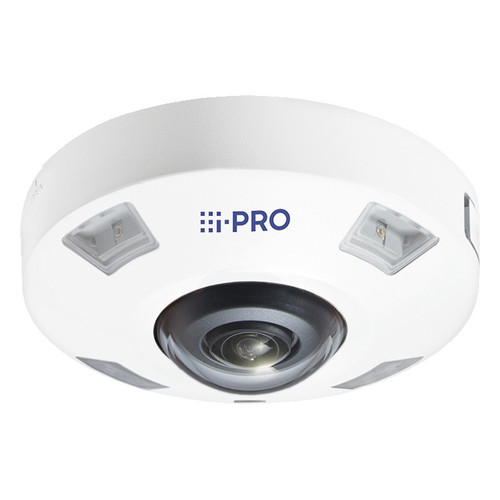
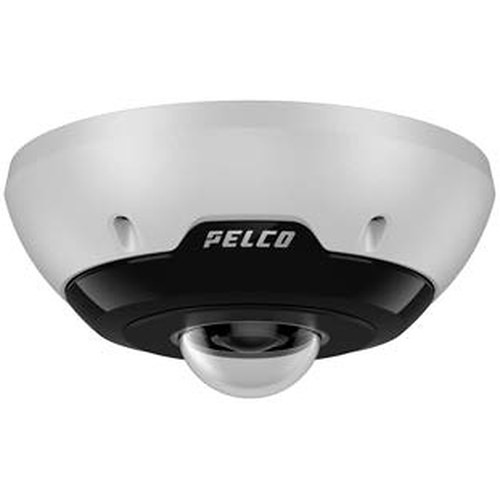
The i-PRO WV-S4576LMA uses an approximately 1/2-type 12MP CMOS sensor with a 1.4 mm focal length lens at f/1.9 aperture, delivering a 183° horizontal and vertical fisheye field of view at up to 2992×2992 resolution and 30 fps. Its minimum illumination is specified at 0.3 lx (color) and 0.04 lx (B&W), supported by a built-in 14-meter IR LED array and an Ambarella CV22 SoC. Dynamic range reaches a specified maximum of 84 dB with Wide Dynamic Range enabled at level 31. The Pelco SRXF3-12360-ES uses a 2.7 mm lens at f/2.5 (with a separately listed aperture of F2.0, which is inconsistent in the provided spec sheet), covering 180°/360° at a maximum resolution of 3840×2160 and a frame rate of only 12.5 fps at full resolution. Pelco specifies a minimum illumination of 0.10 lux and WDR up to 83 dB; no IR illuminator is listed.
For low-light performance, the i-PRO's 0.04 lx B&W threshold with active IR at 14 meters is a concrete advantage over the Pelco's 0.10 lux figure, which has no IR assist specified. The i-PRO's 30 fps at full fisheye resolution versus the Pelco's 12.5 fps is a significant gap for motion-sensitive applications. The Pelco's 2.7 mm focal length is longer than the i-PRO's 1.4 mm, which may affect dewarped image quality, though the Pelco's listed 3840×2160 maximum output dimension differs from the native 12MP fisheye array — the actual sensor size and type are not specified in the provided Pelco data.
What about installation and environment?
Both cameras carry an IP66 ingress protection rating and an IK10 impact resistance rating, and both are rated for an operating temperature range of -40°C to +60°C. The i-PRO WV-S4576LMA additionally holds IP66 per IEC 60529, NEMA 4X per UL50, Type 4X per UL50, and an IK10 shock resistance of 50J per IEC 60068-2-75. It also carries EN45545 and EN50155-TX railway compliance and specifies wind resistance up to 40 m/s (approx. 89 mph). The Pelco SRXF3-12360-ES adds an IP67 rating (immersion to 1 meter) not listed for the i-PRO. The i-PRO also incorporates an anti-condensation Rosahl element, which is not mentioned for the Pelco.
On power, the i-PRO WV-S4576LMA operates on DC 12V or PoE per IEEE 802.3af (PoE Class 0), making it compatible with standard PoE switches. The Pelco SRXF3-12360-ES requires PoE+ (IEEE 802.3at, PoE Class 3), demanding a PoE+ capable switch or injector and drawing more switch-port budget. Mounting options for the i-PRO are specified as wall and ceiling; the Pelco spec sheet lists wall, ceiling, pole, pendant, and corner mounting options, offering greater installation flexibility. The i-PRO dimensions are ø154 mm × 60.3 mm (H); the Pelco dimensions are 6" × 6" × 2.81". The Pelco weight is listed as approximately 1.001 kg (2.21 lb) with wall mount; the i-PRO mass is approximately 880 g (1.94 lbs).
Which fits your VMS and analytics better?
The i-PRO WV-S4576LMA supports ONVIF Profiles G, M, S, and T, while the Pelco SRXF3-12360-ES supports ONVIF Profile S and Profile T. The i-PRO's Profile G support enables standardized on-camera recording management, and Profile M adds metadata streaming for analytics interoperability — neither is listed for the Pelco. Both cameras support on-board microSD storage. For audio, the i-PRO provides a 3.5 mm stereo mic/line input with plug-in power, a 3.5 mm audio output, and configurable volume levels; the Pelco spec notes microphone support but does not specify connector type, impedance, or output capability in the provided data.
For edge analytics, the i-PRO offers AI-VMD, AI People Counting for 360° fisheye, AI Privacy Guard for 360° fisheye, AI Scene Change Detection, AI Sound Classification (gunshot, yell, vehicle horn, glass break), and video motion detection across 4 areas — all running on the onboard Ambarella CV22 SoC. The Pelco SRXF3-12360-ES lists Pelco Smart Analytics with 8 behavior detection modes, but the specific behavior types are not enumerated in the provided spec data. The i-PRO also provides 3 alarm inputs and 1 alarm output on external I/O terminals; external I/O terminal specifications are not listed for the Pelco. Both cameras support HTTPS encryption and H.264 video compression; H.265 is specified for the i-PRO but is not confirmed in the Pelco's primary spec fields (the Pelco compression field in the raw data lists both H.265 and H.264, but the camera's primary spec sheet entry lists only H.264 — buyers should verify directly with Pelco).
Which should you choose: the S4576LMA or the SRXF3-12360-ES?
Our take: The WV-S4576LMA is the stronger choice when low-light performance, higher frame rates, and deep AI analytics integration are the primary requirements. Three concrete spec deltas stand out: the i-PRO's minimum illumination of 0.04 lx (B&W) with a built-in 14-meter IR array versus the Pelco's 0.10 lux with no IR illuminator specified; the i-PRO's 30 fps at full fisheye resolution versus the Pelco's 12.5 fps; and the i-PRO's ONVIF Profile G and M support versus the Pelco's Profile S and T only, which matters for VMS-agnostic on-camera recording and metadata streaming. The i-PRO also runs on standard 802.3af PoE (Class 0), reducing infrastructure cost compared to the Pelco's PoE+ (Class 3) requirement. The Pelco SRXF3-12360-ES may be the appropriate choice for installations already standardized on the Pelco/VideoXpert VMS ecosystem, where Pelco Smart Analytics integration is a platform requirement or where IP67 immersion rating is specifically needed.
Side-by-Side Comparison
Spec-for-spec, from manufacturer data.
| Specification | i-PRO S4576LMA | Pelco SRXF3-12360-ES |
|---|---|---|
| Resolution | 12MP (2992×2992 fisheye) | 12MP (3840×2160 max) |
| Image Sensor | Approx. 1/2-type 12MP CMOS | Not specified |
| Focal Length | 1.4 mm | 2.7 mm |
| Max Aperture | f/1.9 | f/2.5 (F2.0 also listed — inconsistent in provided spec) |
| Field of View | 183° H × 183° V | 180° / 360° |
| Max Frame Rate | 30 fps | 12.5 fps (full resolution) |
| Min Illumination | 0.3 lx color / 0.04 lx B&W | 0.10 lux |
| IR Illuminator | Built-in, 14 m range | Not specified |
| WDR / Dynamic Range | Max. 84 dB (WDR On, level 31) | WDR, up to 83 dB |
| Video Compression | H.265, H.264 | H.264 (H.265 unconfirmed in primary spec) |
| Power Input / PoE Class | DC 12V or PoE IEEE 802.3af (Class 0) | PoE+ IEEE 802.3at (Class 3) |
| IP Rating | IP66, NEMA 4X, Type 4X | IP66, IP67 |
| Impact Rating | IK10 (50J, IEC 60068-2-75) | IK10 |
| Operating Temperature | -40°C to +60°C | -40°C to +60°C |
| ONVIF Profiles | G, M, S, T | S, T |
| Edge Analytics | AI-VMD, People Counting, Privacy Guard, Scene Change Detection, Sound Classification (4 types) | Pelco Smart Analytics, 8 behaviors (types not specified) |
| Audio | 3.5 mm mic/line input; 3.5 mm audio output | Microphone supported (connector/output not specified) |
| Edge Storage | microSD | microSD |
| External I/O | 3× Alarm IN, 1× Alarm OUT, 1× AUX OUT | Not specified |
| Dimensions | ø154 mm × 60.3 mm (H) | 6" × 6" × 2.81" |
| Weight | Approx. 880 g (1.94 lbs) | Approx. 1.001 kg (2.21 lbs) with wall mount |
| Warranty | 5-Year | 5-Year |
Frequently Asked Questions
Which should you choose: the S4576LMA or the SRXF3-12360-ES?
The WV-S4576LMA is the stronger choice when low-light performance, higher frame rates, and deep AI analytics integration are the primary requirements. Three concrete spec deltas stand out: the i-PRO's minimum illumination of 0.04 lx (B&W) with a built-in 14-meter IR array versus the Pelco's 0.10 lux with no IR illuminator specified; the i-PRO's 30 fps at full fisheye resolution versus the Pelco's 12.5 fps; and the i-PRO's ONVIF Profile G and M support versus the Pelco's Profile S and T only, which matters for VMS-agnostic on-camera recording and metadata streaming. The i-PRO also runs on standard 802.3af PoE (Class 0), reducing infrastructure cost compared to the Pelco's PoE+ (Class 3) requirement. The Pelco SRXF3-12360-ES may be the appropriate choice for installations already standardized on the Pelco/VideoXpert VMS ecosystem, where Pelco Smart Analytics integration is a platform requirement or where IP67 immersion rating is specifically needed.
Is the WV-S4576LMA or SRXF3-12360-ES better for low-light and nighttime coverage?
The WV-S4576LMA specifies a minimum illumination of 0.04 lx in B&W mode and includes a built-in 14-meter IR LED array, enabling near-zero-light operation without external illuminators. The SRXF3-12360-ES specifies 0.10 lux minimum illumination and does not list any built-in IR illuminator in the provided specifications. For unlit or dimly lit environments, the i-PRO has a measurable advantage on both sensitivity and active IR reach.
Which camera needs less from my network switch — the i-PRO or the Pelco?
The i-PRO WV-S4576LMA operates on standard IEEE 802.3af PoE (Class 0), which is supported by virtually all current managed and unmanaged PoE switches. The Pelco SRXF3-12360-ES requires IEEE 802.3at PoE+ (Class 3), which draws up to 30W per port and requires a PoE+ capable switch or injector. If your switch infrastructure is 802.3af-only, only the i-PRO is compatible without additional hardware.
Will either camera work with a non-manufacturer VMS through ONVIF?
Both cameras declare ONVIF compliance. The i-PRO WV-S4576LMA supports ONVIF Profiles G, M, S, and T, covering recording management (G), metadata/analytics (M), streaming (S), and H.264/H.265 media (T). The Pelco SRXF3-12360-ES supports ONVIF Profile S and Profile T per the provided specifications. For VMS platforms that rely on Profile G for edge recording management or Profile M for analytics metadata, only the i-PRO lists those profiles.
Get a Second Opinion on Your Camera Choice
Share your site layout, coverage goals, and budget. Our team will validate the camera selection, flag anything we would change, and recommend products that match the use case.