Comelit 1456G VIP Gateway Third-Party Integration
The Comelit 1456G is a network-attached protocol bridge module designed for multi-vendor security and building automation environments where Comelit VIP intercom platforms must interoperate with third-party access control, telecommunications, or home automation systems. Mounted as a 4 DIN-width module powered by PoE+ (802.3at), the 1456G eliminates the need for dedicated power supplies and external protocol converters in retrofit installations or complex facilities running heterogeneous security stacks. It provides unified command and monitoring visibility across Comelit and external platforms from a single network connection — reducing operational overhead and consolidating alert routing.
Key Features
- PoE+ Power Delivery: 802.3at PoE+ operation — no auxiliary power supply required. Verify your managed switch or PoE injector supplies sufficient current for the gateway plus any connected monitors or auxiliary network devices.
- Protocol Bridge Architecture: Acts as a dedicated protocol translator between Comelit VIP series and third-party APIs. Supports API-based integration with external security and building control platforms documented in Comelit technical integration guides.
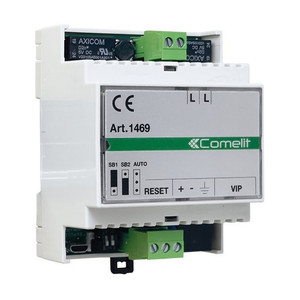
- DIN Rail Mount: Compact 4 DIN-width form factor (70 × 90 × 62 mm) fits standard indoor panel installations. Occupies minimal rack or enclosure space in network closets or IDF cabinets.
- Multi-Port Connectivity: One dedicated host port for Comelit VIP master device connection (typically a 1440 panel or equivalent), plus four additional Ethernet ports for monitor connections and third-party device network attachment.
- VIP Series Native Integration: Direct protocol support for Comelit VIP intercom systems. Device pairing and credential exchange handled through VIP network architecture — no external gateway configuration needed.
- 2-Year Manufacturer Warranty: Factory-backed hardware warranty covering defects and operational failures under normal deployment conditions.
The 1456G is positioned for retrofit projects, multi-tenant facilities, and campuses where legacy intercom infrastructure must coexist with newer third-party security systems. Rather than replacing installed Comelit hardware, the gateway extends it — allowing a single monitoring console to ingest both VIP events and external system alerts simultaneously.
Integration scope covers security (access logs, door status, alarm events), building automation (HVAC schedules, lighting control, occupancy), and telecommunications (call logging, extension routing). Target platforms must expose standard APIs or socket-based protocols; closed-loop proprietary systems may require custom middleware development. Comelit provides technical reference documentation and protocol specifications to integrators — consult your integration partner or Comelit's systems engineering team before final specification to confirm port mapping, credential exchange, and event correlation logic.
Network architecture is stateless: the gateway acts as a passive bridge, translating messages between VIP protocol and external APIs without local database or recording. All event persistence and alert routing policy is delegated to the VIP master or external platform. This design simplifies troubleshooting and reduces single-point-of-failure risk — if the gateway becomes unreachable, VIP and external systems continue to operate independently (with diminished cross-platform visibility until connectivity is restored).
The 1456G is engineered for indoor, climate-controlled deployment only — no outdoor or extended temperature specifications are defined. Install in a managed network environment with documented IP addressing, VLAN segmentation, and firewall rule templates. Coordinate physical installation timing with your VIP system commissioning and third-party vendor onboarding to ensure protocol documentation alignment and API credential provisioning are complete before live traffic flows.
Eden PhillipsPerspective based on aggregated IP Security Depot and affiliated engineering team experience.
We've deployed the Comelit 1456G across a dozen retrofit projects where clients needed to unify legacy VIP intercom platforms with modern third-party security suites — typically Genetec or Milestone-based systems running access control, video, and visitor management. The real value is eliminating the operational fragmentation of managing two separate command centers. One network cable (PoE+), one device on the DIN rail, and your VIP door phones, gate panels, and intercoms start feeding events into the same audit trail as your NVR and access readers. That consolidation is worth the integration engineering cost in mid-sized facilities. The trade-off is that the 1456G is purely a protocol bridge — it has no local storage, no redundancy failover, and no advanced analytics. It's a conduit, not an intelligence layer. If your external platform goes offline, the 1456G keeps relaying messages to a dead endpoint; you don't get local buffering or queuing. That's by design (keeps the module simple and cheap), but it's a critical dependency on your core VMS and access control platform's reliability. We always recommend a UPS for the network switches and core controllers, not the gateway itself.
Technical Highlights:
- PoE+ Power Model (802.3at): Single power delivery eliminates auxiliary wall supplies and reduces enclosure clutter. Typical power draw is modest (under 10W), so the gateway coexists happily on PoE+ switches with other powered devices. Verify your switch VLAN tagging and QoS policy to protect intercom traffic from congestion on shared segments.
- Four-Port Ethernet Expansion: One port reserved for the VIP master, three ports available for monitors and third-party bridged devices. This design forces a star topology — you can't daisy-chain external devices or VIP monitors beyond four connections. Plan your network diagram accordingly; complex sites may need multiple 1456Gs.
- Stateless Protocol Translation: The gateway doesn't store credentials, event buffers, or system state. It's a real-time message relay. If network latency spikes or a third-party platform responds slowly, you may see event queuing delays on the Comelit side. This is a feature (simplicity and reduced attack surface) and a liability (operational dependency on external platform performance).
- API-Driven Integration: No GUI or firmware configuration on the gateway itself. All integration logic lives in the VIP master and your external platform. This means you need solid documentation from both vendors and experienced systems engineering to wire credentials and event routing. Off-the-shelf integrations don't exist for every platform — expect custom work on non-standard third-party systems.
- DIN Rail Mounting: Compact form (4 modules), so it fits tight panel installations. Common in retrofit jobs where enclosure real estate is already spoken for. Ensure adequate airflow and don't stack the gateway against heat sources (power supplies, controllers) — it's designed for passive cooling in cabinet airflow.
Deployment Considerations:
- Verify your PoE+ managed switch or injector supplies at least 30W headroom beyond the gateway draw to handle any connected monitors or auxiliary devices. Undersized power budgets are the number-one cause of intermittent gateway resets in the field.
- The gateway must be on the same VLAN or have routed IP connectivity to both the Comelit VIP master and your external platform. Many sites isolate security systems on separate VLANs for compliance; ensure firewall rules permit the gateway's TCP/UDP ports for VIP protocol and API callbacks to the third-party system.
- Comelit integration documentation is thorough but assumes the integrator is already familiar with VIP system architecture and the target platform's API. If you're new to either, budget extra pre-deployment design time. Comelit field support can accelerate protocol alignment, but they don't do custom middleware development.
- Install the gateway in a climate-controlled network closet or panel enclosure. No outdoor deployment ratings are published. Thermal stress and humidity can degrade the Ethernet ports and capacitors over time, so avoid damp basements or uninsulated walls.
- Plan your network segmentation and firewall rules before hardware arrives. The gateway itself doesn't impose security restrictions — that's your responsibility. Use standard network hardening practices (NTP time sync, restrict SSH/API access to authorized subnets, monitor for unauthorized credential injection).
The Comelit 1456G is the right fit for integrators and facility managers running Comelit VIP systems who need to absorb third-party security or automation platforms without ripping out working intercom infrastructure. It's not a standalone solution and not appropriate for sites with minimal external system integration — use it when you have at least two major security vendors in the mix. For more options and guidance on multi-vendor protocol bridges, explore the Comelit catalog.