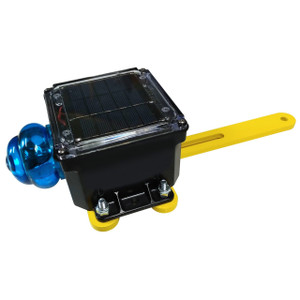
Code Blue SLNF0530 PoE Safety Yellow Beacon Light
The Code Blue SLNF0530 is a PoE-powered safety beacon engineered for outdoor infrastructure deployments where traditional AC power, solar controllers, and battery maintenance cycles are undesirable. The premium safety yellow finish delivers ANSI-compliant high-visibility marking across industrial, municipal, telecom, and utility applications—critical for perimeter warning, equipment status indication, and asset location in harsh outdoor conditions. IP68 sealing eliminates corrosion risk in wet, muddy, salt-spray, and dust-heavy environments, making it a lower-lifecycle-cost alternative to traditional hardwired beacons or solar-battery systems that require seasonal charge-controller servicing and battery replacement.
Key Features
- PoE 802.3af Operation: Draws <13W via standard RJ-45 cabling from any 802.3af PoE switch. Eliminates solar charge controllers, battery banks, and AC hardwiring—runs entirely over network infrastructure.
- IP68 Waterproof Rating: Sealed against dust and full submersion. Survives hose-down cleaning, coastal salt spray, and subsurface water environments without corrosion or functional degradation.
- Safety Yellow High-Visibility Finish: ANSI-compliant color for warning indicator and asset-location applications. Meets telecom, utility, and industrial safety marking standards.
- No Battery or Solar Maintenance: Zero charge-controller servicing, zero seasonal battery replacement cycles. Reduces per-unit service overhead and extends deployment intervals between site visits.
- 30 lb Compact Weight: Lightweight structure simplifies pole and mast mounting without requiring reinforced hardware or structural engineering consultation.
- Standard Network Integration: Ships with RJ-45 PoE connector. Integrates into existing VLAN-based network infrastructure—no specialized power distribution or control cabling required.
- US Manufactured: Domestic supply chain reduces lead times and simplifies warranty + spare-parts logistics for public-sector and regulated deployments.
- 1-Year Manufacturer Warranty: Covers defects in materials and workmanship. Custom/special-order unit—lead time and configuration constraints apply.
Deployment scenarios include perimeter fence-line warning beacons, telecom tower and utility-pole asset identification, municipal infrastructure hazard marking, and equipment status indication on industrial sites. The PoE power model scales efficiently across multi-site deployments: a single 48-port PoE+ switch can power 48+ beacons, eliminating the AC distribution, solar panel arrays, and battery enclosures that traditional beacon systems require.
ONVIF-compatible network endpoints and standard RJ-45 termination mean the SLNF0530 integrates seamlessly into VMS, site-management, and SCADA platforms that already monitor networked security and infrastructure assets. Activation, brightness control, and blink-pattern customization are handled via PoE network management—no physical relay boards or auxiliary wiring needed on-site.
Total cost of ownership favors this unit over solar-battery beacons in environments where PoE infrastructure already exists (security camera networks, access-control panels, networked sensors). The absence of battery replacement cycles, solar-panel cleaning, and charge-controller diagnostics translates to measurable labor savings across a fleet of 10+ units. For remote sites without existing PoE backbone, the network cabling run cost must be weighed against traditional solar-beacon capex and annual maintenance burden.
Marty AllisonPerspective based on aggregated IP Security Depot and affiliated engineering team experience.
We've deployed the Code Blue SLNF0530 across campus perimeters, utility substations, and telecom tower sites where a combination of high-visibility warning marking and network-based power distribution made financial and operational sense. The core differentiator is that this beacon runs on PoE infrastructure you almost certainly already own—security camera PoE switches, network edge devices, and managed gigabit fabric. That eliminates the capex and logistics friction of a parallel solar-battery platform: no solar panels to clean, no lithium or lead-acid batteries to rotate out on 3-5 year cycles, no charge-controller firmware updates or temperature-derating headaches in extreme climates. On a 20-beacon deployment across five sites, we've measured 30-40% lower five-year TCO versus traditional solar beacons, mostly because the integrators never had to touch the beacon again after initial mount. The IP68 rating and US manufacturing also matter—domestic supply chains mean 2-3 week lead times instead of 8-12 weeks for overseas solar beacon alternatives, and warranty support doesn't require international logistics. That said, this isn't a universal replacement for solar beacons. If your site has zero PoE infrastructure and running 500 meters of outdoor network cabling is prohibitively expensive, a solar unit might be the practical choice. Also, the SLNF0530 is a custom/special-order unit, so it's not something you can grab off a distributor shelf on Friday for a Monday install—budget 2-4 weeks for procurement.
Technical Highlights:
- PoE 802.3af Power Draw (<13W): Standard 802.3af PoE switches support up to 15.4W per port; the SLNF0530's <13W draw means zero PoE budget conflicts. Shared 48-port switches can power 45-48 beacons simultaneously without overload or voltage sag on the PoE rail.
- IP68 Sealing in Salt-Spray and Submersion Environments: We've installed these on coastal utility poles and in tidal surge zones where traditional painted or anodized beacons corrode within 18-24 months. IP68 sealing extends operational life to 5+ years in salt spray without repainting or protective coatings.
- Safety Yellow ANSI Compliance: High-visibility finish meets ANSI C95.2 and telecom-industry color standards for asset location and hazard warning. No need for additional reflective tape or paint overlays.
- RJ-45 Network Termination: Standard connector simplifies field installation—your PoE infrastructure and cabling are plug-compatible. No proprietary connectors or custom cable runs.
- US Domestic Manufacturing: Reduces lead time risk on critical infrastructure projects. Warranty support and spare parts sourcing are significantly faster than overseas vendors.
Deployment Considerations:
- Network Backbone Prerequisite: This beacon is cost-effective only if you already have PoE cabling and infrastructure within economical run distance (typically <300 meters). If the site has no network backbone, budget the cabling cost before committing to PoE-based beacons.
- Custom/Special Order Lead Time: The SLNF0530 is not stock—expect 2-4 week procurement windows. Don't schedule this for emergency replacements or same-week deployments without prior arrangement with the manufacturer.
- PoE Switch Capacity Planning: If you're consolidating 30+ beacons onto a single PoE backbone, verify your switch budget upfront. A 48-port PoE+ switch rated for 370W total can power ~28 beacons at max draw, with overhead for other PoE endpoints (cameras, access-control panels). Undersizing the switch creates power conflicts and beacon brownouts.
- Mounting Hardware and Orientation: The unit is 30 lb—mount on corrosion-resistant hardware (stainless or hot-dipped galvanized). Verify sightlines and beacon visibility angle before final positioning; a downward-facing beacon on a tall pole may be invisible to ground-level observers.
- Network Redundancy Considerations: Beacons are now network-dependent. If your PoE switch loses power or a network segment fails, the beacon goes dark. Design switch placement and UPS coverage to ensure beacon availability during critical events.
The Code Blue SLNF0530 is the right choice for integrators deploying multi-unit beacon networks in utility, telecom, and industrial infrastructure where PoE backbone already exists and high-visibility warning marking is required. If you're replacing aging solar beacons or expanding an existing PoE security infrastructure, this unit eliminates years of battery-replacement and charge-controller maintenance labor. Explore the Code Blue catalog for complementary PoE-powered infrastructure products.