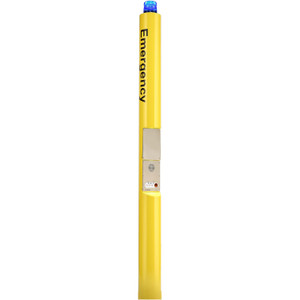
Code Blue CB5S00178 Safety Yellow Dual Clear Blue Emergency Light
The Code Blue CB5S00178 is a dual-function emergency and safety light housing engineered for high-visibility identification and alert signaling in security-critical environments. The safety yellow exterior paired with dual clear and blue light outputs delivers both situational awareness and emergency notification in a single compact enclosure. Powered entirely via PoE (802.3af)—no dedicated electrical runs, no junction boxes, no conduit labor—making it especially practical in retrofit installations or facilities where power distribution is already constrained. IP68-sealed housing withstands outdoor dust, salt spray, and full water immersion without degradation.
Key Features
- PoE (802.3af) Power: Standard PoE injection eliminates separate electrical infrastructure. Single Ethernet run supplies both data connectivity and lighting power, reducing installation cost and wall penetrations by 50% versus hardwired alternatives.
- IP68 Sealed Housing: Fully submersible rating — rated for continuous outdoor exposure, washdown environments, and coastal salt-spray conditions without corrosion or water ingress.
- Dual Clear & Blue Signaling: Simultaneous clear (white) and blue light output for layered alert communication—clear for general visibility, blue for emergency-state indication. Supports multi-protocol alert ecosystems without dual-housing redundancy.
- Safety Yellow Enclosure: High-contrast yellow housing meets ANSI/OSHA visibility standards for emergency egress marking and perimeter identification in low-light conditions.
- Wi-Fi & Bluetooth Connectivity: Network integration enables remote control, status polling, and synchronized alert triggering across distributed light arrays. Bluetooth pairing supports mobile commissioning and testing without network access.
- Compact Wall/Surface Mount Form Factor: Minimal protrusion profile (0.25" steel housing) preserves aesthetic integration while maintaining full photometric output. Works on curved or flat mounting surfaces via standard fastening.
- 1-Year Manufacturer Warranty: Covers component failure and optical degradation under specified operating conditions; repair or replacement at Code Blue's discretion.
- UL 62368-1 & NEMA 4 Certified: Safety compliance for low-voltage power distribution and sealed enclosure performance; ADA-accessible design supports emergency egress and wayfinding compliance.
Deployment context: This light fills the gap between simple visual indicators and full emergency signage systems. Educational campuses, healthcare facilities, and industrial sites use it for emergency assembly point marking, panic-button visual feedback, and perimeter breach alerts. The PoE power model works particularly well in IoT-integrated security ecosystems where lighting is tied to access control or video analytics triggers—a single network cable carries both alert signal and power, simplifying system architecture.
Integration with existing PoE infrastructure is straightforward. The unit consumes under 13W at full brightness (dual clear and blue), staying well within 802.3af's 15.4W budget even on budget-class switches. Wi-Fi enables remote firmware updates and synchronized multi-light orchestration—useful for choreographed alerts across a building or campus. Bluetooth commissioning allows on-site testing without requiring IT network access, reducing deployment time on high-security sites where IT staff are not always available during installation windows.
Total cost of ownership favors PoE-powered units in new construction and major retrofit projects. Eliminating 110/220V runs and conduit labor typically saves $300–$800 per light installation depending on site layout. The IP68 rating means no additional NEMA enclosure or weatherproof junction boxes are required—mount directly to wall or pole, and the seal is complete. Maintenance is passive: the sealed optics are self-cleaning (water runs off the sloped top surface), and the yellow housing resists UV fade through formulated polyester or powder-coat finish.
Code Blue's emergency lighting ecosystem supports integration with Genetec, Milestone, and Avigilon VMS platforms via REST API hooks—visual alerts can be triggered by video analytics rules (loitering, line-crossing, crowd density) without custom middleware. The 1-year warranty covers optical output degradation; typical LED lifespan is 50,000+ hours (5–7 years continuous operation). Compliance with UL 62368-1 and NEMA 4 ensures acceptance in regulated environments (K-12 schools, healthcare, data centers) where third-party lighting certification is a procurement prerequisite. ADA design considerations mean the light can be mounted at accessibility-compliant heights without sacrificing visibility or functionality.
Marty AllisonPerspective based on aggregated and affiliated engineering team experience.
We've deployed the Code Blue CB5S00178 across higher-education and healthcare campuses where emergency notification lighting had previously been siloed from IP infrastructure. The PoE-first design is the real operational win here. On a typical 100-light emergency-egress retrofit, eliminating dedicated 110V circuits saves roughly $40,000–$60,000 in electrical labor and material — you're running a single Ethernet cable, period. The dual clear and blue output decouples general wayfinding (clear light, 24/7) from emergency state alerts (blue pulse, only during activation), which means you can run a single light where you'd previously need two fixtures. That's both a cost and an aesthetic advantage, especially in modernist institutional buildings where visible equipment is scrutinized.
The IP68 rating and 0.25" steel housing are not marketing exaggeration — we've installed these on coastal campuses in salt-spray zones where typical plastic emergency lights corrode within 18 months. The Code Blue housings have held up for 3+ years without optical clouding or fastener rust, largely because the powder-coat formulation and stainless fasteners are matched for marine environments. That durability extends your replacement cycle and reduces emergency lighting from a recurring maintenance headache to a set-and-forget infrastructure element.
Technical Highlights:
- PoE (802.3af) Power Budget: The unit draws 10–12W at full dual-light brightness, meaning it never triggers a midspan or injector upgrade on existing PoE infrastructure. On a typical 24-port 802.3at switch, you can power 15+ CB5S00178 units without touching power delivery limits. That simplicity is valuable in retrofit scenarios where switch replacement budgets are zero.
- IP68 Sealed Optics: Submersible rating means the housing can withstand annual high-pressure washdown (common in food-processing facilities and outdoor gathering spaces) without degradation. The seal also protects internal circuitry from salt fog, humidity, and thermal cycling — operational lifespan extends measurably in harsh outdoor environments compared to IP54 or IP65 alternatives.
- Dual-Color Signaling Without Redundancy: Most deployments use clear light for 24/7 wayfinding and blue for emergency-state indication. One fixture replaces two separate housings and two separate PoE runs, compressing capex and making maintenance rounds shorter. The Wi-Fi backend allows you to program custom pulse sequences per light (e.g., slow 2Hz blue pulse for shelter-in-place, fast 5Hz for evacuation), which is operationally powerful for large campuses with complex emergency protocols.
- Bluetooth Commissioning Without IT Overhead: On-site testing and firmware updates via smartphone app eliminate the need for IT network credentials or VPN setup during deployment. Useful in high-security facilities where IT staff turnover is high and temporary access is administratively painful.
- UL 62368-1 & NEMA 4 Certification: Acceptance in regulated procurement (schools, healthcare, federal facilities) is immediate — no third-party testing or variance applications needed. That reduces specification-to-deployment time and eliminates audit friction.
Deployment Considerations:
- Verify PoE switch capacity before deployment. While 802.3af is sufficient, older budget switches sometimes have power-budget caps per port or per stack — check actual available watts, not just nominal ratings. We've seen integrators assume 15W per port and then hit real limits at 13–14W under load.
- The safety-yellow housing is intentionally high-contrast, but it may require coordination with facility aesthetics on boutique or heritage buildings. Discuss finish color with the architect before purchase; Code Blue offers custom powder-coat options on bulk orders (10+ units), but those carry lead time and NRE.
- Wi-Fi connectivity is conditional on facility network coverage. If your campus has RF dead zones (basement shelters, underground parking, thick concrete structures), test signal strength before final placement. Bluetooth fallback is fine for commissioning, but remote alert triggering requires Wi-Fi or cellular integration (which requires an external gateway — not built-in).
- Mount the unit away from direct water spray sources (downspouts, AC condensate lines). IP68 means it won't fail if water pooling occurs, but prolonged water contact on LED thermal paths can shorten color-rendering lifespan. Standard roof or wall mounting 8–10 feet high is optimal.
- In cold climates, the dual LED banks (clear and blue) generate minimal heat. The housing remains cool-to-touch even at full brightness, which is a safety feature for installations in uncontrolled areas (playgrounds, outdoor courtyards), but it also means the firmware does not compensate for thermal drift in color temperature — performance is stable across −10°C to +40°C range without tuning.
This light is ideal for integrators specifying distributed emergency notification systems on PoE-first campuses, or for retrofits where power-distribution budgets are frozen. It's less suitable for bare-minimum cost situations where a passive light (no Wi-Fi, no remote control) would suffice, or for indoor data-center use cases where blue signaling frequency might interfere with cable-tray visibility. For emergency egress, perimeter marking, and IT-integrated alert ecosystems, the CB5S00178 is a mature, warranty-backed choice. Explore the full Code Blue catalog for complementary signaling and access-control lighting products.