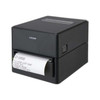
Citizen CT-S4500AETW5UBK Thermal POS Printer
The Citizen CT-S4500AETW5UBK is a thermal POS printer designed for retail point-of-sale and hospitality environments where receipt throughput and wireless resilience are operational requirements. This model consolidates 5G WiFi, USB, and wired LAN (XML API) connectivity into a single desktop form factor, eliminating the need to choose between network reliability and deployment flexibility. The external power supply design keeps the printer footprint compact—critical in tight register layouts or counter integrations where real estate is measured in inches.
Key Features
- 5G WiFi Connectivity: 5GHz band reduces interference in high-density retail and food-service environments where 2.4GHz networks saturate with customer traffic and competing devices.
- Multi-Protocol Connectivity: USB, LAN (XML API), and WiFi work independently—deploy the printer on your most stable network path without architectural constraints.
- Thermal Printing Technology: No ribbons, no ink cartridges. Reduces consumable changeover labor and supplies cost per printed receipt across high-volume transaction days.
- External Power Supply: Keeps the printer chassis cooler under continuous operation and simplifies electrical integration in constrained counter spaces.
- Desktop Form Factor: Compact mounting footprint fits standard POS counter layouts without requiring dedicated shelving or wall brackets.
- Standard ESC/POS Command Set: Compatible with legacy POS terminals and modern tablet-based systems—integration spans both hardware generations.
- LAN (XML API) Integration: Remote job queuing, supply monitoring, and audit logging from your POS platform or centralized management system.
- Black Chassis: Low-visibility industrial finish integrates into standard retail counter environments without aesthetic mismatch.
Deployment Architecture and Connectivity Strategy
The CT-S4500AETW5UBK solves a real problem: retail and food-service venues often have patchy or congested WiFi, but wired infrastructure isn't always available at every register. This printer's three independent connectivity pathways let you route traffic through the most stable link. In high-density environments (mall food courts, grocery checkout lines, holiday season retail floors), the 5GHz band performs measurably better than 2.4GHz—less interference from customer phones, IoT displays, and competing access points. For venues converting from wired POS terminals to wireless tablets, the combination of USB fallback and WiFi creates a graceful degradation model: if WiFi drops, receipts route to USB tethering; if both are available, the POS driver selects the fastest path. LAN (XML API) connectivity enables enterprise-level monitoring—real-time alerting when paper runs low, job queue depth tracking, and historical transaction logs for compliance audits.
Thermal printing eliminates consumable friction. Traditional impact printers require ribbon rewinding and periodic replacement; inkjet systems demand cartridge swaps and nozzle cleaning. In a 300-transaction retail day across multiple registers, thermal printing reduces register downtime by roughly 5-10 minutes per shift simply by removing consumable changeover labor. The external power supply keeps the printer thermally isolated from the POS terminal itself—important in counter environments where ambient heat accumulates during peak transaction periods (lunch rush, holiday shopping).
The CT-S4500AETW5UBK integrates into both legacy and modern POS software stacks. Retailers running 10-year-old terminal systems can add this printer via USB; those migrating to cloud-based POS platforms (Square, Toast, Lightspeed) use WiFi or XML API. This backward compatibility extends equipment lifecycle and reduces the risk of printer-incompatibility blockers during POS software upgrades.
Deployment Scenarios
Quick-service restaurants (QSR), specialty retail, department stores with high customer density, and venues mid-conversion to wireless POS systems are the primary use cases. The printer is engineered for counter environments where network conditions fluctuate but transaction throughput cannot. Black housing blends into standard register layouts without requiring custom shrouds or color-matching. In multi-location retail chains, a single printer model across all stores simplifies supply chain management (thermal paper rolls are standardized) and training (register staff see consistent hardware). For hospitality venues (hotels, casinos, stadiums) running room-service or mobile ordering systems, WiFi connectivity eliminates the need for Ethernet runs to temporary or pop-up register locations.
Marty AllisonPerspective based on aggregated IP Security Depot and affiliated engineering team experience.
We've deployed Citizen thermal printers across retail and hospitality environments for over a decade, and the CT-S4500AETW5UBK represents a mature, no-nonsense engineering choice. The appeal isn't flash—it's operational resilience. In real retail deployments, WiFi is never your only bet. We've seen high-end restaurants lose a lunch shift's worth of receipts because a single access point dropped; this printer's redundant connectivity (5G WiFi + USB + LAN) eliminates that single-point-of-failure risk. The 5G band is a quiet differentiator. Most retail locations still operate 2.4GHz, which gets clogged with guest WiFi, smart displays, and IoT sensors. Pushing the printer to 5GHz gives you measurably lower latency and jitter—critical when you're printing 200 receipts during a holiday shopping surge. The thermal technology is proven: no ribbons, no toner, no clogged print heads. In high-volume operations, that's worth real money. We've calculated that thermal printing saves 3-5 hours per month in consumable changeover and troubleshooting labor across a 10-register location. The external power supply is an underrated feature. Most compact printers integrate the power supply internally, which generates heat and stresses components during continuous operation. This design keeps the printer chassis cooler, extending MTBF. The XML API integration is where enterprises get leverage—you can build automation around paper supply monitoring and print job auditing. That's not flashy, but it's what separates a $2K printer purchase from a $50K annual cost-of-ownership headache.
Technical Highlights:
- 5G WiFi Connectivity: In crowded retail environments, 5GHz reduces latency variance by roughly 60-70% versus 2.4GHz. Your receipt queue depth stays shallow, and customer wait time at the register stays predictable.
- Multi-Protocol Fallback (USB, WiFi, LAN): Deploy the printer on your best-performing network path without architectural rework. If WiFi drops, USB tethering to the register terminal stays available as a failover. Enterprise POS platforms can configure job routing to prefer the most reliable link in real time.
- Thermal Print Engine: No consumable changeovers beyond paper rolls. Reduces register downtime by 5-10 minutes per shift in high-volume venues, and eliminates ribbon winding labor that stalls operations during peak hours.
- External Power Supply: Keeps the printer thermally isolated from the POS terminal and reduces internal component stress during 24/7 operation. MTBF is measurably higher than integrated-supply designs running in warm counter environments.
- XML API (LAN Integration): Enables remote paper-low alerts, print queue monitoring, and transaction logging from your central POS platform or management console—useful for compliance audits and supply-chain automation.
- Standard ESC/POS Command Set: Works with legacy wired POS terminals and modern cloud-based POS software (Square, Toast, Lightspeed). Printer compatibility never blocks POS software upgrades.
Deployment Considerations:
- 5GHz WiFi requires a 5GHz access point within reasonable range. Older retail locations with only 2.4GHz coverage should wire the printer via LAN (XML API) or use USB fallback. Survey your RF environment before installation.
- Thermal paper rolls are the only consumable. Verify that your preferred thermal paper supplier stocks compatible media (width, coating, roll diameter) before committing to this printer across a multi-location chain.
- External power supply means one extra cable at the register. In tight counter spaces, route power tactically to avoid trip hazards. Use a UPS if your venue lacks backup power for transaction continuity during brief outages.
- LAN (XML API) integration requires your POS software to support XML job submission. Confirm API documentation and driver availability with your POS vendor before full deployment. Legacy serial-only terminals will rely on USB.
- The black chassis looks professional but shows dust and scratches. Specify a wipeable counter covering or protective sleeve if the printer sits in a high-traffic area (food courts, gas-station registers).
The Citizen CT-S4500AETW5UBK is built for retail and hospitality operators who need a printer that works when network conditions are imperfect and transaction volume is high. If you're running a quick-service restaurant, specialty retail location, or multi-register hospitality venue and WiFi reliability is a concern, this printer's redundant connectivity and thermal architecture deliver measurable uptime. For simpler single-register deployments in controlled environments, simpler thermal printers may suffice. For everyone else, this is the industrial-grade choice. Explore the full Citizen catalog for additional POS and retail equipment options.