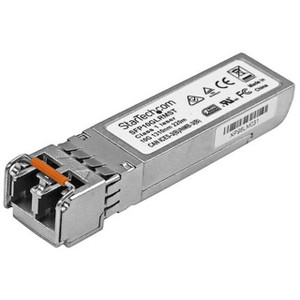
StarTech SFP10GLRST Cisco-Compatible 10GBase-LR SFP+ Transceiver Module
Overview
The StarTech SFP10GLRST is a Cisco SFP-10G-LR compatible SFP+ transceiver designed for 10GBase-LR single-mode fiber links running at 10 Gbps over distances up to 10 km (6.2 miles). If you need to bridge two building switches across a campus backbone, connect a distribution layer to a core switch over existing single-mode plant, or push 10GbE between datacenters without pulling new fiber, this module is built for exactly that application. It operates at 1310nm over LC duplex connectors — the standard for SMF 10GbE — and draws less than 1.3W, so it won't push your switch's thermal or power budget.
Compliance with IEEE 802.3ae 10GBASE-LR means it will interoperate across the broad ecosystem of 10GbE switches and routers that follow that standard, not just Cisco gear.
Key Features
- 10 Gbps Full-Duplex at 10 km: The SFP10GLRST delivers a full 10 Gbps in both directions simultaneously over single-mode fiber up to 10 km. That reach covers most enterprise campus topologies without requiring amplifiers or repeaters — meaningful when you're connecting buildings separated by 2–5 km of existing SMF conduit.
- 1310nm Wavelength, LC Duplex: The 1310nm operating wavelength is the industry-standard for 10GBase-LR SMF links, meaning your existing OS1/OS2 fiber plant is ready to go. LC duplex connectors are universal on 10GbE SMF gear, so no adapters are needed.
- Sub-1.3W Power Consumption: Drawing under 1.3W, this module imposes almost no load on your switch's per-port power allocation. In high-density line cards where 24 or 48 SFP+ slots are populated simultaneously, that adds up — switches with tight thermal envelopes will thank you.
- 2,104,865-Hour MTBF: That MTBF figure translates to a projected mean failure interval of roughly 240 years — effectively telling you this module should not be the thing that fails in your fiber link. It's the kind of number that matters when the transceiver is inside a sealed rack in a remote IDF closet you visit twice a year.
- 0°C to 70°C Operating Range: Covers standard commercial and datacenter environments. For installations in conditioned IDF closets, server rooms, or climate-controlled wiring enclosures, this range is sufficient. If you're mounting gear in an outdoor enclosure or an unconditioned industrial space that swings below 0°C, you'll want an industrial-temp variant instead.
- Storage Temperature to -40°C / 85°C: Wide storage range means the module can sit on a shelf in a warehouse or be shipped through temperature extremes without pre-conditioning concerns — useful when you're staging spares for a multi-site rollout.
- 5–95% RH Humidity Tolerance: Handles typical data center and wiring closet humidity ranges without issue. Not rated for condensing environments, so keep this in mind for coastal or industrial deployments with high moisture exposure.
- Compact Form Factor — 2.2 × 0.5 × 0.5 in, 0.8 oz: Standard SFP+ mechanical profile at 22g means it hot-swaps into any SFP+ cage without clearance concerns. Hot-swap capability is critical in production environments where pulling a card for a transceiver swap causes downtime.
Integration & Compatibility
The SFP10GLRST is designed as a drop-in replacement for the Cisco SFP-10G-LR. It follows IEEE 802.3ae 10GBASE-LR, which is the governing standard for 10GbE single-mode fiber links. Verify your SFP+ compatible network switches support third-party or generic-coded transceivers — some Cisco IOS and NX-OS configurations require the 'service unsupported-transceiver' command to accept non-OEM modules without generating an unsupported-transceiver alarm. This is a software configuration step, not a hardware incompatibility. Confirm fiber type: this module requires single-mode fiber (OS1 or OS2). Do not pair it with OM3/OM4 multimode plant — that is the most common field mistake with LR modules, and it will result in a non-functional link regardless of SFP coding.
For network architects evaluating 10GbE network switching infrastructure, pairing this module with a matched SFP10GLRST at the remote end (or a genuine Cisco SFP-10G-LR) on the same SMF run is the standard deployment pattern. Mixed-vendor LR transceivers on the same link are generally interoperable provided both conform to IEEE 802.3ae, but validate with your switch vendor's compatibility matrix before deploying in a production SLA environment.
Review your PoE switch and uplink planning guides if this module is being deployed as the uplink for a surveillance or access control distribution switch — 10GbE uplinks from aggregation switches are increasingly common as camera counts grow and per-camera bitrates increase with 4K and AI-analytics streams.
Frequently Asked Questions
Q: Will the SFP10GLRST work in a Cisco Catalyst or Nexus switch without triggering an unsupported transceiver error?
A: The SFP10GLRST is coded for Cisco compatibility. Some Cisco IOS/NX-OS versions generate an unsupported-transceiver warning when a non-OEM module is inserted. In most cases, issuing the 'service unsupported-transceiver' command resolves this and allows the port to come up normally. The module itself is electrically compatible.
Q: What fiber type does the SFP10GLRST require?
A: Single-mode fiber only — OS1 or OS2. The 1310nm wavelength and 10 km reach specification are defined for SMF. Do not use this module on multimode fiber (OM1/OM2/OM3/OM4) — the link will not establish.
Q: What is the maximum link distance for the SFP10GLRST?
A: 10 km (6.2 miles) over single-mode fiber, per the IEEE 802.3ae 10GBASE-LR specification. This covers most campus and metro backbone applications without repeaters.
Q: What connector type does this module use?
A: LC duplex. This is the standard connector for 10GBase-LR single-mode fiber links. Both ends of the fiber run must terminate in LC connectors (or use an appropriate LC adapter at the patch panel).
Q: Can this module be used at both ends of a fiber link, or does one end need to be a genuine Cisco module?
A: You can use the SFP10GLRST at both ends. Provided both transceivers conform to IEEE 802.3ae 10GBASE-LR and operate at 1310nm, the link will function. Mixed-vendor configurations (SFP10GLRST on one end, OEM Cisco on the other) are also generally interoperable under the same standard.
Q: What is the operating temperature range of the SFP10GLRST?
A: 0°C to 70°C (32°F to 158°F). This covers standard commercial, datacenter, and conditioned IDF environments. It is not rated for outdoor or industrial unconditioned enclosures where temperatures may fall below freezing.
The spec I always flag first on the SFP10GLRST is the MTBF: 2,104,865 hours. When you're dropping transceivers into remote IDF closets or aggregation switches that feed an entire building's camera and access control infrastructure, you want the fiber uplink to be the last thing on your failure-mode checklist — and that number supports treating it that way.
Technical Highlights:
- 10 km Single-Mode Reach: Full 10 Gbps at 1310nm over up to 10 km of OS1/OS2 SMF — enough to span most enterprise campuses and connect remote buildings without repeaters or amplifiers.
- Sub-1.3W Consumption: Under 1.3W per port means a fully populated 48-port line card draws under 63W from transceivers alone — far less thermal load than comparable copper 10GbE deployments, which matters in dense IDF and MDF installations.
- 2,104,865-Hour MTBF: Projected mean failure interval of ~240 years under standard operating conditions — puts transceiver failure well below fiber, connector, and switch hardware in your reliability model.
Deployment Considerations:
- Confirm your Cisco switch configuration accepts third-party transceivers before deployment — 'service unsupported-transceiver' is a one-line IOS fix, but skipping this step means a silent port-down until someone investigates the log.
- Operating range is 0°C to 70°C — fine for conditioned spaces, but not suitable for outdoor enclosures or industrial environments that see sub-zero temperatures. For those, source an industrial-temp variant rated to -40°C.
The SFP10GLRST is the right call for campus fiber backbone uplinks connecting aggregation switches in conditioned IDFs — particularly where existing single-mode plant is already in place and the project budget doesn't justify OEM Cisco transceiver pricing at scale.