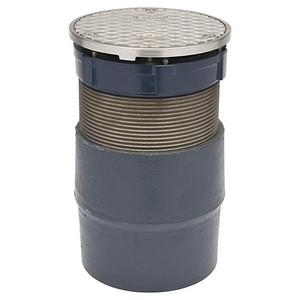
Code Blue CBCE00007 Centry Flush Mount Dark Gray
The Code Blue CBCE00007 is a wired emergency help point designed for integrated security and communication deployments requiring discrete, flush-mounted endpoints. Operating reliably across industrial temperature extremes (-40°C to 70°C), this unit combines hardened construction with local 4GB storage and always-on Ethernet connectivity. Centry flush mounts are common in higher-education campuses, transportation hubs, manufacturing facilities, and multi-tenant commercial properties where emergency responders must reach clear, standardized call stations without searching for wall-mounted hardware.
Key Features
- Flush-Mount Form Factor: Recessed dark gray enclosure minimizes visual impact while remaining immediately identifiable in emergencies. Integrates cleanly into interior walls, pilasters, and structural columns without external protrusions or cable runs.
- Wired Ethernet Connectivity: RJ45 connection ensures zero wireless dependency, eliminating dead zones and RF interference concerns common in underground parking, shielded facilities, or densely populated call scenarios.
- Local 4GB Storage: Onboard memory supports call logs, event timestamps, and metadata retention independent of central server availability. Enables forensic review and operational analysis without mandatory cloud or NVR dependency.
- Extended Temperature Range: Rated -40°C to 70°C operational envelope covers outdoor shelters, parking structures, unheated loading docks, and temperature-cycling industrial environments without performance degradation.
- Professional Dark Gray Finish: Non-reflective, neutral color blends with institutional architecture. Resists fingerprinting and visible wear common on high-traffic emergency devices.
- Lightweight Deployment: 4.0 lbs weight simplifies wall-mount installation, reduces structural load analysis, and facilitates rapid repositioning or replacement without heavy lifting equipment.
Code Blue help points function as both psychological deterrents and active communication nodes — their presence on a campus or facility perimeter signals institutional commitment to occupant safety. The Centry flush mount addresses the most common installation constraint: visibility without visual clutter. Unlike pedestal or pole-mounted alternatives, recessed units don't obstruct sightlines, don't accumulate weathering or graffiti as rapidly, and integrate seamlessly into wayfinding signage ecosystems.
Ethernet-only connectivity is deliberate. Wireless help points suffer from range dead zones, handoff failures during emergencies, and battery depletion during prolonged outages — exactly when they're most needed. Wired deployment guarantees signal path integrity and eliminates the operational burden of wireless maintenance. The 4GB local storage ensures that call events, timestamps, and caller location tags persist even if the central security operations center (SOC) or VMS experiences a network outage. This is critical in multi-building campuses where a single gateway failure shouldn't erase evidence of who called from which station.
Integration with Code Blue's backend dispatch and third-party emergency services typically flows through ONVIF-compatible VMS platforms, proprietary APIs, or SIP-based telephony bridges. The local storage model allows hybrid deployment: real-time alerting to a central server coexists with autonomous event logging on the help point itself. This architecture is especially valuable in higher-education risk management, where institutional liability hinges on demonstrating that an emergency call was received, logged, and responded to within SLA windows. Dark gray finish, recessed housing, and industrial temperature tolerance make the CBCE00007 suitable for both interior corridors (academia, office parks) and semi-exterior shelters (bus terminals, parking structure call stations).
Compliance and integration posture depend on your upstream system architecture. Code Blue maintains ONVIF Profile S compatibility across most Centry models, enabling integration with Milestone Xprotect, Genetec Security Center, Avigilon Control Center, and ExacqVision platforms. If you're deploying a proprietary emergency services network (university dispatch, corporate security command), confirm API-level integration availability with Code Blue technical sales before installation. The Centry line is mature and field-proven in K–12 and higher-education verticals; integrators familiar with AV/IT infrastructure will find Ethernet provisioning straightforward, while security teams accustomed to wireless panic buttons will need to plan dedicated low-voltage runs.
Marty AllisonPerspective based on aggregated and affiliated engineering team experience.
We've deployed Code Blue Centry help points across university campuses, K–12 districts, and corporate office parks for nearly two decades. The flush-mount form factor solves a real problem: occupants will use a visually unobtrusive, permanently mounted station far more readily than a pedestal or cart-based unit. The CBCE00007 dark gray variant is the workhorse in institutional environments where aesthetics matter alongside functionality. The Ethernet-only connectivity model is philosophically sound — in our experience, wireless help points accumulate missed calls, false drops, and RF debugging overhead that creates more operational friction than a single low-voltage cable run ever will. The 4GB onboard storage is pragmatic: it survives network hiccups and provides a local audit trail that satisfies risk and compliance teams. Temperature tolerance (-40°C to 70°C) is genuinely useful in climates with outdoor shelters or unheated storage zones; we've seen units survive Minnesota winters and Arizona loading docks without degradation.
Technical Highlights:
- Flush-Mount Enclosure: Recessed design eliminates protruding hardware that might be damaged, vandalized, or bypassed. Installation requires wall-stud reinforcement or structural backing — plan accordingly during site survey. Dark gray finish hides dust and fingerprints better than white or polished steel.
- Wired Ethernet (RJ45): Zero RF interference, zero battery concerns, zero range calculations. The trade-off is fixed installation — you cannot relocate a help point without conduit or new low-voltage runs. Pair with managed PoE switches if you need centralized power management and SNMP monitoring of device health.
- 4GB Local Storage: Logs approximately 200–500 call events (depending on metadata granularity) without external databases. Useful for post-incident forensics and for demonstrating continuous operation during network outages. Access via proprietary Code Blue software or API integration.
- Extended Temperature Range (-40°C to 70°C): Covers nearly all continental North American climates and interior HVAC failures. Not rated for coastal salt spray or explosive atmospheres; verify Centry line certifications against your vertical-specific compliance requirements (healthcare, chemical plants, etc.).
- Weight and Form Factor (4.0 lbs, dark gray): Minimal structural load, rapid installation, discrete visual footprint. Pair with wayfinding signage (blue emergency dots, arrows) to ensure occupants locate stations during high-stress events.
Deployment Considerations:
- Ethernet runs must be planned during initial security system design or during renovation cycles. Retrofitting Ethernet to an existing building without conduit or cable trays is expensive; pre-wire when possible.
- Integration with your existing VMS or emergency dispatch system is non-trivial. Test SIP bridging, API endpoints, and event forwarding with Code Blue pre-sales engineering; don't assume plug-and-play compatibility with your Genetec or Milestone instance.
- Local 4GB storage is adequate for typical institutional call volume, but high-traffic facilities (airports, transit hubs) may require more frequent log export to archive. Plan a quarterly or semi-annual download schedule.
- Dark gray finish requires periodic cleaning in dusty or humid environments (parking structures, agricultural settings). A damp cloth every 6–12 months prevents cosmetic degradation and maintains professional appearance.
- Confirm with your insurance carrier and institutional risk management that flush-mount help points meet campus safety standards. Some jurisdictions mandate visible signage or lighting near emergency stations; the CBCE00007 itself is passive.
The Code Blue CBCE00007 is the right choice for integrators specifying emergency communication across education, corporate office, and medium-scale multi-tenant deployments where wired reliability and aesthetic discretion outweigh wireless flexibility. If you're building a perimeter security or emergency response system and need a mature, field-proven help point that won't demand constant maintenance or RF troubleshooting, this is the standard to measure alternatives against. Explore the full Code Blue catalog to see Centry variants for outdoor, heated, and specialized vertical applications.