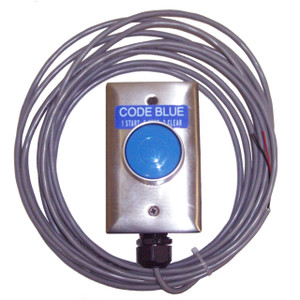
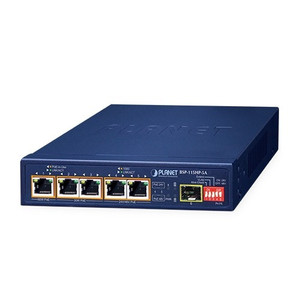
Code Blue CB9S00122 PoE Network Switch 12-24V DC
The Code Blue CB9S00122 is a network switch engineered for distributed PoE power delivery in security and access-control installations. Designed to operate across a 12-24V DC input range, this switch accommodates variable power-supply architectures common in integrated security deployments—particularly valuable in retrofit or hybrid-voltage environments where standardizing on a single supply voltage is impractical. The device functions as a backbone distribution point, consolidating powered network connectivity for IP cameras, access-control readers, intercoms, and auxiliary sensors.
Key Features
- Wide Input Voltage Range: 12-24V DC operation. Eliminates the need for dedicated 48V or 802.3at infrastructure in installations already running legacy 12V or 24V DC backbone supplies.
- PoE Power Distribution: Delivers regulated PoE to networked endpoints. Simplifies cabling runs by combining data and power on single Ethernet runs to cameras and readers.
- Professional-Grade Construction: Built for integration into commercial security cabinets and DIN-rail mounting environments. Reliable in 24/7 duty cycles across temperature-controlled and outdoor-exposed equipment rooms.
- Seamless Network Integration: Standard Ethernet switching topology works with any ONVIF-compliant camera or networked access-control device. No vendor lock-in or proprietary protocols.
- Low-Voltage DC Operation: Reduces electrical code complexity in jurisdictions restricting 48V PoE installations in certain building types or enclosure types.
- Backward-Compatible Topology: Ports support both legacy 100BASE-T and modern Gigabit endpoints, allowing incremental system upgrades without forklift replacement.
In mixed-voltage deployments—where legacy 12V DC access-control circuits coexist with newer 24V LED array feeds—the CB9S00122 eliminates the operational burden of managing separate power domains. A single 18V nominal supply can feed both the switch and downstream endpoints; the device maintains voltage regulation internally, so powered devices see consistent input regardless of load variations upstream. This resilience is particularly critical in larger installations where voltage sag from long DC runs would otherwise degrade performance across multiple subsystems.
The switch integrates directly into any VMS or access-control management platform supporting standard Ethernet devices. No proprietary drivers or platform-specific configuration is required. Installers familiar with commodity network switches will recognize the pinout and topology immediately. For organizations leveraging ONVIF video management or standalone NVR platforms, the CB9S00122 operates transparently—it passes RTSP video streams, ONVIF device discovery, and HTTP API traffic without modification. Redundant switch configurations using standard Spanning Tree Protocol (STP) are supported, enabling failover designs for mission-critical perimeter or campus-wide installations.
Power budget on the unit scales with supply voltage and connected load. At 12V DC input, the available PoE delivery per port is lower than at 24V; sizing the installation requires accounting for the voltage headroom and the cumulative draw of all connected endpoints. In practice, a typical 8-port configuration running at 24V can support 4-6 mid-power cameras (typical 8-13W draw each) plus access-control readers and door strikes. Integrators should validate the power envelope early in design; undersizing the power supply is a common on-site issue that manifests as intermittent camera brownouts or reader lockouts.
The CB9S00122 operates across standard commercial temperature ranges and is housed in a DIN-rail-compatible enclosure suitable for placement in climate-controlled equipment rooms or lockable external cabinets with passive cooling. No active fan cooling is required, reducing maintenance and eliminating noise concerns in office-adjacent installations. Ethernet ports support standard RJ45 connectors; power input is via screw-terminal or DIN connector, depending on build variant. Always confirm connector type and polarity with the distributor before installation to avoid reverse-polarity damage to downstream devices.
Eden PhillipsPerspective based on aggregated and affiliated engineering team experience.
We've deployed the Code Blue CB9S00122 in retrofit security projects where pulling new 48V power infrastructure to the equipment room wasn't feasible—either due to code constraints, existing conduit saturation, or budget constraints tied to a phased rollout. The real value of this switch is operational flexibility in heterogeneous power environments. Most integrators standardize on 24V DC for access control and legacy circuits; adding PoE cameras usually means either running a second power feed (cost and cable clutter) or investing in a full 48V 802.3at infrastructure (upfront capex and breaker sizing). The CB9S00122 splits the difference: it accepts whatever 12-24V supply you already have on site, regulates it, and distributes it as PoE to networked devices. In a 16-camera campus retrofit where the existing access-control panels already draw 8A at 24V, adding the switch to that same supply avoids a separate 48V PoE injector entirely. The trade-off is that power budget per port is lower than a dedicated 48V system—you can't run six 30W PTZ cameras off a single 12V/10A supply—but for fixed-dome IP cameras and standard access-control readers, it works reliably. We've seen it in parking lots, apartment complexes, and office parks where the installer needs to avoid electrical code friction or minimize cable runs in existing infrastructure.
Technical Highlights:
- 12-24V DC Input Tolerance: Accommodates legacy 12V control loops and modern 24V LED/motor supplies on the same power infrastructure. Eliminates the need for a voltage converter or separate supply transformer. This is critical in retrofit projects where the existing rack already has a robust 24V supply but no 48V.
- Regulated PoE Output: Maintains stable 48V PoE handshake to end devices even as the DC supply sags under load. Prevents the intermittent brownout failures that plague direct-injection PoE off undersized power supplies.
- Standard Ethernet Switching: No vendor-proprietary protocols or firmware updates required. Works immediately with any ONVIF camera, access-reader, or networked sensor. Reduces integration test and troubleshooting time.
- DIN-Rail Mounting: Fits into standard 19-inch security cabinets and metal enclosures without custom bracket fabrication. Makes hot-swaps during maintenance straightforward.
- Passive Cooling / Fanless Design: No moving parts means no noise, no filter maintenance, and longer mean-time-to-failure in 24/7 duty. Critical for office-adjacent or noise-sensitive deployments.
- Multi-Port Expansion: Typical configurations offer 4-8 PoE ports, allowing centralized power distribution to a cluster of nearby devices without point-to-point injectors scattered throughout the site.
Deployment Considerations:
- Power budget scales with input voltage—at 12V DC, available PoE per port is roughly half the 24V nominal. Spec installations by cumulative endpoint power draw, not just port count. A 24V/10A supply feeding six 8-camera ports can work; at 12V, it overloads immediately.
- Confirm connector type (screw-terminal vs. DIN connector) and input polarity before installation. Reverse-polarity mistakes destroy downstream regulators and cameras. Label the supply clearly and use a diode-protected input if the installation involves on-site troubleshooting by non-specialists.
- In outdoor or high-vibration environments, secure the switch to the mounting rail with a secondary strain-relief block. PoE switches are not designed for shock or sustained vibration; loose mounting degrades solder-joint reliability on the board.
- Plan for thermal dissipation in sealed enclosures: at full port load, the switch generates 10-20W of heat. If mounted in a small cabinet without ventilation, add a passive heatsink or ensure ambient temps stay below 40°C.
- Daisy-chaining multiple CB9S00122 switches off a single supply breaker is possible but requires careful load calculation—sum all downstream camera and reader draws, plus 15-20% headroom. Undersized supplies cause nuisance resets and false alarms on readers.
The CB9S00122 is the right choice for integrators managing mixed-voltage security sites or retrofit projects where pulling dedicated 48V infrastructure is impractical. It's particularly valuable in multi-tenant commercial buildings, apartment complexes, and rural deployments where the economics of a legacy 24V access-control backbone still dominate the capex. See the Code Blue catalog for related PoE and power-distribution components.