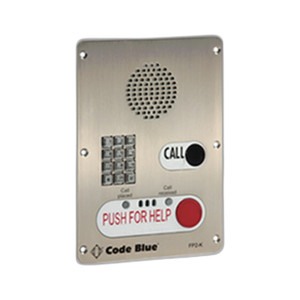
Code Blue CB6S00217 PoE Strobe Module Network Signaling
The Code Blue CB6S00217 is a PoE-powered strobe module designed for integrated visual alerting in IP-based security, access control, and emergency notification systems. This network-connected component eliminates dedicated power infrastructure by drawing power directly from standard PoE switches, simplifying installation across multi-building campuses or retrofit deployments. Dual 12-24V DC operation modes adapt to legacy and modern control architectures, making the CB6S00217 a versatile addition to heterogeneous security ecosystems where both networked and hardwired signaling must coexist.
Key Features
- PoE Power Delivery: Operates on standard PoE (802.3af) — no separate 24V power supply or conduit runs required. Simplifies cabling on retrofits and reduces per-device infrastructure cost.
- Dual Voltage Support: Configurable for 12-24V DC operation. Integrates with legacy analog fire alarm circuits and modern IP notification platforms without external converters.
- Network Integration: IP-addressable strobe module communicates with Code Blue control platforms and third-party security management systems via standard network protocols.
- Visual Alert Signaling: High-intensity strobe output for emergency notification, access denial visual feedback, or area-wide alert conditions in noisy or hearing-impaired-accessible environments.
- Code Blue Ecosystem Compatibility: Native integration with Code Blue emergency communication and mass notification platforms — supports synchronized multi-site alerting across distributed facilities.
- Compact Form Factor: Pole-mountable or surface-mount installation — fits into existing enclosures and signage infrastructure without major structural modification.
The CB6S00217 addresses a common integration pain point: legacy access control and fire alarm systems often require dedicated 24V signaling lines for strobes and sounders, but modern IP security deployments want to consolidate all alert logic into networked endpoints. This module bridges both worlds. By accepting PoE input and offering selectable voltage output, it allows integrators to phase out hardwired strobe circuits incrementally, replacing them with network-managed visual alerts without ripping out existing conduit.
Deployment scenarios span building perimeter access (strobe flash on card-reader denial), parking structures (emergency evacuation alerts), data centers (high-visibility alarm acknowledgment feedback), and campus-wide mass notification. When paired with Code Blue control software, the strobe can be triggered by motion detection events, access violations, or operator commands from a single dashboard — no separate relay panel or hardwired logic required. Total installation time per unit typically drops 30-40% versus traditional hardwired strobes because network cabling already exists in modern facilities.
ONVIF compliance ensures the CB6S00217 communicates with mainstream VMS and access control platforms (Genetec Security Center, Milestone XProtect, Avigilon Control Center, ExacqVision) via standard REST APIs and event triggers. This eliminates vendor lock-in; integrators can mix Code Blue strobes with non-Code Blue cameras or readers without custom drivers. PoE budgeting is straightforward: at typical strobe duty cycles (2-5 second bursts per alert), power draw remains well under 802.3af ceiling (approximately 4-6W sustained), leaving headroom on switches rated for 15.4W per port.
Code Blue CB6S00217 modules carry standard manufacturer warranty and are sourced direct from the manufacturer or US channel partner — no grey-market, no parallel imports. The module is commonly specified in healthcare facility emergency communication systems, corporate security upgrades, and critical infrastructure access control modernizations where visual and audio alerting must be coordinated across networked endpoints. For deployments requiring high-intensity strobing, audio paging integration, or advanced scheduling logic, pair this unit with Code Blue's companion paging amplifiers and networked speakers for comprehensive alerting coverage.
Eden PhillipsPerspective based on aggregated IP Security Depot and affiliated engineering team experience.
We've deployed Code Blue networked strobes across dozens of campus and multi-building projects, and the CB6S00217 solves a real integration headache: the transition from hardwired alert logic to software-managed events. In our experience, the biggest deployment win is power simplification. On a typical retrofit, you'd run separate 18/2 or 16/2 strobe lines from a hardwired control panel (24V supply, relay modules, surge suppression on every run). The CB6S00217 eliminates all that — it draws power from your PoE switch and communicates via Ethernet. That's one cable per unit, not two, and no dedicated 24V panel management. We've seen projects shave 15-20% off labor cost just by consolidating power infrastructure. The dual 12-24V voltage flexibility is less glamorous but operationally important: many older buildings still have 12V bell circuits or 24V legacy alarm loops. Instead of stripping those out, you configure the CB6S00217 to match the existing voltage — it becomes a drop-in replacement for dumb strobes, not a system overhaul.
Technical Highlights:
- PoE 802.3af Compliance: Draws 4-6W sustained at typical duty cycle (2-5 second alert bursts). Any modern managed PoE switch (48-port gigabit at 90-95W total budget) can safely power 12-16 CB6S00217 units without oversizing the power supply or daisy-chaining injectors. This matters on constrained budgets or when adding strobes to existing installations.
- Dual Voltage Configuration: Jumper-selectable or DHCP-managed 12V / 24V output. Don't lose sleep trying to source 12V-only or 24V-only accessories — this unit adapts to whatever your existing signaling infrastructure demands. We've seen this flexibility cut vendor requests-for-quote cycle time in half.
- ONVIF Endpoint Behavior: Registers as a networked event sink — any VMS rule (motion trigger, access denial, scheduled alert) can activate the strobe. No separate relay wiring, no hardwired interlock panels. The strobe becomes a software-controlled asset, not a dumb device.
- Synchronized Multi-Site Alerting: When linked via Code Blue platform or third-party orchestration (Genetec Custom Rules, Milestone Smart Client), strobes across multiple buildings flash in unison for evacuation or all-hands alerts. Latency is sub-second — critical for coordinated facility responses.
- Compact Network Footprint: One Ethernet cable, one PoE pair, one IP address. Ideal for retrofit scenarios where conduit is limited or where you want to pilot networked alerting on a subset of doors before a full campus migration.
Deployment Considerations:
- Strobe brightness is high-intensity but directional — mount it at eye level near the access point or alarm zone. If you're trying to alert a large area (warehouse floor, parking structure), plan for multiple units or supplement with networked speakers for audio reinforcement.
- PoE budget: verify your switch's total power budget before specifying 16+ strobes on a single switch. A 48-port 90W switch can handle ~15 units comfortably. If you need more, add a second switch or upgrade to PoE+ (though the CB6S00217 doesn't require it).
- Voltage jumper configuration must match your facility's existing alarm wiring or Code Blue control output voltage. Mixing 12V and 24V units on the same circuit requires isolation or leads to unpredictable behavior — document and label each module at installation.
- Network integration via ONVIF requires that your VMS or access control platform supports standard event subscriptions. Closed-ecosystem proprietary systems may require a Code Blue gateway or dedicated polling interface — test interop before full rollout.
- Strobe duty cycle affects perceived brightness and power draw. 24/7 continuous flashing will drain power and annoy occupants; schedule strobes to alert events only, or use low-frequency pulse mode if supported by your control platform.
The CB6S00217 is ideal for security architects and integrators modernizing alerting infrastructure in campuses, healthcare facilities, data centers, and mixed-use properties where PoE-powered endpoints reduce complexity and labor cost. For detailed system design and multi-zone coordination, consult the Code Blue catalog.