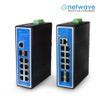
Code Blue CB4R00127 PoE Network Switch
Overview
The Code Blue CB4R00127 is a PoE-enabled network switch designed for surveillance infrastructure where centralized power delivery and ethernet connectivity are critical to system reliability. This model operates on 24V DC input, making it suitable for installations that already run dedicated DC power distribution to network closets or equipment cabinets. The CB4R00127 is purpose-built to consolidate camera feeds, NVR connections, and access control integrations onto a single managed switching platform.
Key Features
- 24V DC Power Input: Eliminates the need for multiple 120/240V AC circuits in surveillance closets. If your facility already runs low-voltage DC power for other security subsystems, the CB4R00127 integrates directly without additional conduit or circuit breaker capacity — a real space and cost saver in retrofit deployments.
- PoE Delivery: Supplies power and data over standard ethernet runs to networked cameras and endpoints. Reduces the number of separate 24V sensor cables you'd otherwise need to run in parallel, cutting installation labor and physical cable clutter.
- Ethernet Connectivity: Provides multiple RJ-45 ports for simultaneous camera, recorder, and access control device connections. Centralizes all surveillance traffic on a single switching fabric, simplifying network management and troubleshooting.
- Surveillance-Focused Design: Built specifically for security deployments rather than general-purpose networking. Prioritizes reliability and uptime in camera-heavy environments where packet loss directly impacts recorded evidence quality.
Integration & Compatibility
The CB4R00127 integrates with standard ONVIF-compliant IP cameras and recorders common across the surveillance industry. Its ethernet-based architecture means any device capable of standard RJ-45 network connection can attach to the switch. Code Blue compatibility with paging and amplification infrastructure allows audio integration during system build-out — a consideration in multi-building campus deployments where synchronized page announcements matter alongside video recording.
Frequently Asked Questions
Q: What is the maximum PoE wattage the CB4R00127 can deliver per port?
A: Consult the product datasheet or contact Code Blue directly for detailed per-port PoE budgets and total aggregate power capacity.
Q: Can the CB4R00127 work with standard 802.3af/at PoE cameras?
A: Yes. Standard PoE cameras drawing under 13W (802.3af) or up to 30W (802.3at) are compatible with PoE network switches. The CB4R00127 supports ethernet-based PoE delivery to compliant devices.
Q: What 24V DC power supply rating do I need to run the CB4R00127?
A: Total power consumption depends on the number and type of devices connected. Refer to the product specifications or contact a pre-sales engineer for sizing guidance based on your camera count and PoE load.
Q: Is the CB4R00127 DIN-rail mountable?
A: Form factor and mounting options are specified in the product documentation. Confirm mounting compatibility with your equipment cabinet layout before purchase.
Q: Does the CB4R00127 support VLAN or traffic prioritization?
A: Management and traffic segregation features depend on the switch firmware. Contact Code Blue for details on layer-2 switching capabilities.
I look at the CB4R00127 as a response to a specific infrastructure problem: facilities that have already committed to 24V DC distribution for access control and sensor power, but were still running separate AC circuits for network switches. The CB4R00127 eliminates that redundancy — your PoE delivery runs on the same 24V backbone, meaning one UPS system protects both cameras and control infrastructure.
Technical Highlights:
- 24V DC Input: Operates directly from the same low-voltage supply used for door locks, card readers, and alarm sensors. If your facility already has redundant 24V supplies or a battery backup, the switch inherits that protection automatically — no separate AC-to-PoE converter needed in the network closet.
- PoE Power Delivery: Consolidates camera power onto ethernet cables, reducing physical runs and conduit fill. In retrofit scenarios where you're adding cameras to a building with full cable trays, this means using existing infrastructure instead of pulling new power parallel to data.
- Ethernet Switching Fabric: Aggregates ONVIF-compliant cameras and recorders on a single managed platform, simplifying port allocation and network segmentation. Multi-building campuses benefit from centralized switching — one switch per facility with uplinks to a core recording system.
Deployment Considerations:
- The 24V DC requirement means you must already have or install a dedicated DC supply rated for aggregate PoE load plus switch overhead. Don't assume your access control 24V supply has the headroom — calculate total wattage first. A typical setup with 8 cameras at 12W each plus switch draw will demand a 150W+ 24V supply.
- PoE power per port is not explicitly stated in available evidence. Contact Code Blue or request a datasheet before assuming this switch can deliver 90W per port — it may be standard 13W (802.3af) or 30W (802.3at), which affects camera model selection.
The CB4R00127 makes sense in campus or multi-building deployments where DC power is already distributed and you want to avoid fragmenting network infrastructure across separate AC-powered switches. Avoid it if your facility runs standard 120V AC throughout — you'll pay more to add DC distribution than you'd save consolidating to one supply.