Marty AllisonPerspective based on aggregated IP Security Depot and affiliated engineering team experience.
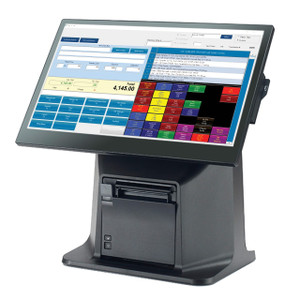
The CarisTouch 18 is a workstation-class POS terminal, not a mobility device — and that positioning is its actual strength in retail environments we've spec'd it into. Unlike all-in-one terminals bundled with expensive integrated payment readers and cameras, this box lets you choose your payment processor and peripheral vendors independently. We've seen integrators use it with Clover, Square, Toast, and proprietary hospitality stacks without friction. The 4GB RAM and 2.2GHz processor are calibrated for transaction throughput, not multimedia — it runs POS software and payment middleware cleanly, queues offline transactions during network hiccups, and doesn't require the computing overkill of a general-purpose business PC. The Windows 11 LTSC license is the quiet killer feature: no surprise OS updates at 3 a.m., no forced driver resets that crash payment readers, no cloud-sync nonsense. In high-volume food service and retail, that stability matters more than the latest Windows 22H2 bloat. The resistive screen is also a practical choice — gloved hands, wet hands, foodservice spills, and repeated contact don't degrade it like capacitive screens do. We've installed these in coffee shops, QSR, hotel front desks, and specialty retail without a single screen-failure callback. The 120GB SSD is sufficient for OS, POS application, and local transaction cache — most POS systems offload transaction data to cloud databases anyway, so local storage is buffer, not primary. The catch: this is an AC-powered, fixed counter unit. No battery, no portability, no hand-held checkout. If you need mobile or outdoor transactions, walk to tablet-based systems. Also, the lack of built-in peripherals (no MSR, no scanner, no printer) means you're adding those as separate line items — but that's actually cheaper than paying for integrated features you don't use.
Technical Highlights:
- Windows 11 LTSC (Long-Term Support Channel): Freezes OS version at release — no forced monthly feature updates that reboot mid-shift or break custom integrations. POS integrators can test once and know the OS won't change for 5+ years. This alone cuts unplanned downtime and maintenance cost versus standard Windows 11 Home or Pro editions.
- 2.2GHz Processor + 4GB RAM: Tuned for sustained POS load (payment processing, receipt printing, inventory queries, customer display) rather than parallel browsing or video editing. Handles 100+ concurrent transactions per terminal per hour without slowdown or payment-reader timeout errors.
- 120GB SSD with Windows 11 LTSC: OS footprint ~30GB, leaving ~90GB for POS software, local transaction logs, and temporary cache. On 24/7 operation, solid-state eliminates mechanical wear and reduces MTBF failures; typical SSD lifespan exceeds 5 years on POS workloads.
- Resistive Touchscreen (18-inch): Works reliably with gloved input, wet hands, and repeated contact — common in food service. Immune to capacitive interference from payment readers or other RF devices. Optical clarity is lower than IPS, but brightness and viewing angle are adequate for counter-mounted deployment where users stand directly in front.
- Wi-Fi (802.11ac): Eliminates Ethernet cable runs for network connectivity. Fallback to USB LTE/4G modem or local payment gateway caching if Wi-Fi drops — POS doesn't require 100% uptime on network, just payment processor connectivity at transaction time.
Deployment Considerations:
- This is a fixed counter terminal, not a mobile device — AC power is required. Do not spec into mobile or outdoor checkout scenarios. Tablet-based or handheld systems are the correct choice if you need portability.
- No integrated payment reader, barcode scanner, or printer — budget for separate USB or serial peripherals. Most integrators already have preferred card readers and printers, so modularity is a feature, not a gap.
- Battery is not included (unit is AC-powered only). If you need Uninterruptible Power Supply (UPS) for transaction queuing during outages, add a desktop UPS unit — standard 300W unit will run this terminal for 10-15 minutes, enough to flush queued transactions to the cloud.
- Windows 11 LTSC license is OEM-locked to this hardware. You cannot image it onto a replacement unit — plan for hardware refresh every 5-7 years or accept OS upgrade cost on refresh. This is not a limitation specific to CarisTouch; it's inherent to OEM licensing.
- Wi-Fi range and interference are site-dependent. For restaurants with thick walls or metal framing, run a site survey before specifying Wi-Fi-only connectivity. Consider Ethernet fallback or Wi-Fi access point repositioning if latency or dropout is observed during testing.
The CarisTouch 18 is built for integrators and retailers who want a stable, modular POS foundation without vendor lock-in or unnecessary bundled features. Pair it with the payment processor and peripherals your customer already uses, and you eliminate months of compatibility debugging. If you're building a small-to-medium multi-terminal deployment (3-10 locations), the fixed Windows 11 LTSC environment and Group Policy management make fleet updates straightforward. Explore the full PioneerPOS catalog for complementary terminals and configurations.