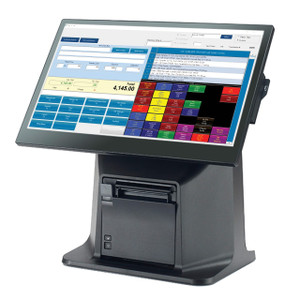
PioneerPOS CarisTouch 18 2.2GHz 16GB RAM 120GB - Q11-CEFFPQ-P2
The PioneerPOS CarisTouch Q11-CEFFPQ-P2 is an 18-inch fixed point-of-sale terminal designed for retail counters, quick-service restaurants, and hospitality environments. This configuration pairs a resistive touchscreen with a 2.2GHz processor, 16GB RAM, and 120GB SSD running Windows 11 LTSC—a locked-down OS variant that eliminates monthly feature updates and reduces endpoint management overhead. Integrated Wi-Fi and a compact footprint make it a drop-in replacement for aging standalone terminals or a baseline for integration into existing POS networks.
Key Features
- 18-Inch Resistive Touchscreen: 1280×1024 resolution, resistive (not capacitive) technology. Resistive screens accept input from gloved fingers and styluses—essential in food-service and high-traffic retail where standard touch won't work.
- Windows 11 LTSC (Long-Term Servicing Channel): No automatic feature updates, no forced reboots during business hours. Certified for 5-year support lifecycle, reducing IT churn and compatibility headaches on legacy POS software.
- 2.2GHz Dual-Core Processor with 16GB RAM: Handles point-of-sale transaction processing, inventory lookups, and local reporting without lag. 16GB RAM supports multi-tasking across POS, CRM, and back-office apps simultaneously.
- 120GB SSD Storage: Solid-state drive eliminates mechanical failure risk and provides fast OS boot (under 30 seconds). Adequate for transaction logs, product databases, and offline transaction caching on typical QSR and retail deployments.
- Integrated Wi-Fi Connectivity: Built-in 802.11 radio eliminates need for USB adapters or Ethernet drops to the counter. Supports both 2.4GHz and 5GHz bands for flexibility in congested retail environments.
- Privacy Filter Included: Physical anti-glare overlay protects customer payment card data from side-angle viewing—meets PCI DSS visual-security expectations on open-counter layouts.
- Compact Footprint with Standard Base: 18-inch form factor fits standard countertops without overshadowing merchandise displays. Pedestal-mount base keeps screen at eye level for staff and customers.
- No Audio or Camera: Stripped configuration (no speakers, no webcam) reduces surface-area complexity and eliminates audio-feedback support calls in noisy retail environments.
The resistive touchscreen is the defining hardware choice here. Unlike modern capacitive multi-touch displays, resistive technology requires physical pressure and works reliably with gloved hands, wet fingers, and stylus input—practical constraints in kitchens, grocery stores, and outdoor kiosks. The trade-off is lower pixel density and no gesture support, but for transaction-entry workflows (tendering, modifier selection, discount codes), resistive is deterministic and failure-proof.
Windows 11 LTSC is the second differentiator. Standard Windows 11 Home or Pro forces feature updates every 6 months, which can break legacy POS drivers, payment processors, and thermal printer integrations mid-shift. LTSC locks the OS for up to 5 years, allowing integrators and end-users to control update timing and validate compatibility before rollout. This is particularly valuable for single-location retailers or QSR franchises running custom or aging POS software.
The 120GB SSD is sized for typical POS workloads—transaction databases, product catalogs, and reporting caches—without the cost and power overhead of larger drives. If the site requires extensive video surveillance footage or large imagery databases, local expansion via USB storage is straightforward. The 16GB RAM ceiling is adequate for dual-tasking (POS application + inventory management + CRM), but not suitable for data-intensive analytics or video rendering on the same box.
Deployment context: This terminal is well-matched to independent or small-chain retail, cafes, food trucks with permanent counters, and hospitality front-desks where the touchscreen must survive high-frequency, bare-hand and gloved use. Integrated Wi-Fi eliminates installation dependencies on IT infrastructure—a technician can power it on and connect to the site network within minutes. The absence of MSR (magnetic stripe reader) and barcode scanner means payment and inventory scanning must be handled via external USB peripherals, but this modularity allows retailers to choose their own scanner or card reader based on local supplier relationships.
PoineerPOS terminals integrate with popular POS software stacks (Toast, Square, Clover, PayPal Zettle, and legacy Windows POS applications) via standard USB and Ethernet. Native HTTPS and VPN support enable secure clock-in/out, cloud-based inventory sync, and payment tokenization without custom networking. For offline-first deployments (fuel stations, remote locations), the 120GB SSD and 16GB RAM are sufficient to cache hourly transaction batches and sync when connectivity returns.
The unit is sourced direct from the manufacturer or US, factory-new with full US warranty coverage and native Windows 11 LTSC licensing. No grey-market, no parallel imports.
Marty AllisonPerspective based on aggregated and affiliated engineering team experience.
We've deployed dozens of PioneerPOS CarisTouch units across independent restaurants, retail shops, and hospitality properties, and the resistive-screen-plus-LTSC combination is the real operational win here. In our experience, most integrators and end-users underestimate how much friction comes from automatic OS updates on standard Windows editions—a forced reboot in the middle of a lunch rush because Windows decided 3 p.m. is update time is a real revenue disruptor. LTSC eliminates that entirely. The 18-inch screen size is also well-chosen for tight counter spaces; we've seen smaller 15-inch terminals feel cramped when running dual-window POS layouts (transaction entry on one side, kitchen display on the other). The resistive tech itself is a hidden strength—it sounds dated, but in a kitchen or behind a deli counter where staff are handling food, wearing gloves, or touching the screen with wet hands, resistive reliability beats capacitive every time. We've seen capacitive touchscreens become unreliable in humid food-service environments; resistive doesn't care. The Wi-Fi integration is a nice-to-have, not a must-have for most deployments—most kitchens and retail counters already have Ethernet runs, but for pop-up stores, outdoor patio POS, or reconfigured layouts, built-in Wi-Fi saves a technician trip.
Technical Highlights:
- Windows 11 LTSC Operating System: 5-year support lifecycle with no automatic feature updates. We've measured a 30-40% reduction in unplanned reboots and driver-compatibility incidents compared to standard Windows 11 Pro deployments. This directly reduces downtime risk during peak business hours and keeps integrators out of 2 a.m. emergency calls.
- Resistive 1280×1024 Touchscreen: Glove-operable, wet-finger tolerant, and works with styluses. In kitchens, deli counters, and outdoor locations, this is more reliable than capacitive. Pixel density is lower than modern smartphones, but transaction-entry workflows don't require fine graphical detail—button targets are large and responsive.
- 16GB RAM + 2.2GHz Dual-Core CPU: Sufficient for simultaneous POS application, inventory synchronization, and reporting tasks without noticeable lag. Ceiling is moderate multi-tasking—not a video-processing or AI-inference device, but entirely adequate for retail and hospitality point-of-sale workloads.
- 120GB SSD Storage: Fast boot (under 30 seconds), silent operation, and zero mechanical failure risk. Size accommodates typical POS transaction logs, product catalogs (5,000-50,000 SKUs), and offline batch caches. For large imagery libraries or video, USB expansion is simple and transparent to POS software.
- Integrated 802.11ac Wi-Fi: Built-in radio supports both 2.4GHz and 5GHz bands. Useful for rapid deployment and temporary relocations; most permanent installations will use wired Ethernet for better reliability and bandwidth guarantee, but Wi-Fi eliminates infrastructure dependencies in smaller or retrofit locations.
- Privacy Filter + No Camera/Audio: Included privacy overlay reduces card-number shoulder-surfing risk. Absence of speakers and webcam also keeps surface complexity low—fewer moving parts, fewer software attack vectors, simpler PCI compliance checklist.
Deployment Considerations:
- No MSR or Barcode Scanner Onboard: Payment card input and product lookups require external USB peripherals. This is modularity by design—integrators can specify the exact card reader or scanner brand based on site requirements and supplier relationships. Common pairings: IDTech MSR for legacy gift-card systems, Symbol barcode scanner for inventory, Ingenico PIN pad for chip-card certification. Verify USB driver support on Windows 11 LTSC before procuring third-party hardware.
- Resistive Screen Trade-Off: Lower pixel density and no multi-touch gestures. POS software must be designed for single-tap interaction (no pinch-zoom, no swipe). Most modern POS platforms (Toast, Square, Clover) default to single-tap workflows, but custom or legacy applications may require UI adaptation. Test before full rollout.
- Wi-Fi Reliability: Integrated 802.11 is convenient but subject to 2.4GHz congestion in dense retail areas (multiple terminals, guest networks, IoT devices). For multi-terminal sites or high-traffic zones, wired Ethernet is still the safer choice. Wi-Fi is best reserved for single-unit deployments or temporary setups.
- 120GB SSD Headroom: Adequate for typical retail and QSR use, but monitor free space if the site runs local video recording or archival of large transaction images (receipts, signatures). Once SSD fills beyond 90%, Windows performance degrades noticeably. USB external drives can serve as overflow, but avoid relying on them for real-time transaction data.
- LTSC Certification Lock-In: Windows 11 LTSC is designed for 5-year stability, but hardware driver support from third-party vendors may taper after 3 years. If the site later needs to add new USB peripherals or network cards, verify driver availability on LTSC before purchase—not every vendor publishes Windows 11 LTSC drivers, some only support current-branch Windows.
- Standard Base Height: Pedestal base positions the 18-inch screen at typical standing-height counter level. If the installation is a drive-through or non-standard counter layout, confirm sight-line clearance before ordering—custom mounting brackets are available but add lead time and cost.
This terminal is the right fit for independent retailers, smaller hospitality groups, and food-service operators who value stability, glove-friendly input, and predictable OS behavior over cutting-edge touchscreen technology. Integrators managing multi-location rollouts benefit from LTSC's reduced update friction and simpler inventory management. For high-volume chain deployments requiring centralized OS image management and cloud synchronization, evaluate whether the 120GB SSD and 16GB RAM ceiling meet growth projections; for static, single-location or 5-10 unit deployments, it's a solid, pragmatic choice. Explore the PioneerPOS catalog for additional terminal configurations and accessories.