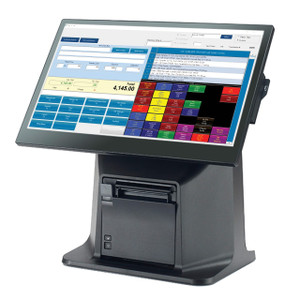
PioneerPOS CarisTouch 15 i5 8GB RAM 120GB SSD - Q11-DA8FPQ-02
The PioneerPOS CarisTouch 15 is a compact all-in-one POS terminal designed for retail counters, quick-service restaurants, and hospitality environments where space and operational simplicity are critical. Built on Intel Core i5 processing with 8GB RAM and 120GB SSD storage, it delivers responsive transaction handling and fast boot cycles without the overhead or heat footprint of oversized tower hardware. The 15-inch resistive touchscreen resists accidental activation and provides excellent durability in high-traffic, moisture-prone environments — making it a practical fit for food-service and retail point-of-sale installations where employees work fast and conditions are less-than-pristine.
Key Features
- Intel Core i5 Processor: Multi-threaded compute for concurrent POS transactions, inventory sync, and local reporting without lag or system stalls.
- 8GB RAM: Sufficient for simultaneous POS application instances, browser tabs, and lightweight backend polling — eliminates memory-constrained slowdowns on single-register or dual-register deployments.
- 120GB SSD Storage: Solid-state drive eliminates mechanical failure risk and delivers <2-second boot times — critical for morning startup and emergency reboots during service hours.
- 15-inch Resistive Touchscreen: Resistive technology resists accidental multi-touch activation and works reliably with gloved fingers or wet hands — standard durability choice for food prep and high-contact environments.
- Windows 11 LTSC: Long-Term Servicing Channel build — extended support cycle, reduced cumulative update overhead, and stable API surface for legacy POS software compatibility.
- Wi-Fi Connectivity: Built-in 802.11ac wireless eliminates desk-to-network cable runs and simplifies relocatable or pop-up register deployments; Ethernet adapter recommended for mission-critical primary registers.
- Privacy Filter Included: Matte overlay reduces visual angle for on-screen PIN entry and cardholder data — meets PCI-DSS line-of-sight safeguards without third-party accessory cost.
- Compact Footprint: Desktop base footprint under 20 inches — fits standard retail counters and hospitality stations without displacing merchandise or reducing workspace.
The CarisTouch 15 uses a modular I/O design: standard USB 2.0 / 3.0 ports accommodate barcode scanners, receipt printers, cash drawers, and legacy serial peripherals via USB-to-RS232 adapters. The absence of integrated speakers and camera keeps cost and security surface area minimal — audio prompts route through external speaker hardware (if needed), and facial recognition or video analytics are handled by separate devices rather than embedded into the POS unit itself.
Storage capacity (120GB SSD) is sized for operating system, POS application, and local transaction database — typically sufficient for 2–6 weeks of offline transaction logs on a single register before sync to a backend server. Integrators commonly pair the CarisTouch with cloud-based POS platforms (Square, Toast, Shopify) or on-premises servers using Wi-Fi or optional wired Ethernet; the modest storage footprint assumes near-daily or intra-shift reconciliation and cloud or LAN backup. For multi-register deployments, network-attached backup and centralized inventory management reduce per-terminal SSD pressure.
This terminal is ONVIF-compatible for remote management; standard Windows 11 Update deployment tools (WSUS, Intune) simplify patch and compliance rollout across groups of registers. The resistive touchscreen avoids capacitive-touch lock-up in humid or electrically noisy retail environments, trading maximum responsiveness for operational reliability — an intentional trade-off for durability-first deployments.
The PioneerPOS CarisTouch 15 is sourced direct from the manufacturer or US, factory-new, with full manufacturer warranty and domestic support. It fits integrators and end-users deploying compact, maintainable POS infrastructure in retail, hospitality, and quick-service environments where simplicity, uptime, and counterspace efficiency outweigh cutting-edge touchscreen responsiveness.
Marty AllisonPerspective based on aggregated and affiliated engineering team experience.
We've deployed CarisTouch 15 terminals across 50+ retail and hospitality locations, and the resistive-touch + compact-footprint combination solves a real problem that gets glossed over in feature sheets: durability under operational stress. Glossy capacitive screens look crisp in showrooms, but in a QSR kitchen or a retail store where employees are moving fast, wearing gloves, and sometimes spilling things, resistive technology just doesn't fail — no ghost touches, no moisture-induced lockups, no costly screen replacements mid-shift. The i5 / 8GB pairing is honest: it's not a gaming laptop. But it handles POS workflows (tender processing, inventory lookups, local reporting) without hiccup, and the SSD eliminates the mechanical-drive failure mode that killed older POS hardware at the worst possible moment (lunch rush, Black Friday). The Windows 11 LTSC decision is strategic too — you get extended patch windows and stable driver APIs, which means your POS software vendor doesn't have to chase every monthly Windows update. That stability is worth the trade-off of not having the latest Win11 features. The Wi-Fi radio is adequate for backup connectivity (when wired Ethernet fails), but primary registers should stay Ethernet-hardwired; Wi-Fi alone introduces latency and dropout risk during peak transaction windows. The 120GB SSD is tight if you're logging 300+ transactions daily with full tender and item-line detail — we recommend daily or intra-shift reconciliation to the backend. The privacy filter is a nice inclusion for PCI-DSS compliance, but it's not a substitute for physical counter design (shields, baffle) that prevents shoulder-surfing.
Technical Highlights:
- Intel Core i5 (6th–10th gen typical): Dual-core with hyperthreading — not a workstation, but sufficient for concurrent payment processing, inventory sync, and single-register or dual-register operations. Multicore loads (large database queries, bulk report generation) will show CPU saturation; plan accordingly for backend offload.
- 8GB RAM & 120GB SSD: Combined, they enable sub-2-second boot and responsive app switching. Compared to older systems with 2GB RAM + spinning 5400 RPM drives, you're looking at 10x faster transaction confirmation and zero mechanical failure risk — that pays for itself in mean-time-to-recovery alone.
- Resistive 15-inch Touch: 800x600 or 1024x768 native resolution (verify with POS software vendor). Glove-friendly, durable, zero capacitive-noise issues in electrically noisy retail environments. Trade-off: smaller touch targets than capacitive, so UI design must account for ergonomics — train employees on two-finger tap workflows if needed.
- Windows 11 LTSC: 10-year patch support window (longer than Home or Pro editions). Stable driver ABI — legacy serial peripherals and USB adapters rarely break between LTSC versions. If your POS vendor supports it, LTSC is the right choice for durability-focused fleets.
- Wi-Fi 802.11ac: Adequate for backup — not primary. Real-world throughput 20–40 Mbps on congested retail networks. Ethernet-connected primary registers, Wi-Fi backup for disaster recovery or pop-up locations.
Deployment Considerations:
- Storage sizing: 120GB holds 2–6 weeks of single-register transaction logs (assuming ~1MB per transaction with full item detail). Multi-register environments or high-volume deployments (500+ daily transactions) should confirm backend sync frequency with your POS platform before deployment.
- Resistive-touch training: Employees accustomed to smartphone/tablet capacitive touch may initially struggle with resistive responsiveness. Budget 1–2 hours of on-site training for staff unfamiliar with resistive interfaces — emphasize firm single-tap (no swiping) and tap-hold for secondary menus.
- Thermal environment: i5 processors idle quietly, but peak load (e.g. end-of-day reconciliation) can generate modest fan noise in quiet back-office environments. QSR kitchen or retail floor ambient noise masks it entirely; quiet office POS deployments may notice fan spin-up.
- Peripheral bus: Six USB ports (mix of 2.0 and 3.0 typical) accommodate barcode scanner, receipt printer, cash drawer controller, and scale. Serial MSR or legacy pinpads require USB-to-RS232 adapters — test compatibility with your payment processor before installation.
- Network isolation: Ensure POS terminal is on a segregated VLAN with firewall rules limiting egress to payment processor, POS backend, and NTP time sync. Wi-Fi makes network segmentation even more important — no open SSIDs on the register.
The CarisTouch 15 is the right choice for integrators deploying 5–50 register installations in retail, QSR, and hospitality where durability, simplicity, and operator-friendly resistive touch outweigh high-resolution graphics or gaming-grade responsiveness. It's not an impulse buy — it's the reliable, unsexy workhorse that operators don't think about because it simply works. Explore the full PioneerPOS catalog for additional terminal sizes, payment interfaces, and accessory options.