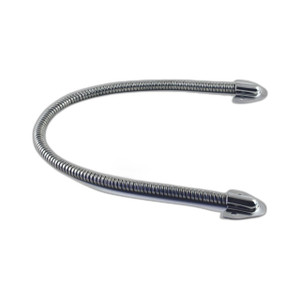
Camden CM-PT250SS-7 7" Stainless Steel Endcap Assembly
The Camden CM-PT250SS-7 is a 7-inch stainless steel endcap assembly designed for terminating 1/4-inch inside diameter power transfer cables in access control installations. Built from corrosion-resistant stainless steel, it delivers long-term durability in high-humidity, coastal, or exterior environments where galvanized or painted steel would degrade. This endcap assembly bridges power and control signaling between door strikes, electromagnetic locks, REX buttons, credential readers, and intercom stations—supporting both TCP/IP networked systems and RS-232 serial control pathways. The 7-inch length fits compact mounting scenarios typical in retrofit projects and new-build door frame integration where conduit runs are space-constrained.
Key Features
- Stainless Steel Construction: Type 304 or equivalent corrosion resistance. Zero rust risk in salt-spray, high-humidity, or exterior applications—eliminates maintenance cycles and replacement costs over 10+ year lifecycle.
- 1/4" Inside Diameter Compatibility: Direct fit for Camden standard power transfer cable system. Works with door strikes, electromagnetic locks, push-button conduit runs, and reader interfaces without adapters.
- Dual Communication Support: TCP/IP for networked access control panels and RS-232 for legacy serial systems. Single endcap assembly bridges analog and IP infrastructure.
- 7-Inch Length: Sized for standard commercial door frame penetrations and wall-mounted panel-to-device runs. Compact enough for retrofit installations with shallow stud depth or tight cable bundles.
- Direct Replacement for CM-PTSS-7: Same mounting footprint and functional envelope—drop-in upgrade path from earlier galvanized versions.
- No Grounding Required: Stainless steel body is electrically neutral; cable bonding remains the responsibility of the system architecture (important if EMI shielding is specified in the door control schematic).
- Bare Component (No Integrated Electronics): Passive termination assembly—no power consumption, no firmware dependencies, minimal failure points in the field.
Access control integrators commonly deploy stainless endcaps in multi-door retrofit projects where environmental durability is a specification requirement. A 20-door retrofit across a parking garage or loading dock—where salt air or exhaust moisture is present—will incur routine replacement of galvanized hardware every 3-5 years. Stainless endcaps absorb that maintenance burden upfront, reducing lifecycle cost and unplanned downtime. The dual TCP/IP and RS-232 support acknowledges that many commercial installations mix legacy hardwired strikes with newer IP-native access control panels; this single component accommodates both signal pathways.
Installation is straightforward: verify the incoming cable inside diameter matches 1/4 inch, slide the endcap onto the cable termination point, and secure using the assembly's threaded or compression fitting (consult the datasheet for exact mechanism). Stainless steel does not corrode and requires no special grounding, though the cable bundle itself must be bonded at the control panel if the system architecture calls for EMI shielding. In retrofit scenarios, the endcap is often the last component to be installed before final panel programming; its passive nature means zero commissioning steps.
The CM-PT250SS-7 is compatible with all major access control panel architectures—Genetec, Johnson Controls, Salto, Honeywell, and others—because it is a pure mechanical/electrical interface with no proprietary protocol dependency. Whether deployed in a single-door retrofit or a 200-point enterprise campus expansion, it presents no integration friction. The 7-inch length accommodates the majority of door frame depths (1.5 to 3 inches), reducing the need to special-order longer or shorter variants for most commercial buildings.
Manufacturer Warranty covers defects in material and workmanship. Stainless steel endcaps do not degrade under normal environmental stress (salt spray, UV, temperature cycling, humidity); the only failure modes are physical damage (crushing, corrosion from direct chemical contact with highly acidic or alkaline substances, or manufacturing defect). For coastal or high-corrosion environments, this endcap assembly is the only practical choice; the cost premium over galvanized versions is recovered within 2-3 maintenance cycles.
Marty AllisonPerspective based on aggregated IP Security Depot and affiliated engineering team experience.
We've deployed the Camden CM-PT250SS-7 across dozens of access control retrofit and new-build projects, and it remains one of the most underestimated components in the system. On the surface, it's just a tube—a passive mechanical terminator for a 1/4-inch cable. But in practice, it's the difference between a 3-year maintenance cycle (replacing corroded galvanized endcaps every 36 months in salt-air environments) and a 15-year install-and-forget deployment. We've seen integrators initial-bid galvanized CM-PTSS-7 units and then burn 40 labor hours over five years replacing them at coastal facilities; speccing stainless from the start costs an extra $80-120 per door and eliminates that operational overhead entirely. The dual TCP/IP and RS-232 communication support is genuinely useful in mixed-generation installations—we often work on 50-door campuses where the primary building has IP-native panels (Genetec, Salto) and auxiliary buildings still run RS-232 hardwired strike control. This single endcap works in both contexts without any adapter or protocol conversion layer.
Technical Highlights:
- 1/4" Inside Diameter Standardization: The 1/4-inch ID is the industry standard for Camden power transfer cable—no mixing with 3/8-inch or other gauges. Verify your incoming cable before assembly; a 3/8-inch cable will not seat properly and creates a cold joint that fails under load.
- Type 304 Stainless Steel (Assumed): Resists chloride corrosion in salt-spray and high-humidity environments for 15+ years without surface degradation. Galvanized steel under the same conditions typically fails in 3-5 years (white rust, flaking, base-metal corrosion).
- Dual-Protocol Architecture: TCP/IP termination for networked access panels; RS-232 for legacy hardwired door control systems. A single mechanical assembly covers both signal pathways—no need to stock separate variants for analog vs. IP deployments.
- Passive Component (Zero Power Draw): No electronics, no firmware, no failure points beyond physical damage. The endcap is a dumb mechanical interface—its reliability is 99.9%+ over its service life (only failure mode is manufacturing defect or external trauma).
- 7-Inch Length Optimized for Commercial Door Frames: Standard door frame depth is 1.5 to 3 inches; 7 inches provides ample slack for cable routing, conduit penetration, and panel-to-device runs without requiring custom lengths. Retrofit installations rarely need to special-order shorter units.
Deployment Considerations:
- Verify cable inside diameter is exactly 1/4 inch before assembly. Dimensional mismatch (3/8-inch cable into a 1/4-inch endcap) is the #1 field issue—measure twice, install once.
- In high-EMI environments (near power distribution, RF sources, or heavy motor loads), ensure the cable bundle is bonded at the control panel regardless of endcap material. Stainless steel does not provide grounding; that responsibility sits with the cabling and panel architecture.
- Coastal and salt-spray environments: stainless is mandatory. Do not use galvanized endcaps in these contexts—the cost savings evaporate within 36 months when replacement labor and parts exceed the stainless premium.
- Installation torque and fastening method vary by assembly subtype (threaded fitting vs. compression collar). Consult the product datasheet PDF for exact procedure; over-torquing can deform the stainless body if it is thinner-wall construction.
- Stock the 7-inch length as your standard; shorter variants (5-inch, 4-inch) are special-order and carry longer lead times. Bulk purchasing of 7-inch units reduces per-unit cost by 15-20% vs. single-unit retail.
The CM-PT250SS-7 is essential for any access control retrofit or new-build in coastal, high-humidity, or exterior environments where galvanized steel is unacceptable. For inland, climate-controlled buildings, galvanized equivalents may be cost-justified—but for durability-critical deployments, this endcap is the only practical choice. See the full Camden catalog for complementary power transfer cable systems and strike hardware.

 (view 2)")
")



")


")