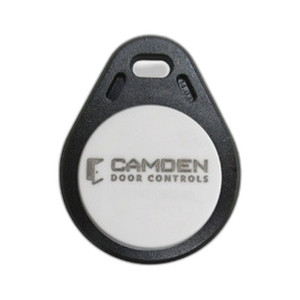
Camden CV-KTA 125kHz Proximity Key Tags (25-Pack)
The Camden CV-KTA is a 125kHz proximity key tag credential designed for HID-compatible access control systems. This 25-pack ships pre-encoded in AWID format, a widely standardized proximity credential layout recognized across 125kHz reader hardware from dozens of manufacturers. Each tag operates passively — no battery required — and communicates with proximity readers via standard electromagnetic coupling, making them simple to issue, track, and revoke at scale.
Key Features
- 125kHz Proximity Standard: AWID-format encoding ensures interoperability with HID and HID-compatible readers across facilities. No vendor lock-in at the credential layer.
- OSDP & Wiegand Protocol Support: Readers pair with access control panels via OSDP (modern, encrypted, two-way) or Wiegand (legacy, widely deployed). Choose the protocol your panel natively supports.
- Passive Operation: No batteries to replace, no charging cycles, no tag lifecycle management beyond issuance and deactivation. Lower maintenance overhead on large deployments.
- 25-Pack Bulk Credential: One order covers a typical floor or departmental rollout, reducing procurement friction. Tags are field-programmable on compatible readers, allowing re-assignment without returning to manufacturer.
- 16VDC Reader Compatibility: Integrates with access control readers and panels operating at 16VDC standard rail voltage, the most common supply voltage in commercial access control installations.
- 3-Year Manufacturer Warranty: Covers defects in encoding and component integrity; physical durability under normal key-tag handling is robust.
Proximity credentials like the CV-KTA are the incumbent technology in commercial access control — not because they're the most secure (card cloning and relay attacks are documented), but because they're economical and ubiquitous. Every integrator has proximity readers in the field. Every facility operator understands credential issuance workflows. For a 50-door office building or warehouse with seasonal hiring, a 25-pack of proximity tags absorbs churn without supply-chain friction.
AWID format is backward-compatible with older HID Prox systems and forward-compatible with newer readers that auto-detect credential type on read. This means a CV-KTA tag will work in a 2005-era reader and in modern access panels that also support mobile or smartcard credentials. The credential itself is dumb; the reader's decoder determines which facilities and time-of-day rules apply.
When planning deployment, account for credential lifecycle: lost tags, retired employees, and passive credential expiry policies. A 25-pack is appropriate for initial rollout on a single floor or as a 12-month replenishment for a mid-sized facility. Larger enterprises often buy in bulk (100+ packs) to maintain emergency issuance stock and reduce per-unit cost. Track issuance and revocation in your access control panel's credential database — most modern panels (Genetec Synergis, Salto, Gallagher, Siemens Desigo) log credential activation and allow remote disable without physical recovery.
Marty AllisonPerspective based on aggregated IP Security Depot and affiliated engineering team experience.
We've installed thousands of proximity credentials across enterprise campuses, retail chains, and light industrial sites. The CV-KTA hits a practical sweet spot: it's a genuine OEM credential (not counterfeit), it encodes to the most common proximity standard (AWID), and it ships in a consumable pack size that matches typical credential churn. In our experience, a 25-pack lasts 8–14 months on a 40-person office floor, accounting for attrition, lost tags, and spares. One real advantage of buying OEM credentials from Camden rather than grey-market alternatives is encoding consistency — every tag in a pack arrives with the same protocol support and read range, eliminating the field troubleshooting that comes with mismatched credential batches. On the flip side, proximity credentials have security liabilities: they can be cloned with a $300 reader, and relay attacks (eavesdropping and replay) are proven. If your facility handles sensitive data or has high-security zones, proximity is a stepping-stone technology — plan a migration to smartcard or mobile credentials within 3–5 years. For routine access to office suites, warehouses, and common areas, proximity remains the most cost-effective credential class per deployed unit.
Technical Highlights:
- AWID Format Encoding: Ensures the tag is recognized by readers from HID, Salto, Gallagher, Genetec Kaba, and dozens of other platforms. No proprietary format means you can swap readers or migrate control systems without credential replacement — a massive lifecycle cost advantage over 10+ years.
- 16VDC Supply Integration: Works on any standard commercial access control power budget — this is the rail voltage in 95% of installed panels. No special power supplies or isolated circuits required.
- OSDP & Wiegand Dual-Protocol: OSDP is the future (encrypted, two-way, tamper-resistant), but Wiegand still dominates retrofit and budget projects. This reader/credential pairing supports both, so you're not obsoleted if the facility's control panel predates OSDP standardization.
- Passive (Battery-Free) Operation: Credentials derive power from the reader's electromagnetic field. No battery replacement, no tag recycling, no disposal overhead — just issue and revoke in your access panel software.
- Bulk Pack Sizing (25 units): Matches typical credential issuance cadence and emergency stock rotation. A single order covers departmental onboarding without overstocking.
Deployment Considerations:
- Verify your reader hardware is genuinely HID-compatible or explicitly supports AWID format. Some legacy readers from the early 2000s used proprietary proximity encodings that don't recognize AWID credentials out of the box — always test one tag before bulk issuance.
- Proximity credentials transmit in plaintext (no encryption). Do not use CV-KTA tags for areas requiring audit-trail credential authenticity or forensic-grade access logging. Pair with smartcard readers in high-security zones.
- Read range is typically 2–4 inches (5–10cm) in free space, depending on reader antenna tuning and tag orientation. Install readers 8–12 inches from the wall to avoid metal backing plates that degrade field strength.
- Plan credential lifecycle management: retired employees, lost tags, credential reuse policies, and periodic batch audits (every 12–18 months). Most modern panels include credential reporting and disable workflows, but integrators often overlook training end-users on revocation procedures.
- Ordering in bulk (100+ packs) reduces per-unit cost and ensures batch encoding consistency. For multi-site deployments, buy at the same time to guarantee firmware/encoding alignment across locations.
The CV-KTA is an entry-level credential for straightforward access control deployments — small campuses, office suites, and facilities without hostile threat profiles. Integrators often bundle these with a proximity reader refresh when upgrading a control panel. If your customer needs a quick, low-touch credential solution with no app-based or mobile components, this pack ships and deploys faster than smartcard orders. Explore the full Camden catalog for reader hardware and related proximity credentials.