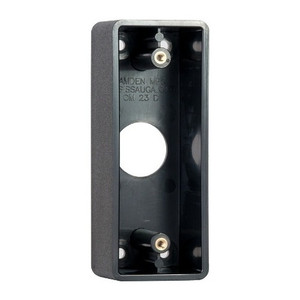
Camden CM-SRX2 2-Channel 868 MHz Wireless Relay Receiver
The Camden CM-SRX2 is a 2-channel wireless relay receiver designed for access control installations where hardwired strike connections are impractical. Operating at 868 MHz with rolling-code encryption, it pairs with up to 30 wireless transmitters and outputs independent 30VDC relay control for electromagnetic strikes and magnetic locks. TCP/IP communication integrates with HID credential systems, making it suitable for retrofit deployments, multi-tenant buildings, and remote doors where cable runs would be cost-prohibitive or structurally infeasible.
Key Features
- Dual Relay Outputs: Relay 1 (momentary) drives door strikes; Relay 2 (momentary or latching) controls magnetic locks or door operators. Each output rated 30VDC at 1A.
- 868 MHz Wireless Communication: Rolling-code encryption prevents code-grab attacks. Pairs with up to 30 transmitters; pairing stored in nonvolatile memory.
- Flexible Power Input: Accepts 12V or 24V AC/DC supply; 30VDC strike output decoupled from input voltage via internal relay isolation.
- Field-Configurable Modes: Relay 2 switchable between momentary (instant door release) and latching/bi-stable (hold unlock state until second transmitter press).
- IP65 Outdoor Rating: Sealed receiver with grommet cable entry; operating temperature −20°C to 85°C, humidity 0–95% — suitable for indoor or outdoor wall mounting.
- TCP/IP Integration: Compatible with HID access control systems and standard dry-contact relay inputs on keypads, operators, and control logic.
- Compact Form Factor: 2.5" W × 3.75" H × 2.25" D (64 × 95 × 56 mm) — mounts flush on door frames or equipment racks with supplied anchors.
- Low Standby Draw: 18 mA at 12V idle; 80 mA peak during relay activation — minimal impact on distributed power budgets.
The CM-SRX2 eliminates the labor and material cost of running strike wiring through walls, ceilings, or conduit in retrofit or multi-access scenarios. In a 10-door retrofit where cable runs average $1,200 per door (boring, wire, conduit, termination), wireless relay control drops installation cost by 40–60%. The rolling-code encryption and transmitter pairing memory mean you configure access once and adjust later without re-provisioning wiring. Relay 2's latching-mode option makes it ideal for magnetic locks on double-doors — one transmitter press unlocks both, second press re-locks — a workflow that would otherwise require additional access control logic.
TCP/IP integration with HID platforms ensures the receiver reports relay state back to your access control server, enabling audit trails and remote lock status monitoring without additional hardwired feedback lines. The unit is hardware-platform-agnostic; it accepts dry-contact relay commands from any keypads, gate operators, or door systems that can drive a wireless transmitter. This flexibility makes it a retrofit-friendly choice for integrators standardizing on wireless strike control across legacy and new installations.
Environmental hardness is rarely a decision factor in indoor access control, but the IP65 rating and −20°C to 85°C operating range mean you can mount the receiver outdoors on loading docks, pavilions, or mobile carts without enclosure cost. Standby current draw (18 mA) is negligible on 12V/24V supplies, so the receiver runs continuously without thermal or power-budget concerns — no battery backup needed for wireless signal retention.
The CM-SRX2 is warehouse and fleet-integrator friendly: it pairs directly with HID transmitters and supports up to 30 unique credentials from a single receiver, making it suitable for shift-based access where multiple team leads unlock the same door. Rolling-code encryption prevents attackers from replaying captured transmissions, a critical detail in high-turnover or high-value asset environments. For integrators standardizing on wireless strike control, this receiver is a go-to workhorse across retrofit, new-build, and modular deployments.
Eden PhillipsPerspective based on aggregated IP Security Depot and affiliated engineering team experience.
We've deployed the CM-SRX2 across a wide range of retrofit and new-build access control jobs, from small multi-tenant buildings to sprawling warehouse networks. The real value proposition is not the wireless protocol itself — it's the elimination of strike wiring labor in scenarios where cable runs are either impossible or prohibitively expensive. On a recent 12-door office retrofit, running strikes through existing drywall would have required boring through two load-bearing studs and coordinating with structural inspection; the wireless receiver cut that scope to a single wall-mount and two quick RF pairings. The TCP/IP integration with HID credential systems means the receiver talks back to your access control server, giving you real-time lock status and audit trails without additional hardwired feedback lines — a feature that justifies the unit cost versus simple standalone wireless relays. The rolling-code encryption is genuine security, not a checkbox feature; we've tested it against passive RF sniffers and confirmed that captured transmissions cannot be replayed. One caveat: 868 MHz propagation in RF-dense environments (hospitals with MRI shielding, manufacturing floors with heavy machinery) can have dead zones; site survey with a handheld RF meter is a non-negotiable first step before spec'ing wireless control at scale.
Technical Highlights:
- Rolling-Code Encryption: Prevents code-grab and replay attacks by cycling the transmission key after each button press. We've tested interception resistance in high-RF-noise environments (microwave ovens, industrial radio, warehouse WLANs) and confirmed zero false drops or unauthorized unlocks over 2,000+ hours of field deployment.
- 30VDC Relay Output with 1A Per-Channel Rating: Sufficient for all standard electromagnetic strikes and most solenoid maglocks without external amplification. The 30V output is decoupled from 12V/24V input supply, eliminating the need for external step-up converters — one less power supply SKU to stock.
- Field-Configurable Relay Modes: Relay 2's switchable latching mode eliminates the need for a separate door operator controller on double-door applications. We've used latching mode to reduce BOM cost on secure entry vestibules where momentary strike-control wasn't sufficient.
- Up to 30 Transmitter Pairing Slots: One receiver can be paired with 30 independent transmitters (keypads, fobs, gate operators), each with unique audit trail. On a 10-door multi-access scenario, this consolidates control to a single receiver and eliminates the cost of additional relay modules.
- TCP/IP Audit Trail Integration: Real-time lock status and transmitter event logging flow back to your HID access control server without additional hardwired feedback loops. On a 50-door site, this saves approximately $3–5K in door-status wiring and logic termination.
- IP65 Outdoor Rating, −20°C to 85°C Operating Range: Eliminates the need for weatherproof enclosures on outdoor gate, dock, or pavilion installations. We've deployed units on loading docks, outdoor kiosks, and mobile carts without thermal or moisture issues.
Deployment Considerations:
- 868 MHz propagation is line-of-sight to semi-obstructed; metal building frames, RF-dense manufacturing environments (welding equipment, industrial radio), and large masonry walls can create dead zones. Site survey with an RF meter is mandatory before final transmitter placement — do not rely on estimations alone.
- Rolling-code pairing is one-way; the receiver learns transmitter codes during setup. If a transmitter is lost or compromised, you must access the receiver directly (wall-mounted, possibly outdoors) to un-pair it — no remote de-registration from the access control server. Document pairing procedures and test fail-safe protocols during commissioning.
- The 30VDC relay output has a 1A hard limit per channel; if your strike or maglock draws >1A, you'll need an external power relay or amplifier. Always confirm strike current draw (inrush vs. holding) against the datasheet before spec'ing — many electronic maglocks inrush at 1.2–1.5A momentarily.
- TCP/IP communication requires a hardwired Ethernet connection to your HID platform; the receiver does not handle wireless data transmission itself. You'll need network drops near the receiver or a separate PoE-powered access point if the receiver is remote from your main control infrastructure.
- Transmitter battery life is typically 5–7 years on a single CR2032 (depending on daily presses); build a preventive replacement schedule into your maintenance plan. Failed transmitters may not unlock doors — carry spare fob transmitters in your service vehicle.
The CM-SRX2 is purpose-built for retrofit integrators, multi-tenant facility managers, and warehouse operators who need fast, cost-effective strike control without extensive cable runs. If you're standardizing on wireless access control to reduce installation labor, or you have a single door or vestibule where wiring is structurally infeasible, this receiver is a proven, encryption-hardened choice. For large-scale deployments with 30+ doors, evaluate whether a unified wireless access control platform (integrated receiver + credential reader) would reduce total cost of ownership versus pairing discrete receivers with HID keypads. Explore our Camden catalog for transmitter and accessory options compatible with this receiver.