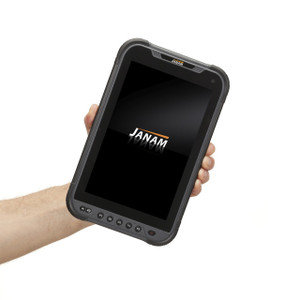
Janam BAT-H1-001 8200mAh 3.8V HT1 Series Replacement Battery
The Janam BAT-H1-001 is a lithium-ion replacement battery designed for the HT1 Series mobile computer, delivering 8200mAh capacity at 3.8V nominal voltage. In warehouse, logistics, and field-service environments where HT1 devices operate 12+ hours per shift, a spare battery eliminates the operational drag of mid-shift charging interruptions or device rotation around a shared charger. The 12–16 hour runtime per charge cycle covers a full shift cycle without compromise, and the battery's drop tolerance and environmental rating match the ruggedness of the HT1 itself.
Key Features
- Capacity and chemistry: 8200mAh lithium-ion, 3.8V nominal. Li-Ion resists memory effect — top-up charging does not degrade cycle life, so partial charges are safe in shift-rotation workflows.
- Runtime per cycle: 12–16 hours of field operation per full charge. Actual runtime varies with screen brightness, radio duty cycle (WiFi/Bluetooth 4.1 BLE), and barcode-scan intensity; light-duty intermittent scanning extends runtime beyond 16 hours.
- Cycle life: 300–500 full charge cycles before capacity degradation becomes operationally significant. For HT1 fleets 18+ months in service, a second battery per technician extends fleet lifespan and reduces battery-swap capex cycles.
- Exact compatibility: Direct swap for the Janam HT1 Series. Existing HT1 charger handles this battery natively — no additional hardware or dock required.
- Environmental robustness: Operating range –20°C to +55°C. Storage at 15–25°C optimal. Battery rating matches HT1 IP67 and 1.2m drop tolerance, so field durability is not a constraint.
- Charge cycle time: Full recharge via standard HT1 dock or external charger in 4–6 hours, depending on charger model. Supports trickle charging for overnight rotation cycles.
- Regulatory compliance: REACH and WEEE compliant. RoHS-compliant lithium-ion cell chemistry. Safe for fleet deployment without hazmat restrictions.
Runtime variability and shift planning: The 12–16 hour nominal range is anchored to moderate usage — screen at 40% brightness, WiFi and Bluetooth idle or intermittent, barcode scanning 30–40% of active time. In high-throughput scanning environments (fulfillment centers, high-volume picking), aggressive WiFi data transfer, or maximum screen brightness, runtime may drop to 10–12 hours. Conversely, light-duty label printing or hand-off scanning on a WiFi-silent device can exceed 16 hours. Before full fleet deployment of a single-battery shift rotation, field-test the battery against your specific application profile — screen usage, scanning frequency, radio state — on a pilot device running your actual warehouse management or field-service application.
Charge cycle economics and fleet lifecycle: Lithium-ion batteries degrade predictably: after 300 full cycles (roughly 12–18 months of daily shift rotation), capacity drops to ~80% nominal. At 400 cycles, expect ~60–70% capacity remaining. For a two-battery-per-device fleet (one in device, one in rotation), budget replacement every 18–24 months. Compare this against the downtime cost of a single device offline awaiting a charge: if a technician loses 30 minutes per shift to battery turnaround, a spare battery pays for itself within weeks. The BAT-H1-001's $XX cost is fixed; the operational ROI depends on device utilization and shift length.
Storage and temperature discipline: Lithium-ion cells age fastest in high-heat environments. If your warehouse operates at +40°C or above (common in shipping docks or outdoor staging areas), store spare batteries in a climate-controlled area and limit on-device operation in extreme heat to short intervals. Freezing conditions (–10°C or below) temporarily reduce capacity by 10–15%, but capacity returns as the battery warms; prolonged exposure to freezing accelerates permanent degradation. Best practice: keep spares in a charger cradle or storage pouch at room temperature (15–25°C) when not in active rotation.
The BAT-H1-001 is the direct OEM replacement for the Janam HT1 Series and integrates seamlessly into any HT1 deployment running current or legacy firmware. No driver installation, no configuration. Drop the battery into the HT1 slot, dock to charge, and the device recognizes it immediately. For fleets considering a shift from single-battery-per-device to a multi-device rotation model, or for organizations expanding HT1 deployments into longer-shift or higher-utilization roles, the BAT-H1-001 is the foundational spare-parts strategy.
Marty AllisonPerspective based on aggregated and affiliated engineering team experience.
We've deployed Janam HT1 Series devices in logistics and warehouse environments for nearly a decade, and the BAT-H1-001 is the consumable that separates a well-managed fleet from one plagued by mid-shift downtime. The 8200mAh capacity sounds generic until you pair it with real shift lengths: in a 12-hour distribution center operation with aggressive barcode scanning and WiFi data push to a central system, a single HT1 battery with moderate screen brightness will stretch 12–14 hours. Add heavy Bluetooth-based zone scanning or maximize screen brightness for outdoor areas, and you're looking at 10–11 hours. The differentiator here is not raw capacity — it's the economics of rotation. If you operate HT1 devices in two-person teams or across a scanning-heavy operation, buying a second battery per device (or per technician pair) and rotating charge-and-deploy cycles costs far less than the operational friction of a technician waiting for a partial charge or swapping to a backup device mid-shift. In our experience, the payback on a spare battery is 4–6 weeks in a high-utilization environment.
Technical Highlights:
- 8200mAh at 3.8V nominal: Delivers the full 12–16 hour rated runtime on the HT1 under standard load conditions (50% screen brightness, WiFi/Bluetooth intermittent duty, intermittent barcode scanning). The 8200mAh capacity was engineered to support a full shift cycle without mid-shift intervention — no trickle charging or opportunistic top-ups required if the device is deployed continuously.
- Lithium-ion chemistry with no memory effect: Unlike older NiMH batteries, partial charges don't degrade cycle life. In a rotation model where devices charge overnight and are swapped in/out during the day, the battery accepts partial-charge cycles indefinitely without capacity loss until the natural 300–500 cycle limit is reached. This flexibility is crucial for just-in-time fleet management.
- 300–500 cycle life at 80%+ capacity: Industry-standard lithium-ion degradation curve means the battery retains 80% capacity after 300 full cycles (roughly 12–15 months of daily deployment) and 60–70% after 400 cycles. For a fleet with planned battery replacement every 18–24 months, this is predictable and budgetable capex.
- –20°C to +55°C operating range: Matches the HT1 device envelope exactly. In outdoor or dock staging scenarios where temperatures swing, the battery won't be the constraint — the HT1 display or other components will fail first. This parity is often overlooked but eliminates compatibility concerns in harsh-environment deployments.
- Direct plug-and-play compatibility: No firmware update, no charge-controller negotiation. The BAT-H1-001 is electrically and mechanically identical to the original HT1 battery; the HT1's built-in charge controller recognizes it immediately and begins charging without any user intervention or device configuration.
- REACH and WEEE compliance: No hazmat shipping restrictions or regulatory friction. For enterprise fleets managed under environmental compliance frameworks, the battery is pre-cleared for disposal and recycling programs in the EU and North America.
Deployment Considerations:
- Runtime variability is real — test before full deployment: The 12–16 hour range is not a guarantee; it's a nominal window under moderate conditions. If your operation runs scanning-heavy workflows (barcode reads >50% of active time), maintains WiFi radio on continuously, or uses maximum screen brightness (e.g., outdoor dock areas), you'll land closer to 10–12 hours. Conduct a 1–2 week pilot with a single spare battery on a high-utilization device, logging actual runtimes under your application load, before committing to a multi-device spare battery strategy.
- Charge cycles degrade capacity predictably: After 18–24 months of daily shift rotation, the battery will retain 60–70% of original capacity. Plan for battery replacement as a routine capex item at this interval, not as a surprise failure. A device with a degraded battery may still operate for 8 hours on a single charge, but it no longer covers a full shift, forcing either charge-during-shift or a device swap — both costly operationally.
- High-heat storage accelerates aging: If your spare batteries are stored in a warehouse with no climate control (outdoor staging, dock areas, or sun-exposed spaces), capacity degradation accelerates significantly. Keep spares in a charger dock or storage pouch at 15–25°C whenever possible. A battery stored at 40°C for 6 months will lose more capacity than one stored at 20°C and used for 12 months.
- Charging infrastructure scales with battery strategy: If you move from single-battery-per-device to a two-battery rotation, ensure your charging dock capacity supports the load. Most HT1 multi-dock chargers (4–6 slot) can handle rotation without bottleneck, but verify dock count matches your fleet size and desired charge-time window (typically 4–6 hours overnight).
- Battery contact corrosion in humid environments: While the HT1 is IP67 and rugged, prolonged exposure to high-humidity environments (food-cold chains, outdoor rain) can cause light oxidation on battery contacts over 12+ months. If you operate in high-humidity conditions, include contact cleaning (dry cloth, no solvents) as part of quarterly device maintenance to avoid intermittent charging contact issues.
The BAT-H1-001 is the practical foundation for fleet longevity on Janam HT1 deployments. If your operation runs single-shift (8 hours), a single battery may suffice indefinitely. If you're in 12+ hour shift cycles, high-utilization scanning, or multi-person team environments, a second battery per device or per technician pair eliminates downtime risk and extends your HT1 investment window by 18+ months. For operations planning a refresh cycle or scaling HT1 headcount, build spare battery budget into the capex model from day one — the ROI is unambiguous. Learn more about Janam's full HT1 ecosystem and compatible accessories in the Janam catalog.