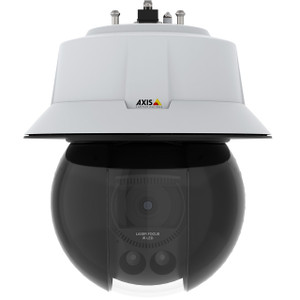
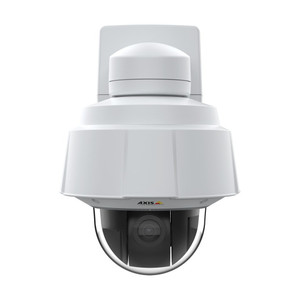
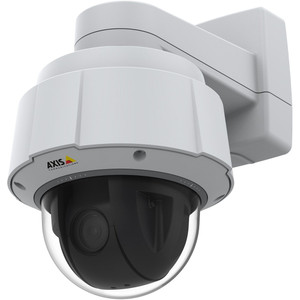
Axis 02023-004 V5938 8MP 4K PTZ Live Streaming Camera
The Axis V5938 (model 02023-004) is a professional PTZ network camera designed for broadcast-quality live streaming and demanding surveillance in auditoriums, stadiums, classrooms, and production control rooms. It delivers 8MP 4K resolution with extensive pan-tilt-zoom coverage, making it suitable for environments where operators need to capture dynamic subjects across large spaces without repositioning multiple fixed cameras.
Key Features
- 8MP 4K resolution at 30fps standard, 60fps maximum: Produces broadcast-grade video detail across the entire frame. The 60fps capability is critical for fast-action environments like live sports or theater production — it eliminates motion blur that would otherwise require post-processing compensation or multiple replay angles.
- 20x optical zoom with 4.4–88.4mm focal length: Lets you frame wide-angle crowd shots and tight close-ups of speakers or performers from a single mounting location. Optical zoom preserves image detail; the additional 12x digital zoom extends reach but at the cost of interpolated pixel data — reserve it for secondary angles or situations where pixel-level sharpness is not critical.
- ±170° pan, -20° to +90° tilt coverage: Delivers near-hemispheric movement. This range eliminates blind spots in most indoor deployments and avoids the mechanical complexity and service issues of 360° endless-pan designs, making it more suitable for climate-controlled venues.
- 1 lux minimum illumination plus IR night vision: Operates in very dim lighting (theater house lights down, stadium lighting off) and switches to IR for complete darkness. 1 lux translates to roughly moonlight level — acceptable for general surveillance but not for fine detail capture in those conditions. IR mode shifts the image to grayscale and has no zoom advantage, so operators will need to pre-position zoom before darkness falls.
- H.264 compression with Axis Zipstream technology: Reduces bitrate 30–50% compared to standard H.264 encoding without degrading perceived quality. On 24/7 multi-camera systems, this lowers NVR storage cost and network bandwidth load — meaningful savings when deploying across multiple venues.
- Autotracking 2 for automated subject following: Keeps dynamic subjects centered in the frame without manual pan-tilt input. Useful for single-operator control of large spaces, but requires clear contrast between subject and background and performs best outdoors or in well-lit environments. Avoid relying on it in shadowed areas or crowds.
- 1/2.5" CMOS sensor with Dynamic Contrast WDR: Handles mixed lighting (sunlit windows alongside indoor lighting) by locally adjusting contrast per region of the frame. This prevents blown highlights in bright areas while keeping dark corners visible — essential for venues with skylights, stage lighting, or mixed ambient and artificial light.
- Professional audio support with audio detection: Includes built-in microphone and audio input connector. Audio detection triggers alarms or recordings on sound events. Integrated audio eliminates the need for separate condenser microphones in broadcast workflows, though high-quality lavalier or boundary mic input is still standard practice for production-grade sound.
- Dual alarm inputs and outputs (1/1): Allows external devices (lighting rig, PTZ controller, graphics mixer) to trigger camera actions and vice versa. Tight integration with studio equipment reduces manual coordination overhead.
- PoE power with DC fallback: Draws power from a standard PoE injector or switch. DC option provides redundancy if PoE fails — install a secondary DC supply to keep critical deployments online during switch reboot or PoE power budget exhaustion.
- Signed firmware and secure boot: Protects against unauthorized code injection. These mechanisms are table-stakes in broadcast environments where content security and system integrity matter, but do not prevent network-layer attacks — pair with VLAN isolation and 802.1X authentication for full security posture.
Deployment Context
The V5938 excels in fixed indoor venues with professional AV infrastructure. Its extensive pan-tilt range and 20x zoom minimize the number of cameras required to cover large spaces like lecture halls, auditoriums, and arena floors. The combination of 1 lux low-light sensitivity and IR night vision supports operation through lighting transitions (house lights dimming for presentation, then brightening), reducing the need for manual gain or iris adjustments that would degrade video quality.
Wired connectivity and PoE architecture eliminate wireless reliability concerns and simplify installation in permanent installations. The V5938 is not weather-rated, so skip this model if you need outdoor deployment — consider an outdoor PTZ variant in the Axis IP camera line instead.
Integration & Compatibility
The V5938 is ONVIF-compliant and integrates with standard network video recorders and VMS platforms that support ONVIF Profile S and T. Axis Camera Station and Milestone XProtect both support native Axis PTZ profiles, allowing operators to trigger pan-tilt presets and zoom commands directly from a control interface. The H.264 codec is widely supported across legacy and modern NVR platforms, reducing format conversion overhead during migration or multi-vendor deployments.
Audio streams independently from video, so ensure your NVR or media server is configured to record both streams if synchronized sound is required. The dual alarm I/O can be wired to PoE switches with managed alarm relay outputs for centralized event handling across multiple cameras.
Frequently Asked Questions
Q: Does the Axis 02023-004 support ONVIF?
A: Yes. The V5938 is ONVIF-compliant and supports Profile S (streaming) and Profile T (PTZ control), enabling integration with third-party NVRs and VMS platforms that recognize ONVIF standards.
Q: What is the maximum frame rate at 4K resolution?
A: The V5938 delivers 30fps as standard at 8MP (4K). The 60fps maximum capability is achieved at lower resolutions or reduced image regions — consult the manufacturer datasheet for the exact resolution-to-frame-rate trade-off curve if 60fps at full 4K is required for your workflow.
Q: Does the V5938 require a separate power supply?
A: No. The camera is PoE-powered and draws compliant wattage for standard 802.3af injectors. A DC option is available as redundancy if PoE becomes unavailable, but DC is not required for normal operation.
Q: Can the V5938 operate outdoors?
A: No. The V5938 is rated for indoor climate-controlled environments (0–40°C operating temperature). It lacks an IP67 or higher environmental rating and is not weather-sealed. For outdoor PTZ deployments, select an outdoor-rated PTZ variant from the Axis catalog.
Q: What is the minimum light level for the V5938 to produce usable color video?
A: The camera is rated at 1 lux minimum illumination for color operation. Below that threshold, the camera switches to IR mode (grayscale, 850nm LED illumination). In theater environments with house lights dimmed to 0.5 lux or lower, IR mode will activate automatically — color will not be available in those conditions.
Q: Does Zipstream technology reduce video quality?
A: Zipstream reduces bitrate 30–50% by analyzing scene complexity and suppressing data in static regions. Perceived quality remains comparable to standard H.264 for most surveillance and broadcast use cases. In fast-action or high-motion scenes, some operators prefer to disable Zipstream and allocate higher bitrate if bandwidth is available.
Marty AllisonPerspective based on aggregated IP Security Depot and affiliated engineering team experience.
The Axis 02023-004 V5938 bridges the gap between surveillance infrastructure and broadcast production equipment. Its 20x optical zoom paired with 1 lux low-light sensitivity delivers flexibility across diverse lighting conditions — a critical advantage in venues where stage lighting, house lighting, and daylight all compete. The autotracking feature ensures dynamic subjects remain centered without manual operator intervention, reducing fatigue during long events and freeing the operator to manage multiple PTZ cameras simultaneously.
Technical Highlights:
- ±170° pan and -20° to +90° tilt: Near-hemispheric coverage without mechanical complexity of endless-pan designs. Avoids the service intervals and bearing wear that plague continuous-rotation PTZ heads in 24/7 venues.
- H.264 with Zipstream: 30–50% bitrate reduction compared to standard H.264. On 24/7 recording across 4–6 PTZ cameras, this nets real storage savings — typically 15–25% overall system bitrate reduction depending on scene motion.
- Dual alarm I/O with audio detection: Enables tight integration with external studio equipment (lighting rigs, graphics mixers, automated lighting systems). Audio detection can trigger recording or alerting when speech or crowd noise crosses a threshold.
Deployment Considerations:
- Indoor-only rating: 0–40°C operating range. This camera will not tolerate temperature swings, moisture, or UV exposure — outdoor venues require a different PTZ variant.
- 1 lux is theater-dark, not pitch-black: Below 1 lux (house lights dimmed to near-off), the camera switches to IR grayscale automatically. Operators planning 24/7 operation in dim venues must either accept IR output or add supplemental lighting.
- 60fps requires resolution trade-off: The 60fps maximum is achieved at reduced resolution or smaller ROI. If your broadcast workflow demands 60fps at full 8MP, verify frame rate against resolution using the manufacturer datasheet before committing to this model.
The V5938 is best deployed in fixed auditorium, classroom, and sports broadcast environments where professional AV infrastructure is already in place and operators are comfortable managing PTZ presets and pan-tilt control. It is not a plug-and-play surveillance camera — it is a production tool that rewards skilled setup and ongoing operator attention.