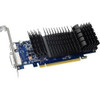
ASUS GT1030-2G-CSM GeForce GT 1030 2GB GDDR5 Low-Profile Graphics Card
The ASUS GT1030-2G-CSM is a discrete PCIe 3.0 graphics card built around NVIDIA's GeForce GT 1030 GPU with 2GB of GDDR5 memory — a practical add-in card for small-form-factor workstations, video wall controllers, and multi-display security operator stations where the integrated graphics simply can't drive the required outputs. If you're standing up a surveillance review workstation or a dual-screen dispatch console and need a low-power, single-slot discrete GPU that won't demand a new power supply, this is the card to evaluate.
Key Features
- GeForce GT 1030 GPU at 1266 MHz base / 1506 MHz boost: The 1506 MHz GPU boost clock gives the GT1030-2G-CSM enough headroom to decode and render multiple 1080p streams simultaneously — adequate for a 4–8 camera review station running decoded streams in a VMS client without hammering the host CPU.
- 2GB GDDR5 at 6008 MHz on a 64-bit bus: GDDR5 at 6008 MHz delivers roughly 48 GB/s of memory bandwidth over a 64-bit interface. For a card in this class, that's sufficient for dual-1080p display operation and lightweight CUDA workloads. Don't expect 4K gaming, but for driving dual 1920×1080 operator monitors this is the point.
- HDMI 2.0b + DVI-D — two simultaneous displays: HDMI 2.0b supports up to 4K@60Hz on a single port (though the card's GPU is the practical limit at 1080p), and the DVI-D port handles a legacy monitor without an adapter. Two display outputs means one card supports a standard dual-screen operator workstation with no splitters or docking hacks.
- PCIe 3.0 interface — broad motherboard compatibility: PCIe 3.0 x16 slots are universal on commercial workstation and server platforms from the last decade. This card also runs in PCIe 2.0 slots at reduced bandwidth — no meaningful performance impact at this GPU tier. Drop it into nearly any available slot in a small workstation chassis.
- DirectX 12 and PhysX support: DirectX 12 support matters less for pure surveillance use than for mixed-use workstations running modern software stacks. If the station doubles as a light productivity or visualization machine, DX12 keeps options open without requiring a higher-power card.
- CUDA-enabled GPU: NVIDIA CUDA support means certain VMS platforms and analytics engines can offload decode or inference tasks to the GPU rather than the CPU. At the GT 1030 tier this is modest, but for small deployments running software-based motion detection or basic decoding offload, it's a real capability — not marketing language.
- Maximum resolution 1920×1080: The GT 1030 is optimized for 1080p output. If your operator monitors are 1080p — the most common standard in commercial security installations — this card is correctly spec'd and won't be the bottleneck. For 4K workstations, look higher in the NVIDIA lineup.
Integration and Compatibility
The GT1030-2G-CSM installs into any PCIe 3.0 (or 2.0) x16 slot and draws power from the slot alone — no auxiliary power connector required, which matters in compact workstations where the PSU headroom is limited. The card weighs 1.75 lb and measures 14.00 × 11.50 × 3.50 inches, so verify your chassis clearance before ordering; this is not a half-height or true low-profile card despite the GT 1030 silicon's compact nature. HDMI 2.0b and DVI-D outputs are directly compatible with the overwhelming majority of commercial operator monitors. For IP camera review workstations feeding into a network video recorder or VMS client, this card handles the display rendering load without requiring a workstation-class GPU. It pairs well with any PoE network switch infrastructure feeding cameras into a central review console. If your VMS platform supports CUDA-accelerated decoding, verify driver compatibility on your specific OS — ASUS publishes driver support via the NVIDIA standard driver stack. For operators managing outdoor IP camera feeds from a central console, this card drives two monitors cleanly at full 1080p without thermal or power concerns in a standard office environment.
Frequently Asked Questions
Q: What display outputs does the GT1030-2G-CSM provide?
A: The GT1030-2G-CSM has one HDMI 2.0b port and one DVI-D port, supporting up to two simultaneous displays at a maximum resolution of 1920×1080 pixels each.
Q: Does the GT1030-2G-CSM require an external power connector?
A: No. The card draws power entirely from the PCIe slot, making it compatible with compact workstations and small-form-factor systems with limited PSU headroom.
Q: What is the GPU boost clock speed on the GT1030-2G-CSM?
A: The GeForce GT 1030 on this card boosts to 1506 MHz, with a base clock of 1266 MHz. This headroom supports sustained multi-stream video rendering without thermal throttling under typical operator workstation loads.
Q: Is the GT1030-2G-CSM compatible with PCIe 2.0 motherboards?
A: Yes. PCIe 3.0 cards are backward-compatible with PCIe 2.0 slots. Performance at the GT 1030's tier is not meaningfully affected by the reduced bandwidth of a PCIe 2.0 slot.
Q: Does the GT1030-2G-CSM support CUDA for GPU-accelerated decoding in VMS software?
A: Yes, the GeForce GT 1030 is CUDA-enabled. Whether a specific VMS platform leverages CUDA for stream decoding or analytics offload depends on the software — consult your VMS vendor's GPU acceleration documentation for compatibility details.
Q: What are the physical dimensions of the GT1030-2G-CSM?
A: The card measures 14.00 × 11.50 × 3.50 inches and weighs 1.75 lb. Verify chassis clearance before installation, particularly in compact or small-form-factor enclosures.
The GT1030-2G-CSM earns its place in security workstation builds specifically because of the slot-only power draw — no 6-pin connector, no PSU upgrade conversation. I've spec'd this card into compact operator consoles where the integrator had a Lenovo ThinkCentre or HP EliteDesk with a 180W brick supply and needed a second monitor output without touching the power chain. The 1506 MHz boost clock on the GT 1030 handles that workload cleanly.
Technical Highlights:
- GDDR5 at 6008 MHz: At ~48 GB/s of memory bandwidth, this card handles dual 1080p decode rendering without frame drops on a properly configured VMS client — the memory subsystem is the right tier for this GPU class.
- HDMI 2.0b output: HDMI 2.0b is the version that supports HDR signaling and 4K@60Hz — future-proof for the monitor side even if the GPU itself tops out at 1080p practical output. No adapter needed for modern commercial displays.
- CUDA support on GT 1030: Modest but real. VMS platforms like Milestone and Genetec can use CUDA for stream decoding offload. At the GT 1030 tier, expect relief on 4–8 stream decode, not 64-channel AI analytics.
Deployment Considerations:
- The card physically measures 14.00 × 11.50 × 3.50 inches — measure your chassis before ordering. Despite GT 1030 being marketed as a compact GPU, the ASUS PCB is full-length. Tight small-form-factor cases may not clear it.
- Maximum resolution is 1920×1080 per output. If your deployment spec calls for 4K operator monitors, this card is not the right pick — step up to a GT 1050 Ti or higher within the NVIDIA lineup.
The GT1030-2G-CSM is the right call for a dual-1080p security operator console running 4–8 decoded camera streams in a VMS client, installed in a compact commercial workstation where PSU headroom is the binding constraint. Don't put it in a 4K video wall controller or a heavy analytics workstation — it's not built for that load.