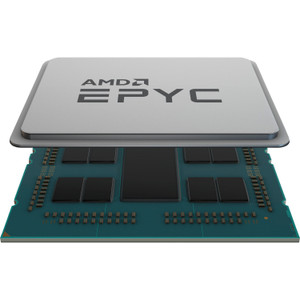
HPE P76562-B21 AMD EPYC 9555 64-Core Server Processor
Overview
The HPE P76562-B21 is a factory-new AMD EPYC 9555 processor validated for HPE OEM platforms — a 64-core, SP5-socket CPU aimed squarely at dense compute workloads where per-socket core count, memory bandwidth, and I/O throughput determine whether a server node keeps up or becomes the bottleneck. At 3.2 GHz base with boost to 4.4 GHz, it covers both throughput-sensitive parallel work and latency-sensitive single-threaded operations without requiring a different SKU for each use case. If you are speccing a new HPE rack node for AI inference, high-throughput database, or large-scale virtualization, P76562-B21 (often searched as P76562 B21) belongs on your evaluation shortlist.
Key Features
- 64 Physical Cores per Socket: Double the core density of mid-range server CPUs means more VMs per host or more parallel inference threads without adding a second physical server — directly reduces per-workload licensing costs on per-socket software like VMware or SQL Server.
- 3.2 GHz Base / 4.4 GHz Boost: The 1.2 GHz spread between base and boost gives the scheduler room to accelerate single-threaded work (query planning, compilation, sequential log replay) while the base clock sustains predictable throughput under full 64-core saturation — useful for mixed workloads that can't be neatly parallelized.
- 256 MB L3 Cache: At 256 MB, the on-die cache is large enough to hold working sets that would otherwise spill to DRAM on competing platforms — meaningful for in-memory databases, analytics engines, and security event correlation platforms processing large time-window data sets without cache thrash.
- PCIe 5.0 x128 Lanes: 128 lanes of Gen 5 doubles the raw bandwidth of a PCIe 4.0 platform per lane — a single socket can saturate multiple 100 GbE NICs, NVMe Gen 5 arrays, and GPU/accelerator cards simultaneously without lane contention. For storage-heavy or networking-heavy HPE configurations, this headroom matters.
- 12-Channel DDR5 up to 6000 MT/s: Twelve memory channels at up to 6000 MT/s yields up to 576 GB/s of per-socket memory bandwidth — roughly 2–3x a dual-channel DDR4 workstation. Workloads that are memory-bandwidth-bound (genomics, large matrix operations, video analytics at scale) see direct throughput improvements proportional to how bandwidth-starved the previous platform was.
- DDR5 Memory Architecture: DDR5 delivers improved per-DIMM capacity ceilings compared to DDR4, meaning you can populate higher total system memory per node — important when running large in-memory datasets or many memory-hungry VMs without going to a two-socket configuration.
- SP5 Socket: The EPYC 9000-series SP5 socket is the current-generation HPE platform socket, keeping this processor relevant for the next HPE server generation cycle and ensuring accessory ecosystem support (coolers, memory, validated adapters) through mainstream availability.
Integration & Compatibility
The P76562-B21 is validated for HPE OEM platforms using the SP5 socket — verify your specific HPE server model's QuickSpecs or HPE SPOCK compatibility tool to confirm support before ordering. The processor pairs with DDR5 DIMMs running up to 6000 MT/s across 12 channels; populate channels symmetrically for full bandwidth. PCIe 5.0 x128 lane availability depends on the HPE platform's physical slot layout and bifurcation support — not every SP5 board exposes all 128 lanes to accessible slots. For HPE server platforms already in your environment, cross-reference the server's supported processor list; SP5 does not accommodate prior-generation EPYC 7000/8000 CPUs and is not backward compatible with SP3. If you are building a new node around this CPU, review the server processor catalog alongside validated memory and storage options. For infrastructure teams evaluating high-core-count compute, a high-throughput switching fabric is typically the next bottleneck after upgrading per-socket compute density — 64-core nodes generating NVMe and network I/O at scale can expose underspecced ToR switches quickly. For guidance on matching processor specs to workload requirements, the server selection guide covers core-count vs. clock-speed trade-offs in depth.
Frequently Asked Questions
Q: What HPE server models is the P76562-B21 compatible with?
A: The P76562-B21 uses the SP5 socket and is validated for HPE OEM platforms supporting the EPYC 9000 series. Verify compatibility against the specific HPE server's QuickSpecs or HPE SPOCK tool before ordering — SP5 is not interchangeable with prior EPYC socket generations.
Q: What memory type and speed does the P76562-B21 support?
A: The EPYC 9555 supports DDR5 across 12 memory channels at up to 6000 MT/s, delivering up to 576 GB/s of per-socket memory bandwidth. Populate channels symmetrically to reach maximum bandwidth.
Q: What is the warranty on the P76562-B21?
A: Per available product data, the P76562-B21 carries a 90-day seller warranty. No manufacturer warranty term is confirmed for this SKU — factor this into your procurement decision for production environments.
Q: Does the P76562-B21 support PCIe 5.0?
A: Yes. The EPYC 9555 provides PCIe 5.0 with up to 128 lanes per socket. Actual accessible lanes depend on the HPE platform's physical slot layout and bifurcation configuration.
Q: What is the boost clock speed of the P76562-B21?
A: The EPYC 9555 boosts up to 4.4 GHz from a 3.2 GHz base clock, giving the CPU headroom to accelerate single-threaded operations while sustaining 3.2 GHz across all 64 cores under full load.
Q: Is the P76562-B21 a new or refurbished unit?
A: The P76562-B21 is listed as brand new, factory-new condition — not refurbished or previously installed.
The P76562-B21 is one of those processors where the spec that stands out is the 576 GB/s per-socket memory bandwidth — that number changes what you can run on a single node. I have seen plenty of deployments where the CPU core count looked fine on paper but the actual bottleneck was memory bus saturation under concurrent workloads; the 12-channel DDR5 architecture on the EPYC 9555 removes that ceiling for most enterprise use cases short of in-memory databases at extreme scale.
Technical Highlights:
- 256 MB L3 Cache: At this cache size, a single socket can hold working sets that would thrash DRAM on a 32–64 MB L3 platform — directly relevant for security analytics engines correlating event streams across multi-hour windows in memory.
- PCIe 5.0 x128 Lanes: 128 Gen 5 lanes per socket means you can attach dual 100 GbE NICs, multiple NVMe Gen 5 arrays, and a GPU without hitting lane saturation — no need to choose which I/O path gets bandwidth priority.
- 4.4 GHz Boost Clock: The 1.2 GHz boost headroom above the 3.2 GHz base is usable for real workloads — query planning, JIT compilation, log parsing — not just synthetic benchmarks, because the thermal envelope of an SP5 platform is designed to sustain boost on lightly threaded jobs.
Deployment Considerations:
- SP5 is not backward compatible with EPYC 7002/7003 (SP3) platforms — confirm your HPE chassis supports the 9000 series before the processor ships; a socket mismatch is not a field fix.
- The 90-day seller warranty and no confirmed manufacturer warranty term means this SKU is better suited to environments with existing HPE support contracts or spares pools than to standalone production nodes without a fallback CPU.
For HPE rack deployments running dense virtualization, large-scale video analytics, or AI inference workloads where per-socket bandwidth and lane count determine node design, the P76562-B21 is the right call — specifically in configurations where memory bandwidth, not core count alone, is the gating resource.