

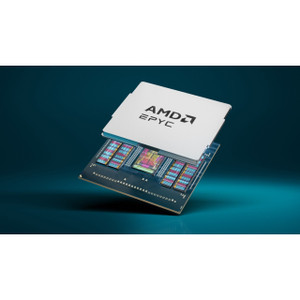
AMD 100-000001542 Epyc (forty-eight-core) Model 9455
Usually Ships in 2-3 Weeks
Free shipping over $499
$4,799.99

Manufacturer-verified compatible cameras, recorders, mounts, accessories, and licenses for this product. Adjust quantities and add the entire bundle to your cart in one click.
Questions about this product? Free pre-sales support from a senior specialist — product questions, compatibility checks, BOM quotes, price confirmation — typically answered within one business day. Need camera placement or system design work? Engineering time is $175 per hour (qty 1 = 1 hour). Hardware buyers get up to one hour ($175) credited back on their order.
The AMD 100-000001563 is a 48-core EPYC processor engineered for high-density compute deployments in data centers, surveillance infrastructure, and edge systems. This processor delivers the core count and memory bandwidth necessary for simultaneous video analytics, encoding, and recording workloads — the kind of real-time processing that single-threaded or smaller-core CPUs cannot sustain. Weighing just 0.50 lb with a minimal footprint (1.00 x 1.00 x 0.25 inches), the 100-000001563 integrates into existing server platforms where space and thermal efficiency matter.
The 100-000001563 integrates into EPYC-socket server platforms commonly deployed as NVR backbones, video analytics appliances, and edge surveillance gateways. Verify your target motherboard or OEM system specification references EPYC socket compatibility before procurement. UNSPSC code 43201503 classifies this as a processor component, meaning integration requires a compatible server chassis, power supply, and memory module selection.
This processor is a core compute element, not a complete system. Buyers should already have a defined server platform (OEM appliance, bare-metal chassis, or motherboard SKU) in mind. The 48-core count makes sense for centralized surveillance backends handling 50–200+ camera streams, AI-driven event detection at scale, or edge-compute appliances running multiple analytics models in parallel. Single-NVR or small-scale (under 10-camera) deployments typically benefit from lower-core-count options.
No package contents are specified in manufacturer documentation. Verify with your supplier whether thermal solution, documentation, or mounting hardware are included separately.
Q: Is the AMD 100-000001563 suitable for a small surveillance system with 4–6 cameras?
A: No. The 48-core EPYC architecture is overkill for small deployments and results in unnecessary cost. A lower-core-count processor or integrated NVR appliance is more cost-effective for that scale.
Q: What video encoding formats does the 100-000001563 support?
A: The processor itself is format-agnostic — it executes software codecs (H.265, H.264, VP9, AV1) based on whatever surveillance application you deploy. Some EPYC platforms include hardware accelerators; verify your OEM system specification.
Q: What is the thermal design power (TDP) of the 100-000001563?
A: TDP is not specified in available documentation. Contact the OEM system integrator or AMD directly for thermal specifications before finalizing chassis cooling design.
Q: Can I use the 100-000001563 in a standard x86-64 server?
A: Yes, if the server motherboard features an EPYC socket. Confirm socket revision and BIOS compatibility with your motherboard manufacturer before purchasing.
Q: What warranty covers the 100-000001563?
A: Warranty terms are not documented in the provided specifications. Check with the distributor or OEM integrator for coverage details.

The AMD 100-000001563 is a compute engine, not a turnkey appliance — I bring this up because I've seen integrators spec the wrong processor tier and end up with either performance bottlenecks or wasted capacity. This 48-core part makes sense when you're designing a centralized video analytics cluster or an edge gateway that runs object detection, facial recognition, or behavior analytics across dozens of inbound streams in real time. The core count means zero serialization delays; your encoding and analytics pipelines run in parallel without stepping on each other.
Technical Highlights:
Deployment Considerations:
The 100-000001563 shines in two scenarios: first, a centralized NVR appliance handling 150+ simultaneous RTSP streams where you need analytics-at-ingest without frame loss; second, an edge-compute platform running deep-learning models in parallel across multiple camera zones. If neither fits your architecture, step down to a smaller core count and reinvest the savings in redundancy or storage.

Manufacturer-verified compatible cameras, recorders, mounts, accessories, and licenses for this product. Adjust quantities and add the entire bundle to your cart in one click.


Looking for more AMD products? Shop the full AMD catalog →
Support services and planning resources for commercial surveillance, access control, and infrastructure deployments.
Fixed scope • Fixed price