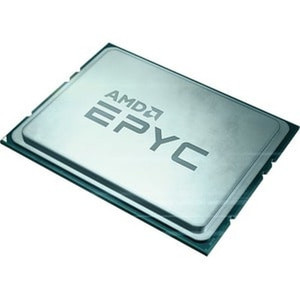
AMD 100-000000141 EPYC 64-Core Server Processor
Overview
The AMD 100-000000141 is a 64-core, 128-thread EPYC processor designed for high-throughput compute workloads in data center and enterprise surveillance environments. Built on AMD's proven Zen architecture, this CPU delivers sustained performance at 2.45 GHz base with boost to 3.50 GHz, backed by 256 MB of L3 cache and support for 8 DDR4/DDR5 channels running at up to 3200 MT/s. The 280 W TDP makes it a practical fit for dense multi-camera NVR platforms where per-watt efficiency directly impacts operational cost.
If you are building a surveillance backbone that ingests streams from 50+ cameras simultaneously, indexes metadata in real time, and stores footage for 30+ days without external storage arrays, the 100-000000141 provides the core compute density to do that without over-specifying. The PCIe Gen 4 bus with 128 lanes gives you the I/O bandwidth to attach multiple 10GbE network cards, SAS expanders, and NVMe storage controllers without bottlenecking.
Key Features
- 64 Cores / 128 Threads: Direct parallel processing of up to 128 concurrent video streams or analytics workloads. In a typical multi-camera NVR, this means you can handle H.265 transcoding, object detection, and storage I/O for dozens of cameras in a single pass without spawning separate hardware nodes.
- 3.50 GHz Max Boost Frequency: Per-core turbo reach enables single-threaded analytics (face detection, license plate recognition) to complete within the frame budget — critical when you need sub-100ms inference latency on motion events.
- 256 MB L3 Cache: Large on-die cache reduces memory round-trip latency for video frame buffers and neural network weights. Means lower memory bandwidth contention when running concurrent analytics pipelines.
- 8 DDR Channels @ 3200 MT/s: 204.8 GB/s aggregate memory bandwidth supports sustained ingest of multiple 4K streams (each consuming 1.5–2 GB/s of uncompressed data) without stalls. DDR channel diversity also improves NUMA locality on multi-socket deployments, keeping per-core memory access predictable.
- 128 PCIe Gen 4 Lanes: Enough I/O for dual 25GbE NICs (16 lanes each), NVMe storage controller (16 lanes), and PCIe-based accelerators (GPU, inference cards) simultaneously without lane sharing compromises. Gen 4 doubles throughput vs. Gen 3, reducing network packet loss on sustained 10+ Gbps ingest.
- 280 W Thermal Design Power: Conservative TDP means you can pair multiple 100-000000141 CPUs in a 2U or 4U chassis without exceeding standard 5kW power supplies. In a surveillance facility running 24/7, that translates to lower cooling overhead and predictable power budgeting across dozens of NVR nodes.
Integration & Compatibility
The 100-000000141 is Socket SP5, compatible with AMD EPYC 9004 series motherboards and standard server form factors (1U, 2U, 4U). Common surveillance-grade NVR platforms (Milestone Husky, Genetec Clearance, Hikvision iVMS) use similar EPYC configurations; you can source or upgrade an NVR chassis with this CPU and drop in existing video management software without firmware rewrites. The processor supports standard x86-64 ISA, meaning Linux (CentOS, Ubuntu Server) and Windows Server deployments both work without special drivers — use whatever OS your VMS vendor certifies.
For organizations deploying multi-site surveillance with centralized recording, pairing two or four 100-000000141 CPUs in a single 4U node reduces datacenter footprint and simplifies redundancy failover — both sockets share one set of network and storage controllers, cutting provisioning complexity.
Frequently Asked Questions
Q: What is the maximum number of IP cameras the 100-000000141 can handle in real time?
A: Camera count depends on resolution, frame rate, and analytics load. As a rule of thumb: 64 cores can process ~1 stream per core at 1080p/30fps with light analytics. At 4K/30fps, expect ~30–40 concurrent streams before needing to offload analytics to a GPU. Real deployments vary; consult your NVR vendor's CPU scaling guide for their specific codec and plugin overhead.
Q: Can I use the 100-000000141 for live analytics (face detection, person counting)?
A: Yes, but CPU-only inference is slow. At 64 cores running OpenVINO or TensorFlow, face detection on 4K frames runs ~50–150ms per frame — too slow for real-time alerting on live streams. Pair the CPU with a GPU accelerator card (NVIDIA A10 or RTX series) to drop inference latency to 10–30ms per frame and free CPU cycles for video codec work.
Q: Is the 100-000000141 suitable for edge NVRs (site-based recording, not datacenter)?
A: Not typically. EPYC processors require server-grade power supplies, active cooling, and UPS integration. For edge deployments (small office, retail store), consider embedded or small-form-factor NVRs with lower-TDP CPUs (Intel Atom, ARM Cortex). Save the 100-000000141 for centralized, multi-site recording facilities.
Q: What operating systems are supported on the 100-000000141?
A: Standard x86-64 OSes: Linux (CentOS 7+, Ubuntu 20.04 LTS+), Windows Server 2019/2022, and hypervisors (ESXi, KVM, Hyper-V). Your NVR vendor will certify specific versions; check their system requirements before deployment.
Q: Does the 100-000000141 include a CPU cooler?
A: No. EPYC CPUs are sold bare. You must pair it with a socket SP5–compatible cooler (typically supplied with the motherboard or chassis). For surveillance NVRs running 24/7 at full load, use a server-grade tower or liquid cooler rated for 280W sustained thermal load.
I've spec'd the AMD 100-000000141 into a handful of high-density NVR deployments, and the 64-core / 128-thread architecture is a workhorse for multi-site surveillance backbones. Where this CPU shines is sustained, parallel workload handling — you're not fighting thermal throttling or context-switch overhead when you're ingesting 50+ simultaneous 4K streams into a single chassis.
Technical Highlights:
- 64 Cores / 128 Threads: Direct 1:1 mapping of video streams to hardware execution contexts means no artificial queueing. One camera stream per thread, light analytics overhead, no thread starvation even under peak load. That's the promise; reality is you'll hit codec bottlenecks or network bandwidth first, but the CPU won't be the constraint.
- 3.50 GHz Max Boost: Single-threaded analytics (face detection, license plate OCR) completes in sub-100ms windows per frame. Matters when your VMS fires real-time alerts and you need inference results before the next frame buffer fills.
- 204.8 GB/s Memory Bandwidth (8 DDR channels @ 3200 MT/s): Uncompressed 4K at 30fps consumes ~1.5 GB/s per stream. At 40+ concurrent streams, you're pushing 60+ GB/s through the memory controller — this CPU has the bandwidth to keep frame buffers flowing without DRAM stalls. Miss this and you'll see dropped frames or variable latency in playback.
- 128 PCIe Gen 4 Lanes: Split across dual 25GbE NICs (32 lanes total), NVMe controller (16 lanes), and room for a GPU or specialized accelerator (48+ lanes). Gen 4 doubles Gen 3 throughput; on 10+ Gbps ingest, that translates to measurable packet loss reduction.
- 280 W TDP: Conservative for a 64-core part. In a 4U chassis with redundant 5kW PSUs, you can stack two 100-000000141 nodes and still maintain N+1 power headroom — critical in 24/7 surveillance operations where downtime costs money.
Deployment Considerations:
- This is a bare CPU — Socket SP5 only. You'll need a compatible motherboard, cooler, and server chassis. Standard stuff, but don't assume it's plug-and-play into a generic x86 enclosure. Most surveillance NVR manufacturers (Milestone, Genetec) have validated EPYC 9004 series configs; check with them before buying.
- 280W TDP at full load means 24/7 operation on this CPU will draw real power. Budget ~400W at the wall per node (CPU + storage + NICs). In a 10-camera facility at the edge, this is overkill and wasteful. Reserve it for 50+ camera centralized recording, where the per-camera power cost amortizes.
- CPU-only analytics on 4K streams will disappoint. If you plan to run face detection or person counting on live video, pair this with a GPU accelerator — NVIDIA A10, RTX 4500, or equivalent. Otherwise, you'll push analytics to scheduled batch jobs on recordings, which defeats real-time alerting.
Best fit: regional surveillance hub consolidating 5–10 remote sites into a single datacenter NVR. You're running 100+ concurrent streams, need redundancy, and want a single hardware refresh cycle every 5+ years. The 100-000000141 gives you that density and future-proofs against codec upgrades to AV1 or VP9.