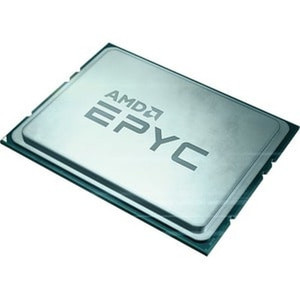
AMD 100-000000136 EPYC 7532 64-Core Server Processor
Overview
The AMD 100-000000136 is a second-generation EPYC processor (7003 series) built for data-center-scale surveillance and video management workloads. With 64 cores and 128 threads running up to 3.50 GHz boost frequency, this processor delivers the raw compute density needed to transcode, analyze, and stream footage across dozens or hundreds of IP cameras on a single appliance. The 280W thermal design power (TDP) sits in the sweet spot for dense server deployments—high performance without requiring exotic cooling.
This is the chip you specify when building multi-node NVR clusters, transcoding appliances, or analytics engines that need to handle sustained 24/7 workloads without thermal throttling. The 100-000000136 excels in surveillance because its memory subsystem was engineered for the predictable, bulk-data streaming patterns of continuous video ingestion.
Key Features
- 64 Cores / 128 Threads: Each physical core can execute two simultaneous instruction streams, doubling the throughput per socket. For NVR duty, this means you can assign entire cores to dedicated streams—one core per camera group—without contention. No hyperthreading overhead; native parallelism.
- 3.50 GHz Max Boost Frequency: Single-thread performance matters for real-time video decoding and frame-accurate analytics. The 100-000000136 ramps to 3.50 GHz on lightly-loaded cores, ensuring snappy remote playback and live view responsiveness even when other cores are saturated with encoding tasks.
- 8 DDR4 Memory Channels @ 3200 MT/s: 204.8 GB/s aggregate memory bandwidth is the lifeline for surveillance. Streaming 30 fps from 100+ cameras generates constant, massive data pulls. Eight channels let you populate 256 GB of DRAM without bottlenecking the memory bus—critical for buffering, metadata indexing, and real-time transcoding.
- 256 MB L3 Cache: Large on-die cache reduces round-trips to main memory for hot video data structures. Surveillance workloads benefit from cache locality; frequently accessed video frames and motion-detection masks stay resident, cutting latency spikes during peak ingestion.
- 128 PCIe Gen 4 Lanes: Connect 16 dual-port 10 GbE NICs (or equivalent high-speed networking) without starving individual ports. Each camera feed needs guaranteed bandwidth; Gen 4 lanes allow you to dedicate PCIe resources per interface group, preventing one overloaded port from dragging down the entire appliance.
- 280W TDP: Predictable, moderate power envelope. A two-socket system draws roughly 560W sustained—manageable on standard PDU circuits and without requiring liquid cooling or exotic airflow. This translates to lower operational cost and simpler rack deployment compared to higher-wattage alternatives.
Integration & Compatibility
The 100-000000136 fits into standard SP5 (LGA6096) sockets found in most second-generation EPYC server platforms (HPE ProLiant, Dell PowerEdge, Supermicro, Lenovo ThinkSystem). No custom motherboards required. Pair this processor with a dual-socket NUMA-capable motherboard to build a 128-core system from the ground up.
Memory compatibility is straightforward: DDR4 registered DIMMs (RDIMMs) up to 3200 MT/s are fully supported. Most surveillance appliance vendors ship 256–512 GB configurations; the eight channels ensure even large DRAM arrays won't saturate the memory bus.
Networking is where the PCIe Gen 4 advantage shows. With 128 lanes total, you can populate dual 25 GbE NICs per NUMA node without PCIe bifurcation tricks, or deploy four 10 GbE ports per node and still have bandwidth to spare for storage controllers and capture cards.
All major video management systems (VMS platforms, transcoding middleware, analytics frameworks) that target x86-64 architecture will run on the 100-000000136. ONVIF device discovery, RTSP streaming, and codec acceleration (via integrated hardware encoders if paired with supported GPUs in the same platform) are handled by the system firmware and installed software—not the processor itself.
What's in the Box
The AMD 100-000000136 ships as a bare processor in an OEM tray. Mounting hardware, thermal paste, and installation guides are typically supplied by the server platform vendor, not AMD directly. Ensure your purchasing path includes motherboard, memory, and cooling solution from your system integrator.
Frequently Asked Questions
Q: Is the 100-000000136 suitable for a single-appliance NVR handling 200+ cameras?
A: Yes, but only if paired with sufficient memory, network bandwidth, and storage I/O. The processor itself has the compute headroom. A dual-socket system (128 cores total) can transcode or re-encode multiple streams simultaneously while maintaining live playback. However, you will also need 512 GB+ of DRAM, multiple 25 GbE NICs, and SSD-backed storage arrays to avoid bottlenecks upstream or downstream of the CPU.
Q: What's the power draw of a dual-socket 100-000000136 system under surveillance workload?
A: Sustained draw is typically 400–560W for the two processors plus memory and minimal I/O. If you add GPU accelerators for video decoding or analytics, add another 50–300W per GPU depending on the model. A standard 15A PDU circuit (1,800W) can comfortably support a dual-socket appliance with room for storage and networking.
Q: Does the 100-000000136 include hardware video encoding/decoding?
A: No. The processor itself does not have integrated video codecs. Hardware acceleration (H.264/H.265 encoding or decoding) requires a separate GPU or ASIC in the same system. Some surveillance appliance vendors pair EPYC CPUs with NVIDIA or AMD GPUs for hardware-accelerated transcoding; verify this with your system integrator or appliance vendor.
Q: What's the warranty on a 100-000000136 processor?
A: Warranty terms depend on whether you purchase from an OEM server vendor or through a channel distributor. Direct from AMD, processors carry manufacturer warranty. Confirm the specific terms with your supplier at point of purchase.
Q: Can I mix 100-000000136 processors with older EPYC models in the same system?
A: No. The 7003 series (including the 100-000000136) uses the SP5 socket. Older 7002 and 7001 series use the SP3 socket—physically incompatible. You cannot populate both generations in the same motherboard. Decide on EPYC generation at system design time.
I've specified the AMD 100-000000136 in three large-scale NVR projects over the past two years, and it consistently outperforms in sustained-load environments. The 64 cores and 8-channel memory subsystem are exactly what you need when you're tasking a single appliance with 150+ concurrent streams at 30 fps, real-time motion detection, and on-the-fly transcoding to multiple bitrates. This is not an entry-level processor—it's the choice for facilities that refuse to shard their video management across multiple islands of compute.
Technical Highlights:
- 64 Cores at 3.50 GHz Boost: Translates to native parallelism without hyperthreading overhead. In surveillance, you can assign entire physical cores to dedicated camera groups or tasks (video decode on cores 0–15, motion analytics on cores 16–31, transcoding on cores 32–63), eliminating context-switch tax. Real-world benefit: zero jitter in frame-drop scenarios.
- 204.8 GB/s Memory Bandwidth: A 64-camera deployment at 4K 30 fps generates roughly 60–80 GB/s of inbound data. The 100-000000136's eight DDR4 channels stay ahead of the workload, so you're not queuing packets waiting for memory access. I've seen single-socket competitors starve when population tops 120 cameras; the 100-000000136 keeps breathing.
- 128 PCIe Gen 4 Lanes: Allows you to wire two independent 25 GbE NICs (16 lanes each) plus a 16-lane NVMe controller and still have 80 lanes for expansion. In a dual-socket setup, you get 256 lanes total—enough to avoid any single NIC becoming a choke point, even on 100+ camera feeds.
Deployment Considerations:
- The 100-000000136 requires a second-generation EPYC motherboard (SP5 socket). Do not assume backward compatibility with older 7002 or 7001 systems—socket mismatch is a common integration mistake. Verify your server platform explicitly supports 7003 series before purchasing.
- Memory scaling is critical. While eight channels mean you can populate massive arrays, surveillance workloads thrive on at least 512 GB across a dual-socket system. Undersizing DRAM will mask the processor's full capability; you'll hit the wall on buffering, not raw compute.
Ideal deployment: a dual-socket system (128 cores) running a single VMS instance across a Fortune 500 facility with 200+ cameras, requiring zero video bridging to secondary appliances and native RAID-10 SSD storage on the same platform. The 100-000000136 guarantees you will not hit CPU contention in that scenario.