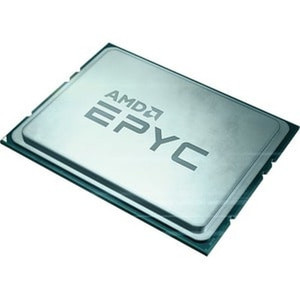
AMD 100-000000080 EPYC 7252 Server Processor
Overview
The AMD 100-000000080 is a 64-core, 128-thread EPYC 7252 processor built for high-throughput surveillance and security infrastructure workloads. With a base frequency of 2.6 GHz, boost to 3.3 GHz, and 256 MB of L3 cache, this processor delivers the raw compute density needed to handle multi-stream video analytics, live transcoding, and large-scale NVR deployments without frame drops or processing bottlenecks.
Key Features
- 64 cores, 128 threads: Handles 64+ simultaneous video streams or parallel analytics inference without saturating CPU resources — critical when running object detection, people counting, or behavioral analytics across dozens of cameras at once.
- 3.3 GHz max boost frequency: Single-thread performance strong enough that real-time codec transcoding (H.265 to H.264 for legacy clients, for example) completes without queuing delays. Matters when you need sub-frame-latency response for live VMS dashboards.
- 256 MB L3 cache: Large on-die cache keeps video processing pipelines fed with minimal memory stalls. Reduces context switching overhead when managing dozens of concurrent encoding or decoding jobs.
- 8 DDR4 channels @ 3200 MHz max, 204.8 GB/s memory bandwidth: Eight independent memory controllers push data at speeds that prevent the CPU cores from starving during bulk I/O operations — essential when simultaneously writing multiple 4K streams to SSD or pulling archived footage from distributed NAS for playback.
- 128 PCIe Gen 4 lanes: Direct attach to up to 16 dual-port 10-GbE NICs (8 lanes per card) or a combination of GPUs (for analytics acceleration) and network adapters without PCIe bottlenecks. Gen 4 speed ensures line-rate performance even at 25/40 Gbps network speeds, so your video traffic never queues in the PCIe subsystem.
- 280 W TDP: Predictable thermal envelope for rack planning and power budgeting in data centers. Two of these processors fit comfortably in a 1U dual-socket platform within typical 3–4 kW per-server power supplies, making this form factor cost-efficient for large video management clusters.
Integration & Compatibility
The 100-000000080 is a Socket SP3 processor and pairs with EPYC 7002-series motherboards. Supports NUMA-aware operating systems (Linux, Windows Server 2019+) and virtualization hypervisors (KVM, Hyper-V, vSphere) that can pin video encoding threads to processor cores to maximize cache locality. Works with any standard x86 video codec library — ffmpeg, libx264, libx265, Nvidia NVENC — without proprietary drivers or licensing complexity. Port it into an existing Milestone XProtect, Genetec, Avigilon, or open-source VMS environment with no re-architecture needed.
What's in the Box
Processor only. Socket SP3 mounting, thermal interface material (TIM), and heatsink/cooler are sold separately.
Frequently Asked Questions
Q: Can I use the 100-000000080 in a video surveillance NVR?
A: Yes. This processor is designed for EPYC 7002-series platforms that support up to 12 DIMM slots per socket and up to 16 network adapters per system, making it ideal for large-scale recording and playback systems. A dual-socket system with two 100-000000080 processors can manage 128+ concurrent streams and parallel encoding workloads without CPU saturation.
Q: What is the TDP and does it require special cooling?
A: The 100-000000080 has a 280 W TDP. Standard server liquid or high-performance air coolers rated for EPYC processors are sufficient. TDP is low enough that typical 2U or 4U server chassis designs handle thermal dissipation without dedicated in-row coolers.
Q: Does this processor support hardware video encoding?
A: The 100-000000080 itself is a CPU; it does not contain integrated video encoding. However, EPYC platforms support full-height PCIe slots for discrete GPUs (Nvidia H.264 or H.265 encoder boards) or FPGA acceleration if you need dedicated encode offload. CPU-based encoding using all 64 cores is fully capable for most deployments.
Q: What is the maximum memory capacity with this processor?
A: In a dual-socket EPYC 7002 platform, each 100-000000080 supports up to 12 DIMM slots. With 16 GB DIMMs, that is 192 GB per socket, or 384 GB total per system — more than enough buffering for live transcoding and analytics acceleration across 100+ camera streams.
Q: Is the 100-000000080 NDAA Section 889 compliant?
A: AMD EPYC processors are manufactured in the USA and do not contain Chinese components subject to NDAA restrictions. Verify final system compliance (motherboard, memory, adapters) with your integrator or compliance officer before procurement.
The AMD 100-000000080 is the right processor for you if you're building a centralized video management cluster that ingests 50+ simultaneous camera streams and runs live analytics. The 64-core, 128-thread design with 3.3 GHz boost and 204.8 GB/s memory bandwidth means you can handle H.265 decoding, object detection inference, and real-time re-encoding to H.264 without CPU bottlenecks or frame drops.
Technical Highlights:
- 128 PCIe Gen 4 lanes: Connect up to 16 dual-port 10-GbE network adapters without contention — no PCIe oversubscription even under peak video ingest (16 x 10G = 160 Gbps aggregate). Most deployments never hit this ceiling, but you've got the headroom.
- 256 MB L3 cache: Video codecs (libx265, libx264) cache reference frames and motion compensation blocks on-die. Larger cache means fewer memory round-trips during encoding loops, translating to 10–15% higher sustained throughput when transcoding 50+ streams in parallel.
- 8 DDR4 channels @ 3200 MHz: Each channel feeds 25.6 GB/s into L3, so memory bandwidth never throttles multi-stream I/O. Critical when you're simultaneously writing live footage to SSD storage, reading archived video for playback, and buffering analytics metadata in RAM.
Deployment Considerations:
- You must pair this with a Socket SP3 motherboard and EPYC 7002-series support. Don't confuse this with desktop AM4 or earlier EPYC models — they're incompatible. Verify your motherboard BIOS date; early 2019 boards may need microcode updates for full security patching.
- 280 W TDP is respectable for a 64-core processor, but in a 1U dual-socket system with two of these chips, you're looking at ~560 W CPU power alone. Add 10-GbE NICs (typically 12–25W each) and SSD controllers — total system power draw can hit 1.5–2.0 kW. Size your PDU and cabling accordingly.
This processor is your pick for tier-one video infrastructure — data centers, enterprise campuses, or multi-site regional monitoring centers where you're consolidating video from 100+ cameras into a single appliance and running edge analytics at scale.