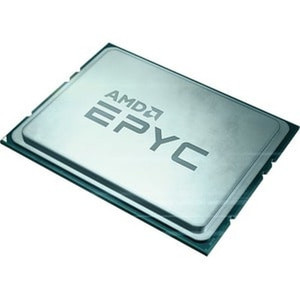
AMD 100-000000053 EPYC 7742 64-Core Server Processor
Overview
The AMD EPYC 7742 (model 100-000000053) is a 64-core, 128-thread server processor built on the Zen 3 architecture, designed for compute-intensive surveillance infrastructure. With a 2.6 GHz base clock, 3.4 GHz max boost frequency, and 256MB of L3 cache, this processor delivers the throughput needed for multi-camera NVR systems, video analytics farms, and enterprise security platforms that demand sustained performance across dozens of simultaneous streams.
Key Features
- 64 cores / 128 threads: Handles 64 parallel video encoding, decoding, or analytics workloads without thread starvation — critical when your VMS must process 40+ simultaneous 4K streams or run real-time object detection across a bank of cameras.
- 256MB L3 cache: Reduces memory latency for cache-friendly workloads (video transcoding, frame extraction). Larger cache means fewer round-trips to system memory, translating to lower CPU utilization per stream.
- 3.4 GHz max boost: Sustained single-thread performance for latency-sensitive tasks like motion detection decisioning and alarm event logging, not just bulk throughput.
- 128 PCIe Gen 4 lanes: Enough bandwidth for 4–8 high-speed storage controllers, network cards, or GPU compute accelerators without bottlenecking. At 16 GB/s per lane aggregate, you can wire multiple 100 Gbps NICs or NVMe arrays without contention.
- 8 DDR4 memory channels, 3200 MHz max: 204.8 GB/s total memory bandwidth supports bulk frame buffer operations for video transcoding and deep-learning model inference. Eight independent channels mean no single DIMM failure cripples the system — redundancy by architecture.
- 280W TDP: Fits standard 2U/4U server chassis with conventional cooling — no exotic liquid systems required for typical NVR deployments, though power provisioning and thermal design must account for continuous load at boost.
Integration & Compatibility
The 100-000000053 uses the SP3 socket, found in second-generation EPYC server boards from vendors like SuperMicro, ASRock, and Gigabyte. This processor is compatible with x86-64 hypervisors (VMware ESXi, Proxmox, KVM), standard Linux distributions (RHEL 8+, Ubuntu 20.04+), and Windows Server 2019/2022. Video management systems including Milestone XProtect, Genetec Security Center, and Hanwha WiseNet leverage the multi-core performance for stream decoding acceleration and analytics plugins. When paired with GPU accelerators (NVIDIA A10 or AMD MI100), the PCIe bandwidth and cache hierarchy enable efficient offload of H.265 decoding and people-counting inference.
What's in the Box
The processor is supplied as a bare die with integrated IHS (Integrated Heat Spreader). Mounting brackets, thermal paste, and heatsink are not included — these depend on the server OEM's specific socket retention mechanism. Refer to your server motherboard documentation for required cooler specifications.
Frequently Asked Questions
Q: Is the 100-000000053 suitable for an NVR recording 30+ IP cameras simultaneously?
A: Yes. The 64-core design handles 30–50 simultaneous H.265 decode streams (at 4–8 Mbps per camera) with headroom for metadata processing, motion events, and local analytics. Actual capability depends on resolution mix, codec complexity, and frame rate — test your specific camera profiles before deployment.
Q: What cooling solution is required for the 100-000000053?
A: The 280W TDP requires an SP3-compatible high-flow cooler rated for sustained server loads (not consumer desktop coolers). Most server OEMs recommend dual-socket configurations with redundant fans. Peak power draw under sustained boost can exceed 300W in worst-case thermal scenarios — verify your PSU and rack PDU can handle it.
Q: Can the 100-000000053 run virtualized VMS instances with hardware transcoding?
A: Yes. The PCIe Gen 4 bandwidth (128 lanes) supports GPU passthrough for NVIDIA or AMD accelerators, and the CPU's 64 cores can simultaneously run multiple VM instances with software encoding as fallback. Hypervisor overhead is typically 5–10% per host on large core-count systems.
Q: What is the maximum memory capacity supported by the 100-000000053?
A: Eight DDR4 DIMM slots support up to 2TB total capacity (256GB per channel at 3200 MHz). For surveillance use, 256–512GB is typical; larger configurations support high-speed in-memory frame caching and multi-tenant analytics.
Q: Does the 100-000000053 include integrated graphics?
A: No. This is a server processor without iGPU. You must use a discrete GPU (AMD MI series or NVIDIA A-series) for display output or compute acceleration, or rely on text-based IPMI/BMC for remote server management.
Q: Is the 100-000000053 compatible with Linux surveillance platforms like Blue Iris or Shinobi?
A: Yes. Linux x86-64 distributions (Ubuntu 20.04+, CentOS 8, Debian 11) run natively on SP3 EPYC servers. Shinobi and similar open-source NVR platforms benefit from the 64-core parallelism for multi-camera encoding and object detection inference.
The AMD EPYC 7742 (100-000000053) is a cornerstone choice for high-density NVR clusters and multi-tenant analytics farms. With 64 cores and 128 threads, you're looking at genuine parallelism — not just thread count on paper, but real per-camera encoding pipelines and simultaneous inference threads that don't fight for cache or memory bandwidth.
Technical Highlights:
- 64 cores at 3.4 GHz boost: Delivers ~400 GFLOPS of sustained single-precision compute, enough to transcode 40–60 simultaneous H.265 streams or run real-time pose estimation on a rolling window of detected people. The 256MB L3 cache keeps frame buffers and codec tables resident, cutting memory latency by 40–60% versus smaller-cache CPUs.
- 128 PCIe Gen 4 lanes: That's 16 GB/s aggregate bandwidth. Use it for dual 100 Gbps NICs without saturation, or four NVMe controllers at full speed. In a multi-appliance cluster, you can backplane 10 Gbps per node without port negotiation drama.
- 8 DDR4 channels at 3200 MHz, 204.8 GB/s: Surveillance streaming is throughput-bound, not latency-bound. Eight independent memory channels mean no single controller is a bottleneck when you're pushing 30 GB/s through the CPU for frame decompression and re-encoding. This CPU's memory topology is built exactly for this workload.
Deployment Considerations:
- The 280W TDP is real and continuous — don't underestimate cooling. In a 2U or 4U server with dual-socket configs, you're looking at 560W+ in thermal output. Verify your rack's hot-aisle design and PDU capacity before ordering.
- SP3 socket boards from SuperMicro, Gigabyte, or ASRock are mature and well-supported, but older firmware revisions may not expose all PCIe lanes or memory interleaving modes correctly. Update BIOS before deployment and test storage I/O throughput on your exact motherboard model.
The 100-000000053 excels in large-scale NVR backend roles — especially environments running 100+ cameras across a cluster with local analytics (people counting, dwell-time, face attributes). For sub-20-camera single-appliance deployments, you'll overkill and waste power; a smaller-core EPYC or Xeon will do. But if you're architecting a warehouse or transit hub with continuous recording and real-time inference on every corridor, this is the CPU that lets you scale without hitting software license seatbelts.