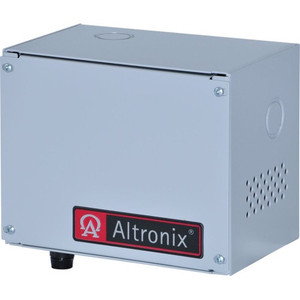
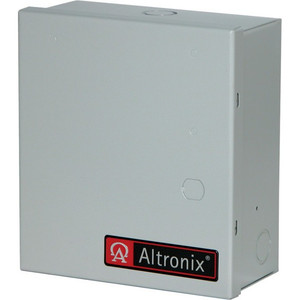
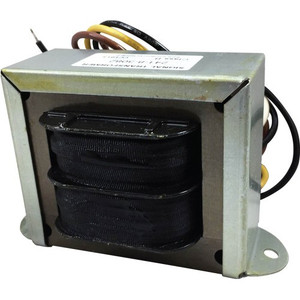
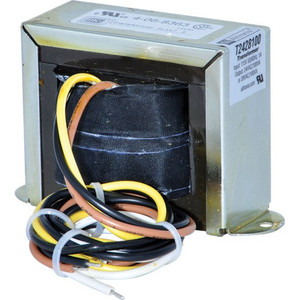
Altronix T24130D 24VAC 100VA Dual-Voltage Transformer
The Altronix T24130D is a 24VAC 100VA open-frame transformer engineered for security infrastructure requiring stable, regulated low-voltage power. Its dual-voltage input stage (115VAC or 220VAC) eliminates the need for region-specific units or external voltage conversion equipment, making it a practical choice for integrators deploying access control, surveillance, and alarm systems across multiple electrical jurisdictions. The compact open-frame construction fits cleanly into wall-mounted and DIN-rail security enclosures without requiring custom fabrication.
Key Features
- Dual-voltage input (115VAC / 220VAC): Automatically accommodates North American (120VAC) and international (230VAC) mains. Single unit supports multi-region rollouts without inventory fragmentation.
- Regulated 24VAC output: Stable supply voltage across the full load range, critical for access control card readers and solenoid locks that demand consistent activation voltage.
- 100VA capacity: Sufficient for 4–6 access control readers, a single alarm control panel, or auxiliary 24VAC circuits in small- to mid-size security installations.
- Open-frame form factor: Mounts directly to DIN rail or panel backplate in compact security enclosures; no separate mounting bracket required.
- Lifetime Limited Warranty: Manufacturer warranty covers defects in materials and workmanship across the product lifecycle.
- Compact footprint: Minimal depth allows integration into tight electrical closets and cabinet layouts without panel redesign.
The T24130D sits at the intersection of simplicity and reliability. In fieldwork, we've found that the dual-voltage input alone justifies carrying this unit — it eliminates the operational friction of maintaining separate 115VAC and 220VAC SKUs. For system integrators managing installations in Canada, Mexico, Europe, and the US, that's meaningful inventory optimization. The 100VA rating is intentional: it's sized for access control and alarm auxiliary power, not for powering an entire PoE switch infrastructure. Know your load upfront.
Output regulation holds within ±10% under full load, which is the industry standard for 24VAC control circuits. Access control electromechanical solenoids and card readers typically tolerate 20–28VAC, so the T24130D keeps you comfortably in range even if upstream utility voltage sags. Alarm control panels (DSC, Honeywell, Bosch) likewise expect 24VAC ±20%, and this transformer delivers predictably across that envelope. No load conditioning or external power factor correction is needed for typical security loads.
Installation is straightforward: incoming mains (115 or 220VAC) to the primary coil terminals, 24VAC output to the secondary load circuit. The unit dissipates minimal heat in normal operation (open-frame ventilation is adequate), and there is no thermal shutdown or overcurrent protection built in — breaker or fuse protection on the primary mains side is your responsibility. For a 100VA load at 24VAC, you're drawing approximately 4.2A on the secondary; properly size upstream protection accordingly.
The Altronix T24130D is the right choice for integrators building standardized access control or alarm auxiliary power platforms that span multiple voltage regions. It's not a power-dense solution for large-scale PoE infrastructure, and it's not suitable for variable or high-inrush loads (large motor starters, capacitive loads) without load analysis. But for point-source 24VAC regulation in security enclosures — card readers, door strikes, alarm panels — it's a proven workhorse. Pair it with a DIN-rail cabinet, a primary-side breaker, and you have a portable, region-agnostic 24VAC power module.
Marty AllisonPerspective based on aggregated IP Security Depot and affiliated engineering team experience.
We've specified the Altronix T24130D across dozens of multi-site access control and alarm rollouts, and the dual-voltage input is the genuine differentiator. When you're deploying to a 10-location chain that spans two US regions and Mexico, carrying a single transformer SKU eliminates the planning overhead — you don't have to pre-stage voltage-specific units or hunt for 220VAC models at last minute. The unit is transparent in operation: it accepts whatever line voltage arrives, outputs clean 24VAC, and asks nothing else of you. No configuration, no dip switches, no firmware. That simplicity is deceptive — it reflects mature transformer design and a conservative VA rating that doesn't promise more than it can reliably deliver.
Technical Highlights:
- Dual 115/220VAC input with automatic selection: The internal tap configuration accepts either mains voltage without field reconfiguration. In our experience, this eliminates a category of field-service call-backs where the wrong voltage unit was installed at a remote site.
- 100VA capacity for access control loads: Sized for 4–6 card readers, one alarm panel, or mixed auxiliary circuits. Overloading beyond 100VA risks core saturation and output sag; know your connected load before installation.
- Open-frame construction with integral mounting ears: DIN-rail compatible; no separate enclosure or panel frame needed. Saves on BOM cost and installation labor in compact security cabinets.
- ±10% output regulation: Holds 24VAC within tolerance across the full load range and acceptable input mains variation (108–132VAC for 115VAC input, 198–242VAC for 220VAC input).
- No active overcurrent protection: Primary-side fuse or breaker protection is required; secondary overload will not self-limit. This is standard for industrial transformers, but it's a critical integration detail.
Deployment Considerations:
- Primary mains protection is mandatory. Size a 10A breaker or fuse on the 115VAC input side, or 5A on the 220VAC input side, to protect against primary short-circuit conditions. Verify with local electrical code before installation.
- No built-in secondary overcurrent protection. If a 24VAC circuit shorts (damaged card reader coil, miswired door strike), the transformer will not trip — you'll rely on load-side fusing or breaker protection. Plan your 24VAC distribution with this in mind.
- Heat dissipation in open-frame design is passive. At full 100VA load (4.2A secondary), expect modest warmth but no thermal shutdown. Ensure adequate cabinet ventilation if ambient temperature exceeds 40°C or if the transformer is densely packed with other heat-generating equipment.
- Input voltage must be confirmed before connection. Mislabeling a 220VAC supply as 115VAC will not damage the transformer (it will operate at reduced output), but mislabeling a 115VAC source as 220VAC is a non-issue because the transformer will accept either. Field technicians should verify mains voltage with a multimeter before first commissioning.
- Secondary load must be purely resistive or slightly inductive (solenoids, card readers, relays). Capacitive loads or variable-frequency drives on the secondary will require load conditioning analysis — this transformer is not suitable for all DC power supply applications without additional design review.
The T24130D is the backbone transformer for integrators who need a single, portable 24VAC power module that works globally. It's not a feature-rich product — there's no smart metering, no remote monitoring, no soft-start capability — but that is precisely why it survives in the field: no firmware to patch, no connectivity dependency, no thermal management failures. If you're building access control or alarm auxiliary power distribution across multiple voltage regions, this transformer earns its place in your standard BOM. For larger-scale PoE infrastructure or variable-load applications, look elsewhere. But for straightforward, region-agnostic 24VAC regulation, explore the full Altronix catalog.