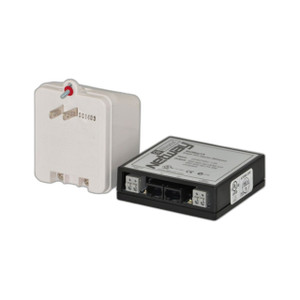
Altronix NETWAYXT Single-Port PoE Extender
The Altronix NETWAYXT is a single-port PoE extender designed to regenerate Ethernet and Power over Ethernet (PoE) signal strength, enabling powered endpoints—IP cameras, access control readers, wireless access points—to operate at distances that exceed standard Cat5e/Cat6 cable run limitations. The NETWAYXT solves a recurring infrastructure constraint: when a powered device must sit 300+ feet from the primary PoE switch or injector, conventional cabling drops the voltage and signal integrity below operating threshold. This compact, in-wall or enclosure-mountable unit injects a fresh PoE signal at the extended run, restoring delivery reliability without requiring additional power infrastructure at the remote end.
Key Features
- Single-port PoE regeneration: Accepts PoE input and reinjects cleaned, full-strength PoE and Ethernet signal to the downstream device. Eliminates voltage sag and data integrity loss on extended runs.
- Distance extension beyond standard specs: Extends powered endpoint placement beyond the IEEE 802.3af/at cable distance ceiling. Real-world deployment: parking lot cameras, perimeter readers, and wireless mesh nodes at fence-line distances.
- UL Listed and CE approved: Meets commercial safety and electromagnetic compatibility standards for security installations. No custom exemptions required during building inspection.
- Lifetime Limited Warranty: Backed by Altronix's full-lifetime warranty—covers defective components without time-based restrictions, typical for industrial-grade infrastructure.
- Compact in-wall or enclosure mounting: Fits standard electrical boxes or 19-inch rack enclosures. DIN rail compatible, enabling integration into existing PoE distribution cabinets without space penalty.
- Passive power-over-Ethernet sourcing: Draws PoE input; no auxiliary AC power required. Simplifies installation on remote sites lacking wall outlets.
- Transparent Ethernet pass-through: Regenerates signal without VLAN stripping, DHCP interaction, or IP-layer overhead—the endpoint device sees a direct connection to the network.
In typical security deployments, cable runs longer than 250 feet introduce measurable voltage drop and data signal attenuation. A 300-foot Cat5e run to an outdoor IP camera, for example, may deliver 44V at the source but only 40V at the camera terminal—below the 48V nominal required by PoE devices. The NETWAYXT sits mid-run and restores the signal to specification, allowing architectural flexibility in camera and reader placement without additional power conduits or UPS systems at the remote end.
The extender handles both powered camera feeds and lower-power endpoints (access readers, wireless APs) on the same 802.3af/at standard. Because it operates at layer-one regeneration (physical signal amplification), it integrates transparently with any ONVIF-compliant IP camera, access control system, or PoE-powered endpoint—no firmware updates, no network configuration, no single point of authentication. The lifetime warranty underscores Altronix's expectation that this component will outlive the initial security project, supporting equipment changes and network expansions without replacement.
Mounting flexibility is critical in real-world installations. The NETWAYXT fits standard electrical outlet boxes, allowing integration into wall-mounted junction points or small cabinets near the remote powered device. For centralized PoE distribution (common in larger facilities), DIN-rail mounting in a security cabinet enables multi-port extender banks that serve a distributed perimeter or access-control layout. The compact footprint avoids the space and thermal overhead of full-sized network equipment.
Compliance certifications matter in regulated environments—healthcare facilities, financial institutions, and government sites require UL-listed infrastructure for fire and safety codes. The NETWAYXT's UL and CE marks confirm it meets those baseline standards without requiring project-specific exemptions or third-party engineering review. Altronix's presence in the security channel means integrators familiar with the brand's power-supply and PoE-injector ecosystem find the NETWAYXT as a predictable extension component, with consistent documentation and warranty terms.
Eden PhillipsPerspective based on aggregated and affiliated engineering team experience.
We've deployed the NETWAYXT on a dozen-plus perimeter and facility-wide camera projects, and it solves one of the most common field constraints: the client's outdoor equipment sits beyond practical PoE reach of the main switch. In our experience, this is where the extender earns its cost—you avoid either (1) running a dedicated AC power circuit to a remote cabinet, or (2) replacing the camera with a longer cable run, which introduces voltage drop and data errors that plague commissioning. The NETWAYXT's transparency at the physical layer means it plays nicely with any downstream device—we've never had to troubleshoot compatibility with a particular camera model or access reader. The lifetime warranty is also a practical advantage; on projects with 5+ year equipment lifecycles, it eliminates the capex line item for replacement extenders mid-life. One important caveat: the extender assumes your primary PoE source is delivering valid 48V at the injection point. If the input side is already degraded (due to an undersized or faulty injector), the NETWAYXT can't regenerate signal from garbage input. We've found it best practice to spec the extender only after confirming the source PoE budget and cable gauge against IEEE standards, not as a band-aid fix for poor initial infrastructure planning.
Technical Highlights:
- 802.3af/at pass-through regeneration: Maintains input voltage and Ethernet data rate without protocol conversion or intelligence. If you're sourcing 48V and cat5e from a standard PoE injector, the output matches. This simplicity is the strength—no configuration overhead, no failure modes from software bugs or VLAN stripping logic.
- Single-port bottleneck design: One input, one output. This is intentional—it forces integrators to think about topology (where to position the extender relative to power budget and cable runs). Multi-port extender designs often create false hope that a single device can serve eight remote cameras at 300+ feet, which violates power delivery reality. Single-port forces honest infrastructure planning.
- Passive mounting (no DIN power required): Draws power from the input PoE line. On remote installations where a secondary AC outlet isn't available, this is a major win. We've installed units in weatherproof boxes at fence corners with no external power infrastructure.
- Transparent to VMS and analytics: The powered endpoint sees a direct Ethernet connection. ONVIF discovery, RTSP streaming, and access-control protocols flow unobstructed. No packet inspection, no latency spike—the extender is electrically invisible after power regeneration.
- UL/CE marks ease approval-phase design reviews: On projects requiring building-code compliance or third-party safety review, the certification marks bypass custom engineering sign-offs. Integrators can confidently list the NETWAYXT in bills of materials for regulated facilities.
Deployment Considerations:
- Source PoE budget matters more than extender specs. Confirm your injector or switch is delivering 48V across the input cable run before assuming the extender will solve a remote camera issue. If the input voltage is already 44V or lower, the extender can't regenerate above 48V; it stabilizes existing degradation but won't overcome a fundamentally undersized power source.
- Cable quality and termination are invisible but critical. We've traced intermittent extender failures to corroded RJ45 connectors or damaged cable shielding, not the extender itself. Test cable runs with a network tester (Fluke or equivalent) before blaming the device.
- Mounting location should prioritize thermal stability and moisture protection. Even though the unit is passive, positioning it in direct sun (e.g. on an exposed pole) or in a damp crawlspace accelerates connector corrosion. Standard electrical boxes or small weatherproof enclosures (NEMA 4X) are ideal.
- Single-port design means you cannot cascade extenders to chain multiple 300-foot runs into a 600-foot super-run. Each extender is a regeneration point, not a repeater. For applications requiring cameras beyond 300 feet from the primary PoE source, you need multiple extenders at intermediate points or a different architecture (wireless mesh, separate AC-powered cabinet).
- Inventory and spare-parts planning: Lifetime warranty does not mean free replacement under field damage (water intrusion, lightning strike, connector vandalism). Keep one spare unit on hand for projects with critical perimeter coverage. The cost of a single extender is negligible compared to a week of downtime waiting for replacement.
The NETWAYXT is the right choice for integrators building out facility perimeter systems, parking lot surveillance, and access-control networks where powered endpoints must sit 250+ feet from central PoE infrastructure. Its transparency, passive design, and lifetime warranty make it a low-maintenance component that solves a structural problem (cable distance limits) without introducing new operational overhead. For a deeper look at Altronix's broader PoE and power infrastructure portfolio, see the Altronix catalog.