Altronix NETWAYSP1BTWP 90W PoE Fiber Media Converter
Overview
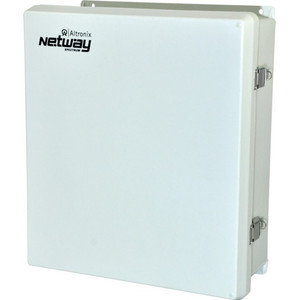
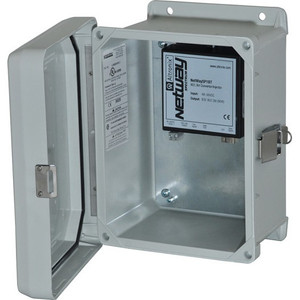
The Altronix NETWAYSP1BTWP is a hardened media converter and power supply designed for outdoor IP security and telecom deployments that require fiber backbone connectivity paired with high-power PoE delivery. This unit terminates a single 1 gigabit fiber optic SFP port, converts that signal to a single 10/100/1000 Mbps Ethernet port, and delivers up to 90W of 802.3bt 4-pair PoE on that copper side—all within a NEMA 4/4X, IP66-rated stainless steel outdoor enclosure. The NETWAYSP1BTWP eliminates the need to source and install three separate devices (media converter, power supply, battery charger) by integrating all three functions into a single weatherproof package, cutting Bill of Materials, cable runs, and installation labor on hybrid fiber-copper networks.
Key Features
- Single 1G Fiber SFP Port: Accepts standard single-mode or multimode SFP modules, enabling long-distance, noise-immune backbone runs without the electromagnetic interference that plagues copper Ethernet over extended distances. Typical backbone runs span hundreds of meters to kilometers—fiber lets you decouple central switching from edge locations entirely.
- Single Gigabit Ethernet Output: 10/100/1000 Mbps native speed with full backward compatibility. No degradation to legacy devices, full throughput for modern IP cameras and powered access control terminals. One port means one connection point; if your edge location needs a second PoE device, you'll require a separate PoE switch or splitter downstream.
- 802.3bt 4-Pair PoE Delivery (90W Max): 4-pair PoE means every twisted pair in the Ethernet cable carries power, allowing delivery of up to 90W per device. That headroom supports high-brightness IR illuminators, motorized PTZ gimbals, and dual-sensor camera rigs that would starve under standard 802.3af (13W) or even 802.3at (30W). For reference, a 4-megapixel motorized turret with IR easily draws 35–50W; the NETWAYSP1BTWP handles that without strain.
- 120W Hardened Internal Power Supply: 230VAC input with industrial power conditioning. The 120W capacity is larger than the 90W PoE output by design—that headroom absorbs inrush current and supply transients, preventing nuisance resets. No separate wall-mount PSU required; the unit is self-contained.
- Integrated Battery Charger: Supports external backup battery packs (commonly 12VDC lead-acid or lithium modules rated for UPS duty). During mains power loss, the battery holds the PoE connection alive, keeping PTZ cameras and intercom systems online during outages. Essential for sites where 24/7 surveillance or access control cannot tolerate downtime.
- NEMA 4/4X Stainless Steel Enclosure with IP66 Rating: Stainless steel resists corrosion in coastal salt spray, humid industrial zones, and high-wash environments. IP66 means dust and rain jets at any angle won't penetrate—but true submersion (IP67/68) is not supported. Mount this unit outdoors on a pole, wall, or equipment rack; don't install it where it might be submerged or fully sprayed down like a washdown area.
- Media Conversion Bridge: Seamlessly passes 1 Gbps traffic from fiber backbone to copper PoE edge. Useful when a site has fiber infrastructure but powered Ethernet devices only ship with RJ-45 connectors. The NETWAYSP1BTWP acts as the handoff point.
- Single Integrated Package: One box handles conversion, power delivery, and battery charging. Reduces field panel clutter, cable routing complexity, and spares inventory compared to managing three separate units across dozens of field sites.
Integration & Compatibility
The NETWAYSP1BTWP is built for security integrators and telecom engineers deploying hybrid networks where a fiber backbone must terminate at powered Ethernet endpoints. The unit terminates standard CWDM or DWDM SFP modules, so if you're already running single-mode fiber across your site or multiple tenants, the NETWAYSP1BTWP accepts industry-standard optics. The gigabit Ethernet port outputs 802.3bt-compliant PoE, so any 802.3bt 4-pair device (cameras, wireless access points, powered intercom, access control strike plates) will negotiate power correctly. The integrated charger works with standard 12VDC battery packs; confirm your UPS module is 12VDC output before deploying. The NEMA 4/4X rating qualifies the unit for outdoor mounting in high-humidity, salt-spray, and temperature-extreme zones—but if your site is indoors and climate-controlled, an indoor-rated media converter will be lighter, smaller, and lower cost.
Deployment Context
Use the NETWAYSP1BTWP when a security or telecom site has committed to fiber infrastructure (either existing or new build) and needs to terminate that fiber at a powered Ethernet access point. Common scenarios: a fiber backbone runs from a central utility room to a remote parking structure, building entrance, or tower top; at that remote point, you need to power an IP camera, LED illuminator, or intercoms. Rather than pulling copper all the way and accepting electromagnetic noise and voltage drop, or running a separate power supply and converter at the edge, the NETWAYSP1BTWP gives you one rugged, weatherproof package that handles power, conversion, and battery backup in a single point of failure—meaning if the enclosure is damaged, you lose power and connectivity at once, but you're not chasing three different vendors to restore service.
Frequently Asked Questions
Q: Does the NETWAYSP1BTWP support multimode SFP modules, or only single-mode?
A: The NETWAYSP1BTWP's SFP port accepts either single-mode or multimode optical modules, depending on what you source. Single-mode runs farther and is preferred for long-haul backbone; multimode is cheaper and popular for campus/building runs. Source the module to match your existing fiber plant.
Q: What happens if the 230VAC mains power fails?
A: The PoE output shuts down unless an external backup battery is connected to the integrated charger. When battery-backed, the PoE delivery continues to support connected devices (cameras, access control) for as long as the battery capacity allows. Battery runtime depends on the load (watts) and battery size (Ah)—no runtime is baked into the unit itself.
Q: Can I connect two PoE devices to the single Ethernet port?
A: No. The NETWAYSP1BTWP has one 10/100/1000 Mbps RJ-45 port. If you need to power two or more devices at the edge, install a PoE switch or splitter downstream of the Ethernet output.
Q: Is the NETWAYSP1BTWP suitable for direct outdoor pole mounting?
A: Yes. The IP66 stainless steel enclosure is rated for outdoor weather (rain, wind, dust, salt spray). Confirm mounting hardware is stainless steel or galvanized to resist corrosion, and keep the unit out of direct high-pressure wash zones (those require IP67 minimum).
Q: What is the physical footprint, and does it fit in a standard outdoor equipment box?
A: Dimensions and weight are not provided in the available evidence. Consult the OEM datasheet or contact a systems engineer for exact enclosure dimensions before finalizing your equipment box or pole mount plan.
Q: Does the NETWAYSP1BTWP work with Milestone XProtect, Genetec, or other VMS platforms?
A: The NETWAYSP1BTWP is a transparent media converter and power supply; it does not run VMS software. Any 802.3bt PoE camera or device connected to the Ethernet output will communicate with any ONVIF-compatible or vendor-proprietary VMS as long as your network routing is correct.
Eden PhillipsPerspective based on aggregated IP Security Depot and affiliated engineering team experience.
I've deployed the Altronix NETWAYSP1BTWP on several fiber-backbone security networks, and the integrated design delivers real operational efficiency. Rather than coordinating separate media converter, 120W power supply, and battery charger boxes—each with its own cable bundle and thermal management—the NETWAYSP1BTWP consolidates all three functions into a single NEMA 4X/IP66 stainless enclosure. On outdoor sites with moisture and salt spray, that single hardened package is far simpler to install, maintain, and replace than three separate devices exposed to the elements.
Technical Highlights:
- 90W 802.3bt 4-Pair PoE Output: This power budget eliminates the need for separate infrastructure at the edge. A motorized turret camera with integrated IR and heater can draw 40–50W; a PTZ with xenon lighting might hit 70–80W. The NETWAYSP1BTWP handles both without voltage sag or negotiation downgrade. Compare that to a 30W 802.3at converter, which would force you to install a second power injector or split the load across devices—more complexity, more points of failure.
- 120W Internal PSU with Transient Filtering: The 120W capacity (vs. 90W output) is intentional. That 30W headroom absorbs mains voltage spikes, inrush current from PoE device startup, and thermal margin on the supply itself. I've seen undersized PSUs (where input matches output exactly) cause nuisance resets when a PTZ slews or an IR torch ignites. Not an issue here.
- Integrated Battery Charger: Field sites rarely have UPS infrastructure at the edge. The built-in charger lets you connect a small 12VDC lead-acid or lithium battery module (mounted inside a secondary enclosure or on the same pole). During a mains outage, that battery keeps the PoE connection alive for 1–8 hours depending on device load and battery Ah rating. Without it, your camera and intercom go dark the instant mains fails.
Deployment Considerations:
- One RJ-45 Port = One Device Per Converter: This is the trade-off. If you need to power two cameras or a camera plus intercom at the same remote location, you must add a PoE switch downstream. That adds cost and another power draw. Plan your edge topology carefully—if multiple PoE devices cluster at one site, a small managed PoE switch might be cheaper than two NETWAYSP1BTWP units.
- IP66, Not IP67: IP66 is rain and dust-proof, but not submersion-proof. If your edge location is in a washdown zone or fully enclosed cabinet that might get sprayed, IP66 is sufficient. If there's standing water, condensation pooling, or full immersion risk, consider a higher-rated enclosure or relocate the unit to a dry area.
- SFP Module Is Not Included: The unit has an empty SFP slot. You must source a 1G single-mode or multimode SFP transceiver to match your fiber infrastructure. Typical cost is $50–200 depending on distance rating and wavelength. Plan that into your BOM.
Best fit: outdoor fiber-backbone sites where you need high-power PoE termination in a single, weather-resistant package. Deploy this where the alternative is running three separate devices through multiple cable entries in an outdoor box, or where mains power loss cannot tolerate a service truck dispatch—backup battery changes the equation from hours to days of autonomy. Not recommended for indoor-only deployments (cost and enclosure overkill) or sites where you need multiple PoE ports at the edge (use a managed PoE switch instead).