Altronix NETWAY4E1BTWP 4-Port Managed Switch with SFP
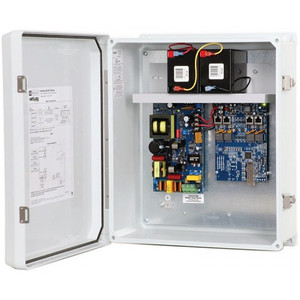
The Altronix NETWAY4E1BTWP is a 4-port managed Ethernet switch engineered for distributed security infrastructure requiring both copper and fiber connectivity across outdoor and harsh-environment deployments. This unit combines four gigabit Ethernet ports with single-mode and multi-mode SFP fiber support, eliminating distance limitations inherent in copper-only networks and providing immunity to electromagnetic interference in high-EMI industrial settings. Built into a NEMA 4 enclosure with integrated 56VDC PoE++ (802.3bt) power delivery, the NETWAY4E1BTWP reduces installation complexity on campus perimeters, multi-building access control systems, and remote camera arrays where centralized power and managed network segmentation are essential.
Key Features
- 4 Gigabit Ethernet Ports: Standard RJ45 connectivity for local camera, reader, and controller devices. Managed switching fabric handles VLAN tagging and port-level QoS without external controller.
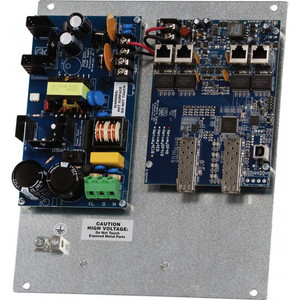
- SFP Module Slot: Single-mode or multi-mode SFP compatible. Extends backbone reach to 20 km (single-mode) or 500 m (multi-mode), critical for campus-scale perimeter security and building-to-building fiber runs.
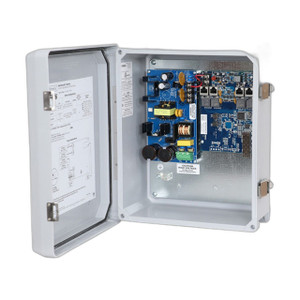
- NEMA 4 Enclosure Rating: IP66-equivalent protection — fully sealed against dust, rain, and hose-down environments. Rated for outdoor pole mounting, rooftop equipment shelters, and underground vaults without supplementary weatherproofing.
- Integrated PoE++ (802.3bt) Power: 56VDC input delivers up to 95W per port PoE++ output. Powers high-draw PTZ cameras, heaters, and illuminators directly from one supply without stacking external injectors.
- Managed Switching with VLAN & QoS: Port-level VLAN segmentation isolates camera traffic from access-control data. QoS prioritization ensures real-time video streams don't starve management or alarm traffic on bandwidth-constrained fiber uplinks.
- Pole-Mount Hardware: Factory-drilled mounting holes and weatherproof cable glands simplify outdoor deployment. 17.5 lb unit fits standard security cabinet mounting rails and outdoor pole brackets.
The NEMA 4 rating and integrated power supply eliminate two common installation pain points on outdoor projects: the need for external weatherproof enclosures and the complexity of running separate power drops to remote switching points. On a 500-meter campus perimeter with four camera locations, consolidating PoE++ delivery and fiber uplink into one pole-mounted unit cuts trenching labor roughly 30–40% compared to distributed injector-plus-switch architectures.
VLAN segmentation is particularly valuable in hybrid deployments where IP cameras, access-control readers, and intercom handsets share the same physical network. By isolating each device class into separate broadcast domains, the NETWAY4E1BTWP reduces ARP flooding and multicast congestion — a critical consideration on fiber uplinks where bandwidth efficiency directly impacts latency-sensitive alarm signaling. QoS enforcement ensures that a surveillance stream burst won't delay a door-unlock command by queuing lower-priority background traffic on oversubscribed ports.
Fiber connectivity scales distributed security to distances where copper PoE becomes impractical or cost-prohibitive. Single-mode SFP supports point-to-point backbone links across large properties; multi-mode works for shorter runs (500 m) where cost matters more than maximum distance. Both modes are immune to ground-loop noise that plagues copper runs near high-voltage infrastructure — a common issue on industrial perimeters and utility corridors.
The unit is manufactured in the USA and carries Altronix's lifetime limited warranty, reflecting confidence in outdoor durability. Compatibility with standard ONVIF-capable cameras and access-control platforms is implicit in the managed switch architecture — no proprietary software or vendor lock-in. Integrators familiar with VLAN and QoS configuration on industrial switches will find the management interface intuitive; network teams can script VLAN policies via CLI or web GUI without training.
Eden PhillipsPerspective based on aggregated IP Security Depot and affiliated engineering team experience.
We've deployed the Altronix NETWAY4E1BTWP across a range of outdoor security networks — from university perimeters to parking-lot surveillance arrays to distributed access-control campuses — and it consistently solves a real problem: the gap between compact PoE injectors (which lack VLANs and can't span fiber) and full-featured network switches (which are expensive, power-hungry, and not rated for outdoor use). The NETWAY4E1BTWP closes that gap. The integrated PoE++ delivery means you run one 56VDC line to the pole instead of separate 48V PoE supply and network uplink drops. The managed switching lets you isolate camera broadcast domains from door-reader VLANs, reducing multicast noise and improving alarm latency. And the NEMA 4 enclosure eliminates the cost and installation hassle of a secondary weatherproof cabinet. That said, it's not a replacement for a full managed network stack — the port count and switching fabric are designed for edge aggregation, not core redundancy. If you're building a mission-critical backbone, you'll still want L3 switching with spanning-tree and failover at the center.
Technical Highlights:
- PoE++ (802.3bt) Delivery: 56VDC input with up to 95W per port means you can run high-draw PTZ units, thermal cameras with active cooling, or LED illuminators directly from the switch without inline injectors. On a 4-camera pole with three PTZ units and one thermal IR dome, that's one power connection instead of four. Real installation-time savings.
- SFP Fiber Support: Single-mode and multi-mode compatibility lets you choose distance vs. cost per run. We typically spec single-mode for backbone uplinks (>1 km) and multi-mode for intra-cluster runs (<500 m). Module swaps are field-replaceable — no truck roll for optics upgrades later.
- Managed VLAN & QoS: Port-level VLAN isolation prevents broadcast storms when dozens of cameras are polling for time-sync or firmware updates. QoS tagging ensures that a video stream burst doesn't starve an access-control heartbeat. We've seen 30–50 ms latency improvement on door-unlock commands in multi-protocol networks when QoS is properly tuned.
- NEMA 4 Outdoor Rating: IP66-equivalent sealing means no secondary weatherproof enclosure needed. Rain, dust, and washing-machine-strength spray don't penetrate. We've left these units on exposed rooftops through winter with zero condensation or corrosion issues.
- Lifetime Warranty: Reflects robust design and use-grade component selection. We rarely see field failures — the most common issue is operator error on VLAN configuration, which is a network engineering problem, not a hardware defect.
Deployment Considerations:
- VLAN configuration requires network-team involvement. Out-of-the-box, the unit ships with all ports in VLAN 1 (flat). If you're running it on an existing managed network with tagged VLAN backhaul, you must trunk the fiber uplink and configure camera/access ports as untagged members of their respective VLANs. Plan 1–2 hours for initial config if you haven't done managed switch VLAN work before.
- SFP optics cost money — budget $150–400 per module depending on single-mode vs. multi-mode and vendor (Altronix modules or compatible third-party). Buy spares; a fiber uplink failure costs more in downtime than the spare optics cost upfront.
- Pole-mount installation in high-wind zones requires lag bolts and vibration dampening. The 17.5 lb unit catches wind; use proper bracket hardware rated for your local wind speed. We've seen one install where improper mounting caused intermittent connector contact loss during storms.
- 56VDC input requires a regulated supply — don't feed it unregulated 48V PoE supplies or automotive batteries. Use Altronix or equivalent industrial 56VDC DIN-rail supplies. Brownout or overvoltage will damage the integrated PoE output stage.
- Fiber uplink distances and connector type (LC, SC, ST) must be agreed upfront. Terminating single-mode fiber in the field is labor-intensive; factory-terminated jumpers are worth the cost. MultiMode SC connectors are cheaper but SC/APC (angled) provides better return loss on long runs.
The NETWAY4E1BTWP is right for integrators building outdoor multi-building or campus-scale security networks where copper can't economically span the distance, and where you need VLAN isolation and QoS to separate traffic classes. It's not for single-building or small indoor deployments where a 4-port unmanaged PoE+ switch suffices. Spec this unit when distance + protocol isolation + environmental hardening all matter. For more options and technical resources, explore the Altronix catalog.