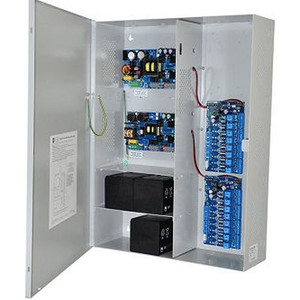
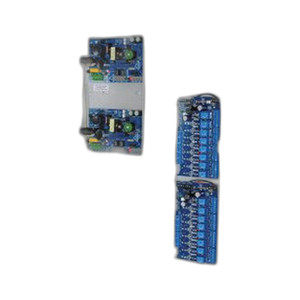
Altronix MAXIMAL75 Dual PSU Access Controller
The Altronix MAXIMAL75 is a dual power supply and access power management unit designed for security installations where access control system downtime is not acceptable. Built around a redundant PSU architecture, the MAXIMAL75 consolidates power distribution and access controller functions into a single compact chassis, eliminating single points of failure across your access infrastructure.
Key Features
- Dual independent power supplies with automatic failover: If the primary supply fails, the MAXIMAL75 switches to the secondary supply without interruption — your access points stay powered and the system stays accessible. This matters in facilities where even brief power loss can create a security vulnerability or lock occupants inside.
- Integrated access power controller: Consolidates separate PSU and access control power management into one unit, reducing chassis count and simplifying wiring — fewer points of failure, easier to troubleshoot, and less floor space consumed.
- Charge circuit support for battery backup: Supports integration with backup batteries and UPS systems, allowing the MAXIMAL75 to condition and charge DC battery packs. Extended runtime during power events depends on battery capacity, but you now have a clear path to keeping access control live during facility-wide outages.
- Robust power conditioning: Protects downstream access readers, controllers, and electric locks from voltage spikes and sags. In environments with unstable utility power or where heavy equipment cycling causes brownouts, this protection extends device lifespan and prevents nuisance failures.
- Compact form factor: Fits into standard 19-inch racks or wall-mount enclosures, making it practical for both centralized access control rooms and distributed deployment across multiple access points. Smaller footprint than running separate PSUs for each zone.
- Lifetime Limited Warranty: Backs the chassis and components against manufacturing defects, giving you confidence in long-term reliability for a mission-critical infrastructure component.
Deployment Context
The MAXIMAL75 addresses a specific problem: multi-door access control systems in facilities where a single power supply failure can cascade into security and operational risk. Common deployments include corporate campuses with distributed badge readers, warehouse and logistics facilities with multiple bay access points, data centers with redundant security requirements, and institutional buildings (hospitals, universities, government) where access integrity is non-negotiable.
The dual PSU design means you can perform PSU maintenance without shutting down access — swap the secondary supply while the primary carries the load. In facilities with high uptime demands, this capability reduces the need for emergency service calls or emergency shutdown windows.
Integration & Compatibility
The MAXIMAL75 integrates with standard 12VDC and 24VDC access control hardware — electric strikes, magnetic locks, credential readers, and access control panels. The charge circuit supports lead-acid or lithium battery packs rated for your access control power requirements. Verify the output voltage and current specifications against your specific reader and lock load before deployment; battery backup runtime depends entirely on battery capacity and total connected load.
For large multi-building or high-density access deployments, consider pairing the MAXIMAL75 with backup power solutions and access control panels that support dual power inputs. This architecture allows one MAXIMAL75 to back up multiple secondary supplies, creating a tiered redundancy strategy.
When to Choose a Different Approach
If your access control load is light (one or two battery-backed readers) and you need only brief runtime during a power event, a smaller single-supply unit with a simple battery backup module may reduce cost and complexity. If you need UPS-grade conditioning with automatic transfer switching and longer runtime, integrate the MAXIMAL75 with a dedicated UPS appliance for your access control zone. For facilities with no backup power requirement, a basic non-redundant power supply handles the job at lower cost, though it sacrifices failover protection.
Frequently Asked Questions
Q: What happens if both power supplies fail simultaneously?
A: The MAXIMAL75 provides PSU redundancy, not power continuity beyond that. If both mains inputs are lost, connected battery packs (if installed) will sustain the system according to their capacity. Without battery backup, loss of both PSU inputs means loss of power to access hardware. Plan UPS or generator backup for the facility mains, not just the MAXIMAL75 itself.
Q: Can I upgrade the MAXIMAL75 with a larger power supply or battery later?
A: Yes, the charge circuit design allows you to integrate larger-capacity battery packs over time. However, verify that the output voltage and current limits of the MAXIMAL75 match your expanded load. Manufacturer documentation specifies maximum charging current and output capacity — confirm these limits before scaling battery capacity.
Q: Does the MAXIMAL75 work with 120VAC mains input, or do I need 240VAC?
A: Check the power input specification in the manufacturer datasheet. The unit is designed for standard facility mains input; confirm your local supply voltage and any required input conditioning or isolation transformer before installation.
Q: What is the warranty on the MAXIMAL75?
A: The unit includes a Lifetime Limited Warranty covering defects in materials and workmanship. Review the warranty terms in the manufacturer documentation — coverage scope, exclusions, and claim procedures are defined there.
Q: Can I install the MAXIMAL75 in an outdoor cabinet or enclosure?
A: The MAXIMAL75 is an indoor electronics chassis. If you need outdoor access control power, install it in a climate-controlled cabinet with proper ventilation, then run conditioned power lines to outdoor readers. Check operating temperature specifications in the datasheet.
Q: How do I monitor the MAXIMAL75 for power supply failures?
A: Many dual-PSU access controllers include status indicators or relay outputs for PSU health. Refer to the product documentation for available monitoring outputs, alarm relay connections, and integration with your security management system.
Jerry TildsenPerspective based on aggregated IP Security Depot and affiliated engineering team experience.
The Altronix MAXIMAL75 solves a real uptime problem for access control: single PSU failure is a common cause of unplanned access lockdown or security breaches in multi-door facilities. The dual independent supplies with automatic failover eliminate that single point of failure, and the integrated charge circuit means you can layer in battery backup without adding a separate charge controller. For facilities that already mandate UPS on their network gear, the MAXIMAL75 extends that discipline to physical access — a best practice I see enforced more often in regulated environments (healthcare, finance, government).
Technical Highlights:
- Dual PSU with automatic switchover: No manual intervention required when primary supply fails — secondary takes over instantly. Downtime measured in milliseconds, not minutes. Matters most in facilities where occupant safety or security depends on continuous access control (hospitals, data centers, government buildings).
- Integrated access power controller: Consolidates power distribution and access control functionality into one chassis — fewer points of failure, simpler troubleshooting, lower total cost of ownership versus separate PSU + dedicated access power controller. You're also reducing enclosure real estate, which matters in rack-dense environments.
- Charge circuit for battery integration: Supports DC battery packs for extended runtime during mains loss. Battery capacity and connected load determine actual runtime; a typical access control zone (4–8 readers, 2–4 strikes) can run 1–4 hours on a modest battery. Critical: don't treat the MAXIMAL75's charge support as a substitute for facility-level UPS or generator planning.
Deployment Considerations:
- Verify your access control load (reader current, lock current, controller draw) against the MAXIMAL75's output current rating before you spec it. Undersizing here will trigger nuisance shutdowns under peak load (e.g., when multiple locks strike simultaneously). Field upgrades are possible, but they're messy.
- The MAXIMAL75's redundancy applies only to the PSU itself, not the mains supply to your facility. If your building's electrical infrastructure is weak or subject to frequent brownouts, the unit will cycle on and off as the input voltage drops and recovers. Install proper input conditioning (voltage regulator, UPS) upstream if your facility has marginal mains quality.
The MAXIMAL75 is the right choice for any multi-door access installation where a single power failure can't be tolerated — corporate campuses, hospitals, data centers, government buildings, and large warehouse operations. Pair it with proper facility-level UPS or generator planning, confirm your load math upfront, and it becomes a durable, low-maintenance foundation for access control uptime.