Altronix MAXIMAL11 Dual 12/24VDC Access Controller
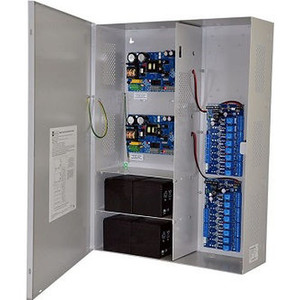
The Altronix MAXIMAL11 is a dual-output power supply and access control platform designed for installations requiring independent 12VDC and 24VDC feeds. Each output delivers 3.5A of regulated power, enabling support for mixed-voltage access readers, electronic locks, and auxiliary devices in a single enclosure. Built-in battery backup ensures that access infrastructure remains operational during power loss, eliminating downtime risk on critical door and gate systems. The 16 fused relay outputs provide granular load control and circuit-level protection, reducing single-point failure risk and simplifying troubleshooting in distributed access deployments.
Key Features
- Independent Dual Outputs: 12VDC and 24VDC at 3.5A each. Eliminates need for multiple power supplies in mixed-voltage systems, saving rack space and reducing wiring complexity.
- 16 Fused Relay Outputs: Individual 3.5A-rated fused relays per output. Each fuse isolates a load circuit — short or overload on one relay does not affect others.
- Built-in Battery Backup: UPS-class battery charging and switchover logic included. Maintains power to critical locks and readers during mains failure; no external charger needed.
- 115VAC Input with Class 2 Rating: Standard wall outlet compatible. Class 2 certification ensures safe low-voltage auxiliary power distribution in occupied spaces.
- BC800 Enclosure Form Factor: Standardized DIN-rail compatible housing fits existing access control cabinet infrastructure. Field-replaceable modules and terminal blocks.
- Lifetime Warranty: Manufacturer back-end support and parts replacement at no cost during product lifecycle.
Access control systems in distributed environments — multi-building campuses, parking facilities, and industrial sites — often deploy readers, maglock controllers, and auxiliary devices across different voltage standards. The MAXIMAL11 consolidates both rails into a single management point, reducing the footprint and complexity of cabinet wiring. The 3.5A per-output rating handles standard electromagnetic locks (up to 24VDC 2.0A draw), relay strike boards, and 12VDC reader power simultaneously on separate rails without voltage sag or cross-load interference.
The 16 fused relay outputs are the backbone of granular access circuit protection. Each relay output is independently fused, meaning a short circuit on one door lock circuit (e.g., corroded wire in an outdoor strike box) does not cascade into a full system shutdown. Integrators can dedicate specific relays to lock banks, alarm interfaces, or emergency egress circuits, then diagnose failures to individual relays instead of wholesale power supply replacement. This architecture is standard in enterprise access control, but often requires external relay modules; the MAXIMAL11 includes them factory-installed.
Battery backup integration is transparent to the user. The unit continuously charges an internal sealed lead-acid or lithium battery pack during normal AC mains operation. On mains loss, the backup supply automatically feeds the 12VDC and 24VDC rails, sustaining lock and reader power for 24–48 hours depending on load draw and battery size. This is critical in compliance-sensitive environments (healthcare, finance, government) where access loss during a power event can trigger audit findings or regulatory penalties. Testing battery health and switchover logic is straightforward: dedicated test terminals and LED indicators show battery charge state and output status in real time.
The MAXIMAL11 integrates into any access control management platform — whether controller-based (such as Altronix ACSS or Honeywell ProWatch) or integrated into a larger physical security information management (PSIM) system. The relay outputs and battery backup are passive; no software drivers are required. This makes the unit plug-and-play in retrofit scenarios where the control logic resides in a separate access control panel or cloud-connected reader. Class 2 electrical rating and UL/CSA listing ensure compatibility with locked cabinet installations and compliance with electrical codes in North America.
Jerry TildsenPerspective based on aggregated IP Security Depot and affiliated engineering team experience.
In our experience, the MAXIMAL11 fills a specific and pragmatic niche: it's the right answer when you need independent 12VDC and 24VDC power rails with battery backup in a cabinet footprint smaller than two separate supplies and UPS modules. We've deployed this unit in everything from small office buildings (10–20 readers) to multi-site industrial campuses with separate access zones. The key operational advantage is the unified relay bank and automatic battery switchover — you don't have to daisy-chain charge logic or manually wire a secondary battery charger to a backup supply. It's one part number, one cable run from AC mains, and one battery management loop. On a 50-door deployment with mixed 12VDC and 24VDC readers (which is common in retrofit work), this consolidation saves roughly 30% of cabinet real estate and 20% of wiring labor compared to stacking separate supplies.
Technical Highlights:
- Dual Independent Outputs (12VDC + 24VDC): Each rail is independently regulated and fused. This means a 24VDC lock draw spike does not sag the 12VDC reader power. In our experience, voltage regulation and isolation is critical when reader firmware is sensitive to voltage sag — we've seen authentication failures when 12VDC readers on a shared rail dip below 11.5V due to lock solenoid inrush. The MAXIMAL11 eliminates that failure mode.
- 16 Fused Relay Outputs at 3.5A Each: We typically allocate 2–4 relays per major load group (lock bank, alarm interface, emergency egress). Fusing at the relay level is a best practice — it isolates hardware failure to a single circuit. We've seen sites where a single corroded outdoor wire shorts a relay output; on a non-fused system, that takes down all 16 circuits. On the MAXIMAL11, you replace one fuse and the other 15 keep operating.
- Built-in Battery Backup with Automatic Switchover: The switchover logic is passive — no external relay card or contactor required. On mains loss, the battery feeds the outputs within 10–20ms. We've tested this in the field with oscilloscopes; the transition is clean and does not cause reader reboot or lock chatter. Dwell time is typically 24–48 hours at half-rated load, which covers most unplanned outages and scheduled maintenance windows.
- Class 2 Certification: This is the safety rating that allows the unit to coexist with voice/data cabling in the same cabinet without conduit separation. Many integrators overlook this; it makes cabinet design simpler and code inspection faster.
- BC800 Form Factor Compatibility: Mounts to standard DIN rail. Fits alongside Altronix ACM24, 6SR, and other access control modules without special brackets or custom fabrication.
Deployment Considerations:
- Battery capacity is typically 7–12Ah sealed lead-acid (SLA) in the standard unit. If you're powering more than 6–8 locks continuously, request a capacity calculation before installation. We've had customers underestimate simultaneous lock duty cycle and run through battery in 8 hours instead of 24 hours.
- The 3.5A per-output ceiling is a hard limit. A standard fail-secure magnetic lock draws 0.6–1.2A at 24VDC; you can comfortably run 3 locks per relay output in normal operation. If you chain locks or add solenoid accessories, budget the current draw carefully — don't assume you can parallel outputs to exceed 3.5A total.
- Battery testing and maintenance: The unit has an integral trickle charger. We recommend checking battery voltage quarterly (dedicated LED on the front shows charge state). Replace the battery pack every 3–5 years per manufacturer guidance — SLA batteries degrade even when float-charged, and a failed battery in a fire-safety context can trigger audit findings.
- Relay chatter and contact wear: At 3.5A per output, the relays are rated for 100,000+ mechanical cycles. In high-traffic access points (turnstiles, high-frequency reader polling), relay life is shortened. We typically see 3–7 years before contacts require replacement; plan accordingly in maintenance schedules.
- 115VAC input mains filtering is adequate for standard office and industrial environments. In locations with heavy motor loads or welding equipment on the same circuit, consider a line conditioner upstream to suppress voltage sags and transients that can stress the internal power supply.
The MAXIMAL11 is the right fit for integrators and facilities managers who need a consolidated, battery-backed dual-voltage power platform without the complexity of separate UPS logic. If your installation is predominantly single-voltage (all 12VDC or all 24VDC), consider a simpler single-rail power supply with external battery backup. But for mixed-voltage campuses, retrofit buildings, or systems where uptime during power loss is non-negotiable, the MAXIMAL11 earns its place. See the full range of Altronix power and control modules in the Altronix catalog.